How the Five Compare on the Numbers
These five listings sell five different quantities of the same object. One is six paddles, one is two, two are a single paddle, and one is a lidded rice bowl with a paddle included as part of the set. A reader comparing prices or figures across them is not comparing the same purchase, and only one listing says which object its own measurements describe.
That matters because only two of the five publish dimension figures that can be a paddle. Yamaco publishes 2.56 by 7.28 by 0.79 in beside a stated 2.6 by 7.3 in and the two agree. FireKylin publishes 3.15 by 7.67 in. The other three publish a bowl, a package with a thickness of 0.04 in, and a triple reading 1 by 1 by 0.1 in.
What the table cannot tell you is what any single paddle in a multipack weighs or measures beyond the one figure Boao gives. A six pack publishing 0.39 lb and a two pack publishing 0.09 lb are both describing a bag of paddles, and neither divides it. The two single paddle listings are the only ones where a published weight or size can only mean one object, and one of those two publishes no weight in its data at all.
What Actually Arrives in the Box
Six, two, and three that are one
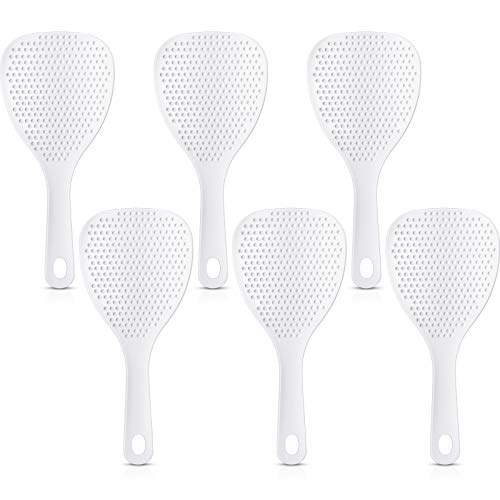
Boao is the only multipack here that publishes a per paddle size: its first bullet says the set contains six, then gives 19 by 8.5 cm, or 7.5 by 3.1 inch, for the paddle itself. That is the right way round, and it is the only listing on this page where a figure in a multipack listing is explicitly about one piece rather than the carton.
FireKylin supplies two identical white plastic paddles and publishes no size in any sentence. Its figures come from the dimension fields alone, at 3.15 by 7.67 in, which are plausible for a paddle and are never confirmed in the maker’s own words. Yamaco and SelHeng each supply one paddle, which removes the question entirely for both of them.
The one purchase where the paddle is the accessory
JapanBargain is selling an ohitsu, a traditional lidded rice bowl, and the paddle arrives with it. Its own bullet calls the set a rice bowl with lid and matching paddle scoop, sized for serving two to three people at a time. Every figure in that listing belongs to the bowl: a stated 6.5 in and dimension fields of 7.3 by 7.4 by 4.7 in.
Nothing in that listing measures the paddle, names its material separately, or says whether it stores inside the bowl. The 0.9 lb covers a bowl, a lid and a paddle together. It is the one pick here where buying for the paddle means buying something else and accepting the paddle unseen, which is worth knowing before comparing it with the rest.
Whether Any Published Figure Describes a Paddle
Two listings whose figures hold up
Yamaco is the cleanest data on the page. Its size attribute reads 2.6 by 7.3 inches, its first bullet repeats it, and its dimension fields read 2.56 by 7.28 by 0.79 in, which is the same measurement to the second decimal. It names its material as Hinoki, states that it is unpainted and that it is made in Japan, and gives a weight of 20 g, or 0.7 oz, in a bullet.
That weight is worth flagging because the dimension data carries none, so a reader filtering on weight would see this paddle as publishing nothing while the maker publishes a figure in plain sight. FireKylin is the other listing whose fields can be the product, at 3.15 by 7.67 in, though it states no size in words to check them against.
Three sets of figures that describe something else
Boao publishes no dimension fields for the product. What it publishes is a package figure of 6.3 by 9.45 by 0.04 in, and 0.04 in is not the thickness of a box holding six plastic paddles. Read as the carton it is wrong, and read as a paddle it contradicts the 7.5 by 3.1 inch the same listing states, so this page uses the maker’s sentence and treats the package figure as unusable.
SelHeng is the plainer case: its fields read 1 by 1 by 0.1 in, three figures that describe nothing, against a stated 6 in in its title and its size attribute. JapanBargain’s 7.3 by 7.4 by 4.7 in is a real measurement of a real object that simply is not the paddle. None of the three carries a warning in the data about any of it.
What Each Listing Says About Looking After It
Four washing routes, one of them a list of prohibitions
Boao is the most permissive: wipe the paddle with hot water or throw it into the dishwasher. JapanBargain states dishwasher safe and BPA free and then rules out the microwave. SelHeng asks for a hand wash with mild soap and warm water followed by thorough drying, which is what natural teak needs and what no other pick here specifies.
FireKylin publishes its care as a list of things not to do: no microwave, nothing near high temperatures above the figure it gives, no wiping with iron wire, and no long term soaking in bleach or dishwashing liquid. That is more restrictive than a dishwasher clearance and less restrictive than a hand wash rule, and it is the only listing here that frames care as prohibitions.
One heat figure, and one listing naming the wrong material
FireKylin is the only pick publishing a temperature at all: food grade plastic it says will withstand up to 482 F, which it also gives as 250 C, and will not melt easily. JapanBargain claims heat resistance for its melamine without putting a figure on it. Boao, Yamaco and SelHeng publish no temperature figure in any bullet.
The same FireKylin caution bullet then forbids damaging the silicone by wiping it with hard objects such as iron wire, on a product its first bullet calls food grade plastic and its own title calls plastic. There is no silicone in this listing’s description of itself, so that sentence belongs to a different product, and nothing in the data flags it.
Which One Fits Your Kitchen
The cook who wants a paddle in every drawer. Boao supplies six, with a per paddle size of 7.5 by 3.1 in, a hanging hole in each handle and a textured surface the maker says keeps rice off. Its package figure of 0.04 in thickness cannot be right, so ignore it.
The household serving rice at the table. JapanBargain is a lidded melamine ohitsu for two to three people with a matching paddle included, at 6.5 in and 0.9 lb for the set. Nothing in the listing measures or describes the paddle on its own.
The cook who wants the paddle to stand up. FireKylin supplies two plastic paddles with a semi circular base, 3.15 by 7.67 in in the fields, 0.09 lb for the pair, and the only temperature figure on the page at 482 F. Its care line is a list of prohibitions.
The cook who wants one good wooden spoon. Yamaco is unpainted Hinoki cypress made in Japan, 2.6 by 7.3 in with fields that agree, and 20 g, or 0.7 oz, stated in a bullet. It publishes no washing instruction of any kind.
The cook who prefers teak and a hand wash. SelHeng is a single 6 in teak paddle with an anti stick surface and the clearest care line here, mild soap, warm water and thorough drying. Its dimension fields of 1 by 1 by 0.1 in cannot be the paddle.
What We Could Not Verify
Everything above comes from the makers’ own listings. These are the things those listings do not answer.
- What one paddle weighs in either multipack. Boao publishes 0.39 lb for six and FireKylin 0.09 lb for two, with no breakdown.
- Any measurement of the JapanBargain paddle. Its stated 6.5 in and its 7.3 by 7.4 by 4.7 in fields both describe the bowl.
- What the SelHeng fields of 1 by 1 by 0.1 in are measuring, on a paddle its own title states as 6 in.
- What the Boao package thickness of 0.04 in describes, since a box of six paddles cannot be that thin.
- Any washing instruction from Yamaco, whose five bullets give a size, a weight, a material, the word unpainted and a country.
- Why the FireKylin caution bullet refers to silicone on a paddle its own title and first bullet both call plastic.