How the Five Compare on the Numbers
The live pages on this pool rank it by how the frame clears the plumbing, by published width and depth, by published height, by what holds the unit still, by how many tiers slide, by load rating, by how many units one purchase brings and by how far each one resizes. All of those describe the organizer as a finished object. None of them asks what it arrives as.
That is the question here. Every one of these five is a frame plus loose pieces, and what separates them is how much of that the listing will tell you. One prints a contents line. One publishes a count for a part it calls removable. One states that a part has to be bought separately. One states that a part stopped being removable. One names a tray and nothing else.
What the table cannot tell you is which of those pieces you would ever need again. A screw count matters if a screw goes missing and a divider count matters if a divider warps, but no listing on this page says whether any part can be reordered. The package line on FlagShip is an inventory, not a parts catalog, and the twelve dividers on HIHEGD are a feature rather than a supply.
What Arrives Loose, and What the Listing Admits
The One Contents Line in This Pool
FlagShip’s last bullet is the only place on this page where a maker totals what is in the box: eight panels, two rack pipes, four expandable pipes, eight screws and a user manual, with a note that the installation tool is not included. Four of the panels are described as large and four as small, and their position moves so the drain pipe sits between them rather than in front of them.
It is also the only listing that contradicts itself on a part. An earlier bullet says four screws and step instructions arrive in the package; the contents line says eight screws. Both figures are published and the listing gives no way to tell which is current, so both are reported here. For a frame that cannot be built without screws, that is the one number a buyer would want settled.
Twelve Dividers, Four Tubes, One Tray
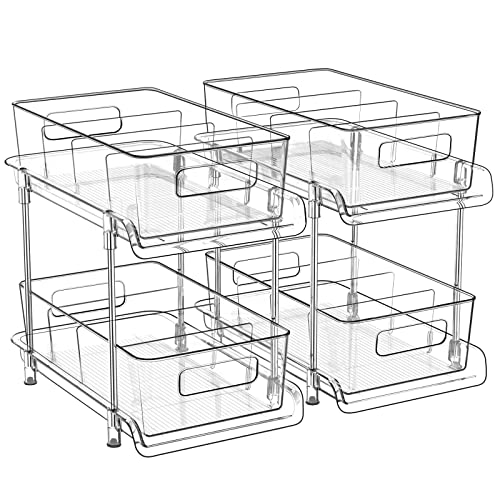
HIHEGD is the only listing on this page to put a double-figure count against a part it calls removable. Twelve dividers, with a stated maximum of four compartments in each of its two tiers, and the trays themselves described as stackable so the pair can be rebuilt taller. Four thickened stainless steel support tubes link the drawers, which the maker names as high-hardness ABS plastic.
LYNK sits at the other end of the same question. It names one removable tray, on the top shelf, for wet sponges and brushes, and it is the only listing of the five to say what a removable part is actually for. Beyond that it publishes no parts count at all, so a reader learns what the tray does and nothing about what else arrives separately.
The Two Statements That Change What You Can Do Later
A Part You Have to Buy
Vtopmart’s closing tip is the only sentence in this pool that puts a part outside the box. The set supports four two-tier organizers, and mixed configurations such as a three-tier unit require additional steel rods. That is useful and incomplete in the same breath: the listing never says how many rods a three-tier build takes, what they cost in effort, or whether the maker supplies them.
Its assembly description is unusually frank for the opposite reason. No tools are required, and the step is inserting a stainless steel tube into a slot in the frame, with a warning in the same bullet about scratching your hands while doing it. Four tubes per unit, eight silicone non-slip pads, two drawers on tracks and a built-in handle, in PET with a clear side.
A Part That Stopped Coming Off
FlagShip’s third bullet records a design change most listings would leave out. There is a wire along the side of the shelf which is not a guardrail but a stiffener, and on the upgraded edition that wire is fixed to the pipe instead of being removable. A buyer reading only the current listing would never know the part had once come off; the listing says so itself.
That is worth more than it looks on a page about reaching parts. It is the only evidence here that any of these makers tracks which pieces detach, and it points the wrong way: the revision removed an option rather than adding one. Delamu and Vtopmart both state that no tools are required, which tells you the frames come apart by hand, but neither says a single part is meant to.
Where the Published Figures Mislead
A Weight Column That Counts Different Things
Vtopmart publishes the lowest weight field on this page, 2.0 lb, and that figure is attached to a four pack. Each of those four organizers has four stainless steel support tubes, a PET body and two drawers, so 2.0 lb cannot describe all four of them together. Delamu’s 2.99 lb covers two three-tier sets, six trays in total. We have treated neither as a per-unit figure.
Against those, LYNK publishes 7.52 lb and FlagShip 6.61 lb, both for one unit, and HIHEGD publishes 5.34 lb with no pack count attached. Those three are comparable with each other. The column as a whole is not a ranking, which is why the lightest field on the page belongs to the purchase that brings the most frames.
When a Sentence Beats Its Own Fields
FlagShip’s dimension fields read 13.18 by 16.74 by 17.32 inches. Its own bullet reads 17 to 25 inches long by 11.5 inches wide by 15 inches high. Those cannot both describe one rack, and only the bullet accounts for a frame the maker says expands, so the sentence was used and the fields were discarded. The table shows both so the disagreement is visible rather than quietly resolved.
HIHEGD has the opposite problem. It publishes no size anywhere in its own words, so its 7.0 by 11.7 by 10.6 inch fields are all a reader gets, with nothing to check them against. Two of the sixteen listings on this fact sheet are plain stacking baskets with no frame, no tubes and no dividers at all, and those were left out: a basket has no parts to reach.
Which One Fits Your Kitchen
Replacing a part is the thing you worry about. FlagShip. It is the only listing here that names every piece in the box, which at least gives you the vocabulary to ask for one. Accept that its own two bullets disagree about whether four screws or eight arrive.
Sorting small bottles into compartments that change. HIHEGD, with twelve removable dividers and a stated maximum of four compartments per tier. Nothing is published about a tool, and nothing is published about size in the maker’s words, so measure against the fields.
One awkward cupboard now and a different one later. Delamu. Two three-tier sets, no tools required, and the only stated rebuild on this page: two plus two plus two gives three two-tier organizers the maker says work independently.
Four cabinets to fix in one order. Vtopmart, at 11.8 by 7.5 by 10 inches each, with four support tubes and eight non-slip pads per unit. Read the last line first: a three-tier build needs steel rods that are not in the box.
Wet sponges and brushes with nowhere to drain. LYNK, the only one of the five with a removable tray and a stated job for it. It publishes no parts count, so what you are buying is a finished shelf rather than a kit.
What We Could Not Verify
These are the specifications we went looking for in all five listings and did not find.
- Whether any part of any of these five can be ordered on its own. No listing names a spare, a replacement or a service route.
- Whether FlagShip ships four screws or eight. Two of its own bullets give different counts.
- Whether HIHEGD’s twelve dividers fit both tiers or are cut for one of them.
- How many additional steel rods a Vtopmart three-tier build needs, and whether the maker supplies them.
- Whether Delamu’s rods are shared between its two sets, which the two plus two plus two rebuild depends on.
- Any assembly time, step count or tool size for HIHEGD, which names no tool requirement either way.