How the Five Compare on the Numbers
A family batch session is not one bag. It is a bulk grocery run broken into twenty portions in one afternoon, and the thing that stops you is not suction, it is the machine. Sealing bars get hot and most vacuum sealers want a pause between bags. So the specification this page turns on is whether the maker says anything at all about sealing bag after bag.
Two of these five address it directly and only one gives a figure. The rest talk about how fast a single bag goes, which is a different claim. After that the useful separator is the bag: how wide a bag the machine will take, and whether a roll is stored and cut on board so you can make a bag the size of a whole chicken.
What the table cannot tell you is how long any of these actually runs before it needs a rest, because only one listing mentions heat in the sealing bar at all. A bags per minute figure and a seconds per bag figure are also not the same thing: one covers the wait between bags and the other does not, and no listing here publishes both.
Sealing Bag After Bag
The Two That Address the Cooldown
QKWXV is the only listing in this pool of eight that names the real problem. It states a built in cooling system that instantly cools the sealing bar, enabling non stop back to back bag preparation without waiting or overheating. Whether it delivers that is not something the listing proves, but it is the only maker that has written down the thing a family session runs into.
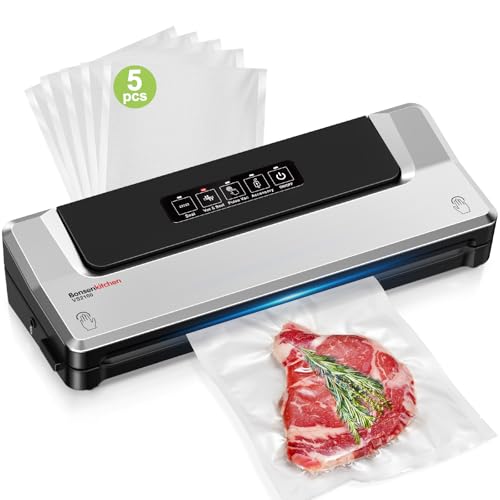
Bonsenkitchen answers the same question with arithmetic instead, stating that you can seal up to 30 bags continuously in just 15 minutes. That works out at one bag every half minute including whatever pause the machine needs, and it is the only throughput figure anywhere in this pool. Those two listings are the only ones treating a session as a session rather than as a single seal.
Speed Per Bag Is Not Throughput
Two more listings publish a per bag time and it is worth not confusing the two. QKWXV states a tight seal in 8 to 18 seconds and MEGAWISE states 10 to 20 seconds for a vacuum and seal. Both are fine figures and neither says anything about what happens on the eleventh bag, which is where a family session actually lives.
Beelicious Pro sits between the two approaches. It states 98 kPa dual pump suction, removes air up to 50 percent faster than basic food sealers, and then makes the family claim directly: a wider easy lift handle and an enhanced motor to reduce hand strain and support steadier repeated sealing. That is a repetition claim without a number, which is better than silence and weaker than 30 bags in 15 minutes.
The Seal Strip and the Bag Width
One Machine States Its Strip Length
MEGAWISE publishes the figure that decides how big a portion you can bag: a 12 inch sealing wire, which it says supports sealing three to five bags at one time. That is the only sealing strip length published anywhere in this pool, and it doubles as a throughput claim because several narrow bags across one strip is a different way of going faster.
The rest describe the strip without measuring it. QKWXV states dual heat strips 30 percent wider than standard models with four layer heating wires, and single or double sealing options. Beelicious Pro states widened dual heating strips. NESCO states double heat seal technology creating stronger seals than single seal machines. None of the three gives a length.
Rolls, Cutters and Custom Bags
For a family the roll matters more than the pre-cut bags, because a roll is how you get a bag sized to a whole chicken or a tray of portions. Four of these five store a roll and cut it on board. NESCO ships two roll widths, 8.6 inches by 9.85 feet and 11.8 inches by 9.85 feet, which is the only listing here giving you a choice of width out of the box.
QKWXV ships a roll 11 inches wide and 5 meters long alongside pre-cut bags at 5.9 by 7.8 inches and 7.8 by 11.8 inches. Beelicious Pro states roll storage, bag cutting, hose storage and bag clip support without naming a width. Bonsenkitchen is the odd one out: five bags in the box, no roll, no cutter and no roll storage mentioned anywhere.
Where the Published Figures Disagree
Two Machines Publish Two Weights
Bonsenkitchen states in its own bullet that the machine measures 15.28 by 5.71 by 3.03 inches and weighs only 2.7 pounds, while the published weight field reads 3.78 pounds. MEGAWISE states 15.2 by 4.1 by 2.3 inches and 2.3 pounds in its own text, while its fields read 4.5 by 15 by 2.5 inches and 2.65 pounds, and its size field gives a third set at 16.14 by 5.59 by 4.02 inches.
Where a maker’s own sentence and a published field disagree, this page uses the sentence and says so. On MEGAWISE that means treating 15.2 by 4.1 by 2.3 inches as the machine and reading the larger size field as the box. Neither discrepancy changes the ranking here, because the axis is throughput rather than footprint, but a page that quotes both should say which it trusts.
What the Left Out Listings Offer
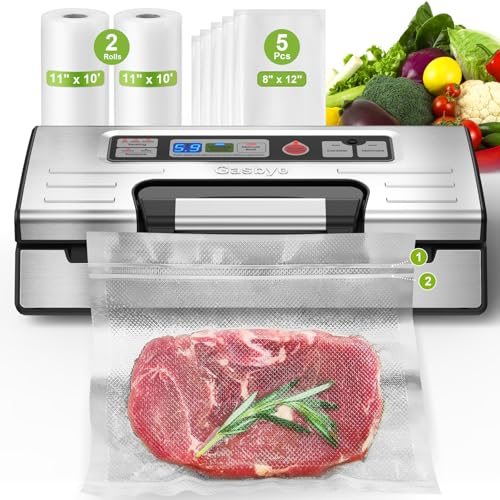
Three listings are on the fact sheet and not on this page. Gasbye states 95 kPa, a double heat seal, built in roll storage and cutter and two 11 inch by 10 foot rolls, plus named replacement parts, and it publishes 15.7 by 7.8 by 4.7 inches and 6.5 pounds. It is well documented and says nothing about sealing repeatedly, which is what this page is about.
FoodSaver claims freshness up to five times longer, vertical storage, 35 percent less bag waste than previous models and an 11 inch by 8 foot roll, again with no repetition claim. Chef Preserve is a handheld the listing compares to a pepper grinder, sealing a bag in 5 seconds with 30 reusable bags and 1000 bags per battery charge. That last figure is a throughput claim, on a tool that seals one zip bag at a time.
Which One Fits Your Kitchen
The cook sealing twenty bags on a Sunday. QKWXV is the only listing that names the cooldown, stating a built in cooling system that cools the sealing bar for non stop back to back sealing. It states 95 kPa from a 230 watt motor, 8 to 18 seconds a seal, dual strips 30 percent wider than standard, an 11 inch roll and 3,000 cycle testing.
The cook who wants the arithmetic. Bonsenkitchen states up to 30 bags continuously in 15 minutes, which is the only throughput figure in this pool, with four modes including a pulse vacuum for soft food. It publishes 15.28 by 5.71 by 3.03 inches in its own words and a three year commitment. It ships five bags and no roll.
The cook portioning a bulk grocery run. Beelicious Pro is the one listing that describes family meal prep as its purpose, with a wider easy lift handle and an enhanced motor stated to support steadier repeated sealing, 98 kPa dual pump suction, air removal up to 50 percent faster, an Extra Moist Mode and label printing with a food tracking app.
The cook sealing several small bags at once. MEGAWISE publishes a 12 inch sealing wire and states it supports three to five bags at one time, with 80 kPa suction, dry, moist and pulse modes, a stated liquid tolerance and 10 to 20 seconds a bag. Its own text gives 15.2 by 4.1 by 2.3 inches and 2.3 pounds.
The cook who wants two bag widths. NESCO ships rolls at 8.6 inches by 9.85 feet and 11.8 inches by 9.85 feet, with built in roll storage and a sliding cutter, a 130 watt double vacuum pump, four modes including a gentle vacuum, a viewing window to check the bag and an easy lock handle. It publishes 6 pounds.
What We Could Not Verify
Everything above is from the makers’ own listings. These are the things a family batch cook needs and the data mostly does not contain.
- Only QKWXV mentions heat in the sealing bar. No other listing says how long the machine can run before it needs a pause.
- Only Bonsenkitchen publishes a throughput figure, and it does not publish a per bag time, so the two cannot be cross checked.
- Only MEGAWISE publishes a sealing strip length. Three other listings describe a wider or doubled strip without a figure.
- Bonsenkitchen states 2.7 pounds in its own bullet against a published field of 3.78, and MEGAWISE states 2.3 pounds against a field of 2.65, so the makers’ sentences are used here.
- MEGAWISE publishes three different size sets across its text, its dimension fields and its size field, and only the first is presented as the machine.
- No listing states a duty cycle, a thermal cutoff or a recommended rest between batches.