How the Five Compare on the Numbers
All five of these listings claim easy cleaning and all five publish a nonstick coating. That is where the agreement ends. Read the bullets carefully and three genuinely different mechanisms appear: plates that come off the machine, a moat that catches batter at the edge of the plate, and a tray that collects what runs out underneath. Most listings offer only the coating.
That distinction decides the routine rather than the first wipe. A nonstick plate releases a waffle. It does nothing about batter that has run into the hinge or down the outside, and on a Belgian grid the deep pockets are exactly where a cloth cannot reach. So the deciding specification here is what the maker says detaches or contains, not how slippery the surface is.
What the table cannot tell you is whether any of these parts are dishwasher safe. Not one of the five says so, including the machine whose plates come out, which is the single row that would decide this comparison. It also cannot tell you how much batter a moat holds before it overflows anyway.
The Three Published Approaches to Cleaning
Taking the surface off the machine
KRUPS is the only listing here that states removable plates with a nonstick coating. That matters more on a Belgian iron than on a shallow one, because a deep grid holds baked batter in pockets a cloth cannot reach, and the only reliable fix is to put the plate under running water.
The limit of the claim is what it does not say. The listing states the plates come out and stops there: no word on whether they go in a dishwasher, and nothing about how they detach. At 9.1 lb the machine itself is not going to a sink, so the plates are the whole cleaning strategy, and you are buying the claim without knowing how far it extends.
Catching the batter at the edge
Breville takes the opposite approach and addresses the spill rather than the surface. Its listing names a no-mess moat as a design feature, and unusually it names the problem too, stating that with many traditional machines batter has a tendency to spill out onto kitchen countertops. That is a specific claim about a specific failure.
Amelkit publishes a wrap-around overflow moat, which covers the full perimeter rather than one side, and pairs it with a claim about the routine: no complex disassembly needed for cleanup. Together those two listings cover the overflow path at the plate edge. Neither says how much their channel holds, so an overfilled iron can still defeat it.
What the Machines Do Not Say
The dishwasher question nobody answers
Five listings claim easy cleaning and not one states whether any part is dishwasher safe. On the machine with removable plates that omission is the most consequential, because a removable plate you must still wash by hand is a smaller gain than it sounds. On the four with fixed plates the question does not arise, which is its own answer.
Chefman is the one listing that fills part of the gap, naming a mild dishwashing soap and a rinse with warm water for its drip tray. That is a hand-washing instruction rather than a dishwasher clearance, and it is still more than any other listing here offers. An explicit instruction is worth more than an adjective.
Coating care, which is the real long-term question
Every one of these five rests on a nonstick coating, and no listing states how to clean that coating without damaging it. That is a genuine gap, because the usual advice for nonstick, which is to avoid abrasives and metal tools, is exactly what a baked-on grid tempts you into using.
Two listings at least describe the coating in more detail. Chefman publishes extra-thick non-stick plates and Amelkit publishes premium non-stick cooking plates, though neither phrase is a thickness you can compare against the other. Nothing on this page distinguishes one coating family from another, so care advice that depends on the material cannot be read off any of the five.
Size, Weight and the Shape of the Job
The irons you can lift
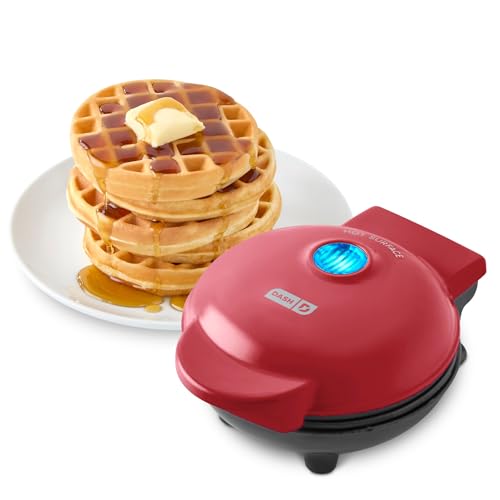
Where nothing detaches, cleaning depends on getting the machine to the water. DASH at 1.14 lb is in a category of its own and can be held under a tap, which makes its bare nonstick-only claim far less of a problem than it reads on paper.
Chefman at 4 lb and Amelkit at 4.3 lb are one-handed lifts to a sink. Breville at 6.7 lb is a two-handed carry but manageable. KRUPS at 9.1 lb is a machine cleaned where it stands, and that is precisely why it is the one with plates that come out: the design answers its own weight.
Where they sit and what that costs
Storage shapes differ more than the weights suggest. KRUPS is published at 9.84 x 18.9 x 9.84 inches, which is a long footprint for a 4-slice machine. Chefman at 10 x 15.6 x 7 inches is a rotating design, and a flip iron needs clearance around it to turn.
Breville is published at 11 x 9 x 5.7 inches, and 5.7 inches on one axis is what lets it sit on a shelf rather than on the counter. DASH at 6.4 x 5 x 2.8 inches fits a drawer, and that is the real argument for a mini iron: an appliance stored in a drawer is cleaned and put away in one motion rather than wiped on the counter where it lives.
Which One Fits Your Kitchen
If you make Belgian waffles often. KRUPS is the only iron here with removable plates, which is the one mechanism that properly clears a deep grid. Accept 9.1 lb and a 9.84 x 18.9 x 9.84 inch footprint for it.
If your problem is batter on the counter. Breville’s no-mess moat addresses exactly that, and its listing is unusually direct about the failure it is designed around. Its own bullet states a 6.625 x 5.625 in waffle.
If you want instructions, not adjectives. Chefman publishes a removable drip tray and names the wash: mild dishwashing soap, warm rinse. At 4 lb it also goes to the sink easily.
If you would rather never dismantle anything. Amelkit publishes a wrap-around moat and states that no complex disassembly is needed, with 8 browning levels and an audible beep so the lid opens at the right moment.
If it has to live in a drawer. DASH at 1.14 lb and 6.4 x 5 x 2.8 inches is the one you can hold under a tap, which covers for a listing that publishes nothing beyond the coating.
What We Could Not Verify
These are the things we went looking for in the five listings and could not source:
- Whether any plate, tray or moat on any of these five is dishwasher safe. No listing states it.
- How the KRUPS plates detach, or whether a tool or a release catch is involved.
- How much batter either moat holds before it overflows past the channel.
- Any coating thickness figure behind the extra-thick and premium nonstick claims.
- How to clean a baked-on grid without abrasives, which no listing addresses despite all five relying on a coating.
- Whether a moat or a drip tray can be emptied without unplugging and moving the machine, which no listing addresses.