How the Five Compare on the Numbers
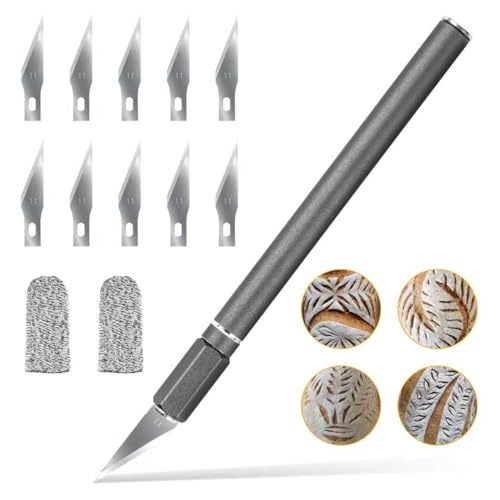
Four of these five publish a blade count. Junclyptic publishes eleven surgical-grade blades, Breadsmart and Gebena publish ten each, and CUTENJOY publishes five. RICCLE publishes no count with the tool at all. Those numbers look comparable and are not, because only one maker publishes how many cutting edges each of its blades actually carries.
Breadsmart publishes four numbered cutting corners per blade, used in sequence until dull. Ten blades at four corners each is forty edges from one box. RICCLE publishes a different version of the same idea, flipping a standard double-edged blade for complete utilization. The other three publish a count and leave the edges per blade unstated.
The second row is the one that undoes the first. A blade count without an edges-per-blade figure is not a supply figure, and four of these five publish only the count. Breadsmart’s forty edges and CUTENJOY’s five blades sit at opposite ends of a comparison the listings barely let you make, which is why the replacement route matters as much as the box contents.
What a Box of Blades Really Gives You
Counting corners instead of blades
Breadsmart is the only maker here that treats a blade as a consumable with a schedule. It publishes four numbered cutting corners per blade and tells you to use each corner until dull, then move on to the next in sequence, describing the result as years of use. Numbering the corners is a small thing that makes the system usable rather than theoretical.
RICCLE approaches it from the tool end rather than the blade end, publishing quick and easy flipping of standard double-edged blades for complete utilization of each blade. That is two edges rather than four, and it depends on the holder letting the blade turn around easily, which the listing states it does.
Counts without context
Junclyptic publishes eleven surgical-grade blades, which is the highest blade count in this group. Gebena publishes ten in high-carbon steel. CUTENJOY publishes five. None of the three publishes how many usable edges each blade carries.
For a tiny kitchen that gap matters because the alternative to a long supply is a cupboard shelf given over to spares. On one loaf a week, five blades and eleven blades are a different number of months, and forty cutting corners is a different scale again. The listings allow that comparison only partly, and this page will not invent the missing half.
When the Box Runs Out
The two that say ordinary blades fit
Gebena publishes the most useful sentence on this page: blades are easily replaceable with standard razor blades, with ten included. A standard blade is sold everywhere and costs very little, so a holder that accepts one has no running cost worth tracking. RICCLE publishes the same compatibility in different words, naming standard double-edged blades.
Gebena then publishes something no other listing in this pool attempts: replacement blades are covered under warranty for life. There is no mechanism described and no limit stated, so it should be read as a published promise rather than a process. It is still the only blade-supply commitment anywhere in this group.
The three that leave it open
Breadsmart, Junclyptic and CUTENJOY publish no compatibility statement and no replacement route. Breadsmart’s four-corner system makes the question less urgent, because forty edges will outlast a lot of baking. Junclyptic’s surgical-grade description suggests a specific blade rather than a generic one, which cuts the other way.
CUTENJOY is the one where the gap matters most, because five is the lowest blade count published here and nothing says what replaces them. The listing spends its detail elsewhere, on the flour duster and the sheath, which are good things to have and not the thing that runs out.
Living With a Razor in a Small Kitchen
Storage, and the one that stays out
All five publish somewhere for the tool to go, which for a razor on a stick is the minimum acceptable. Breadsmart publishes a safety cap specifically so the lame can be kept safely in drawers. Gebena and RICCLE both publish hand-made leather covers. CUTENJOY publishes a handmade faux leather sheath for secure storage after use.
Junclyptic is the exception and the most interesting for a kitchen with no spare drawer: a magnetic docking station, which keeps the tool on a surface rather than inside something. In a tiny kitchen a tool that has a home on the wall is a tool that does not need a drawer, and that is a different proposition from a cover.
Handling the blade safely
CUTENJOY publishes two finger guards specifically for safe blade replacement, which is the only published item here aimed at the moment the blade is handled. Junclyptic publishes a chuck-type clamp you turn, so fingers never grip the blade itself, and adds silicone finger shields to the kit.
Breadsmart’s corner rotation means the blade is handled a quarter as often, which is a safety benefit the listing does not claim. RICCLE’s flip means the blade is handled but not removed. Gebena publishes no handling feature at all, only the leather cover, which protects the blade rather than the hand.
Which One Fits Your Kitchen
Baker who hates reordering anything. Breadsmart publishes ten blades with four numbered cutting corners each, used in sequence, with a safety cap for a drawer, at 0.1 lb.
Baker who wants spares from any shop. Gebena publishes ten high-carbon steel blades, states standard razor blades fit, covers replacements for life and supplies a hand-made leather cover.
Baker with no drawer to spare. Junclyptic publishes eleven surgical-grade blades, a chuck-type clamp for changing them without touching the edge, scoring templates, silicone finger shields and a magnetic docking station, at 0.1 lb.
Baker who wants both edges used. RICCLE publishes flipping of standard double-edged blades for complete utilization, on a wood handle with a stainless stick and a leather cover, at 0.13 lb.
Baker who also dusts flour. CUTENJOY publishes five blades, two finger guards, a faux leather sheath and an 18/8 stainless flour duster with a spring-loaded one-handed handle, at 0.15 lb.
What We Could Not Verify
These are the figures that would settle a running cost, and the listings mostly do not carry them. Nothing below has been estimated or borrowed from another listing.
- Only one pick publishes how many cutting edges each blade carries, so four supplies cannot be compared.
- Three of the five publish no replacement route, so whether ordinary razor blades fit is unstated.
- RICCLE publishes no blade count with the tool at all.
- No pick publishes how many loaves a blade lasts, which is the figure all of this stands in for.
- Gebena and CUTENJOY publish no dimensions, so neither can be measured for a drawer.
- Gebena publishes a lifetime blade warranty with no mechanism or limit described.