How the Five Compare on the Numbers
An adjustable rolling pin is not one object. It is a pin plus a handful of small rings that have to live somewhere, and in a kitchen with one utensil drawer that is the part worth counting. These five listings count them in three different ways: rings, pairs and sets. Read literally, the purchases here range from four small parts to ten.
Only one of these five says where the rings go, in a bullet that calls its wooden holder a bonus without listing it among the contents. The other four never raise storage. So the page counts parts first, then looks at what each maker does to stop you confusing one ring with another, then at what else arrives in the box.
The width fields in this pool should be ignored. Geesta publishes 0.5 inches of width against a 23 inch length, and no rolling pin is half an inch across. Folksy publishes 0.39 inches on the same basis. Both figures are almost certainly a carton edge or a placeholder, and this page uses the lengths and the weights and nothing else from the fields.
Rings, Pairs, and What Actually Arrives
Three Listings Count Something Other Than Rings
AMUZHI is the clearest of the five and the most honest about the arithmetic: four pairs of removable color coded rings, which is eight objects, screwed onto both ends of the pin. A pair is what a pin actually uses, one ring at each end, so a set of four thicknesses means eight rings whether a listing says so or not.
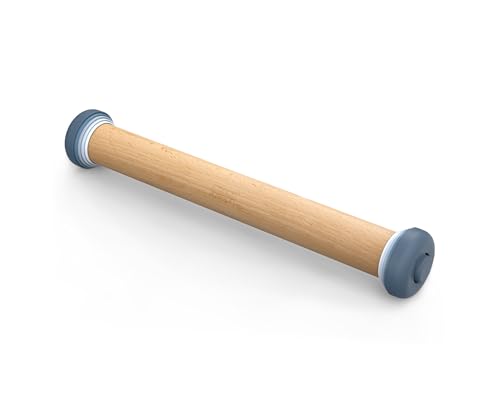
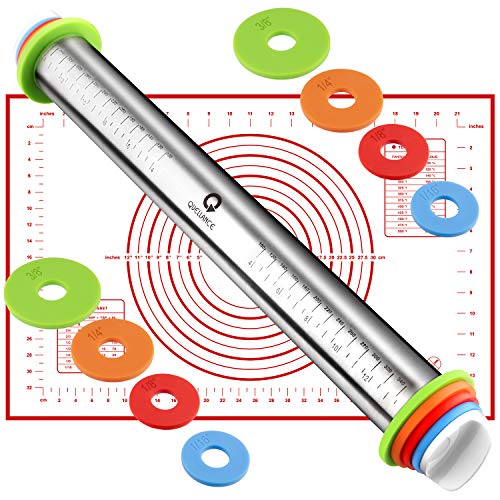
Joseph Joseph says five sets of removable rings, which reads as ten. Folksy Super Kitchen says five different sizes designed for each end of the product, which also reads as ten. Geesta says five rings each marked on the side, and QUELLANCE says four sizes of removable rings. Neither of those two states whether one ring or two arrives per thickness.
Four Small Parts, or Ten
Read at face value these five range from four loose parts to ten, and that is a real difference in a drawer. Ten small rings is a handful of identical looking plastic or silicone circles, and losing one costs you a whole thickness setting, because a pin with a ring on one end only rolls a wedge.
Nothing in any of these five listings tells you whether a replacement ring can be bought at all. That is the gap that matters most on an adjustable pin, more than the barrel material or the length, and not one of them addresses it in a single sentence. A ring is the one part of this purchase small enough to vanish, and the only part no listing here accounts for.
Telling One Ring From Another
Two Listings Mark Them and Two Do Not
AMUZHI color codes its four pairs, which is the most useful answer here: a color tells you a thickness across a drawer without reading anything. Geesta marks each ring on the side with its size, which works when you are holding it and not when it is in a heap. Both approaches beat what the other three offer, which is nothing.
Joseph Joseph publishes five thicknesses in millimeters with inch equivalents, 2, 4, 6, 8 and 10 mm, and says to twist the rings to remove and adjust, without saying whether the rings themselves carry a marking. Folksy lists 10, 8, 5, 3 and 2 mm silicone rings and QUELLANCE four sizes from 2 to 10 mm, neither with any labeling published.
Where the Figures Do Not Line Up
Two of these listings give a different millimeter value for the same inch fraction. QUELLANCE states its four rings in inch fractions and as 2, 4, 6 and 10 mm, which makes an eighth of an inch equal 4 mm. Joseph Joseph states 4 mm as one sixth of an inch instead, and puts 8 mm at five sixteenths. The fractions are approximate in both cases and the listings say so, but a buyer matching a recipe should use the millimeter figure.
Folksy sidesteps the problem by publishing millimeters only: 10, 8, 5, 3 and 2 mm. Geesta sidesteps it a different way and worse, describing five circumference options with no figure at all for any of them, which on a tool whose whole purpose is a stated thickness is the single largest omission on this page.
What Else Arrives, and Where It Goes
The One Listing That Says Where the Rings Go
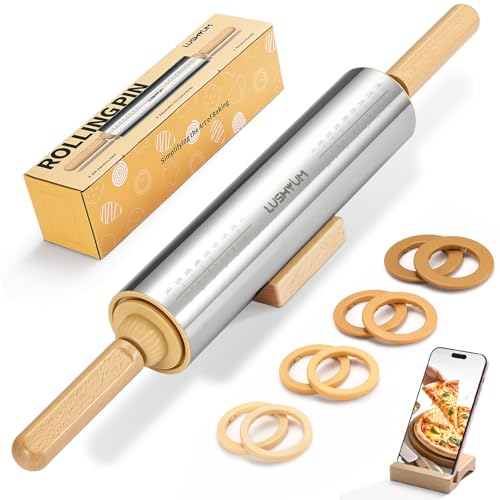
Geesta is the only pick that raises storage, in a bullet that reads as a bonus. It describes a wooden holder that keeps the pin from rolling off the counter and doubles as a phone and tablet rest, and then says the rings themselves can be stored back on the package. The same bullet states that the PP rings clean up in a dishwasher, which no other pick says about its rings.
That is worth knowing and it is also worth treating carefully. A bonus named in a bullet is not a contents list, and the listing never counts the holder among what arrives. What can be said is that one of these five makers thought about where the rings live, and that the other four expect you to solve it yourself with a drawer, a bag or a jar.
The Pin That Brings a Mat
QUELLANCE is the only pick that arrives with a second object, a baking mat with measurements printed on it, which its bullets frame as letting you roll to a size without a pastry board or a ruler. It is also the pick with the fewest ring sizes, four, so the purchase trades ring count for a mat.
The two steel pins that publish etched rulers on the barrel are answering the same need without the extra object. AMUZHI etches a dual sided ruler in inches and millimeters into its 17 inch barrel, and Geesta laser etches centimeter and inch markers into its teak. For a small kitchen that is one thing to store rather than two.
Which One Fits Your Kitchen
The drawer where rings get mixed up. AMUZHI color codes four pairs of rings, eight in all, screwed onto the ends of a 430 stainless barrel of 17 inches with an etched ruler in inches and millimeters, at 1.0 lb. The maker also suggests chilling the steel before rolling butter dough.
The baker matching a recipe in millimeters. Joseph Joseph publishes five thicknesses as 2, 4, 6, 8 and 10 mm with inch equivalents on a beech pin of 16.54 inches and 0.93 lb, and states it can be used without rings as a conventional pin. Ten rings arrive, unmarked.
The kitchen that wants nothing to scratch. Folksy Super Kitchen fits silicone rings at 10, 8, 5, 3 and 2 mm to a steel barrel of 15.75 inches at 0.81 lb, dishwasher safe with dimensions on the surface. Its own bullets name two different steel grades.
The counter with no pastry board. QUELLANCE pairs a 17 inch 430 stainless pin at 1.23 lb with a baking mat marked for measuring, and four ring sizes from 2 to 10 mm. Four rings is the fewest loose parts among these five.
The baker who wants the rings labeled and washable. Geesta marks each of five PP rings on the side and states they can go in a dishwasher, on a teak French style pin with laser etched centimeter and inch markers. Its rings carry no published thickness figure at all.
What We Could Not Verify
These are the figures and statements we went looking for in the manufacturer listings and could not find. Nothing below was estimated, and nothing on this page was measured by us.
- Whether the Geesta, Joseph Joseph, Folksy and QUELLANCE ring counts mean rings or pairs of rings.
- Whether replacement rings can be bought for any of these pins, which none of the five listings addresses.
- Whether the Geesta wooden holder is included, since the bullet names it as a bonus and the contents are never listed.
- A thickness figure for any of the five Geesta rings, described only as circumference options.
- Which steel grade the Folksy pin uses, given as 18/8 in one bullet and 304 in another.
- A believable width for the Geesta and Folksy pins, published as 0.5 and 0.39 inches.