How the Five Compare on the Numbers
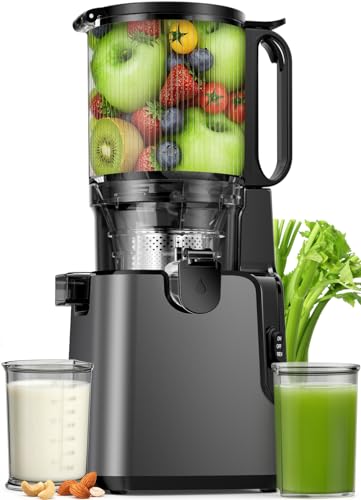
A cold press pool can quietly fill up with centrifugal machines, because the two words get used interchangeably in listing titles. That did not happen here. All five of these are slow masticating juicers that crush and press with an auger, and three of them publish an auger speed to prove it: 55 RPM on YPONE, 55 RPM on TUUMIIST and 64 RPM on Ganiza. Nothing had to be thrown out.
The figure that separates them is the feed chute, because it decides how much chopping you do before you start. EanOruus publishes 6.5 inches, ECOSELF 6 inches, and YPONE and TUUMIIST 5.8 inches each. Ganiza publishes the smallest opening of the five and contradicts itself about it, with 4.06 inches in the title and 4.3 inches in the feature bullets.
Two rows in that table should be read with suspicion. YPONE publishes a width of 3.94 inches while describing a 5.8 inch feed chute, which cannot both be true, so the maker’s own sentence is the one this page uses and the field is discarded. Ganiza publishes 8 by 11 by 8 inches, which is hard to square with a 43 oz hopper and a vertical auger, and its own bullets give no dimension at all. Nothing on this page is built on either figure.
The Feed Chute and What It Costs You
Inches of Opening Against Minutes of Chopping
The whole sales pitch of a wide chute is that an apple goes in whole. EanOruus publishes 6.5 inches and says it takes large whole fruits including apples and oranges. ECOSELF publishes 6 inches and lists apples, oranges, pears, carrots, celery, cucumbers, spinach and kale. YPONE and TUUMIIST both publish 5.8 inches and both say pre-cutting is not needed for oranges, apples and celery.
Ganiza is the outlier and it is honest about what it is instead. Its bullets claim a 4.3 inch chute and describe the machine as compact yet powerful, aimed at home kitchens rather than family batches. A narrower opening means more knife work, and for one or two glasses a day that trade is often worth making, because the machine takes up less of the counter while it does it.
Hopper Capacity Is a Separate Question
A chute is the hole; a hopper is how much waits above the auger. EanOruus and ECOSELF both publish 100 oz, and both frame it the same way, as enough ingredients for a family gathering or several days of meal prep in one loading. Ganiza publishes 43 oz alongside its 4.3 inch chute, which is a consistent picture of a smaller machine.
YPONE and TUUMIIST publish no hopper figure at all. YPONE describes an extra large capacity that holds a lot of fruit and vegetables at once, and TUUMIIST says nothing on the subject, so the two machines with matching 5.8 inch chutes cannot be compared on how much they hold. That is the single biggest hole in this comparison, because chute and hopper together are what decide a batch.
Speed, Power and Noise
Why 55 RPM Is a Selling Point
A masticating juicer turns slowly on purpose. YPONE and TUUMIIST both publish 55 RPM and both explain it the same way: low speed squeezing limits heat and oxidation. Ganiza publishes 64 RPM with the same reasoning. The three figures are close enough that no buyer should choose between them on speed alone, and that is worth saying, because the number is used as a headline.
EanOruus and ECOSELF publish no RPM figure at all. EanOruus describes a high torque AC brushless motor and ECOSELF a low speed high torque motor with an all metal gearbox, which are both descriptions of the same category without the number attached. Both are the larger machines here by hopper capacity, so the two you would most want a speed figure for are the two that withhold it.
Wattage and Decibels Are Almost Unpublished
Only two of the five publish a motor rating. Ganiza publishes a 350 W peak power figure and TUUMIIST publishes 300 W, and even those two are not quite comparable because one says peak and the other does not qualify it. YPONE calls its motor powerful, EanOruus calls its motor high torque and ECOSELF calls its motor upgraded, and none of the three attaches a number.
Noise is worse. Ganiza is the only machine here that publishes a figure, under 60 dB, and it does so in the same bullet as the wattage. EanOruus uses the phrase whisper quiet and ECOSELF says its gearbox reduces vibration and operating noise, both without a decibel figure. YPONE and TUUMIIST say nothing about noise, so four of these five cannot be ranked on it.
Filters, Sorbet and Cleaning
Three Filters, Two Strainers or One Piece
What comes in the box changes what the machine is for. ECOSELF supplies three filters and names each one: fine for smooth juice, coarse for a pulpy texture and a blank one for frozen desserts. Ganiza also supplies three detachable filters but describes them collectively, aimed at fibrous fruit and vegetables rather than at three different results in the glass.
EanOruus supplies two interchangeable strainers, juice and sorbet, and sells the machine as three in one with nut milk as the third job. YPONE takes a different route with two layers of 0.3 mm mesh in one strainer, claiming less clogging and no residue. TUUMIIST supplies the fewest options and turns that into its pitch, a one piece interior that cleans in under five minutes.
Cleaning Is Where These Machines Are Won or Lost
Every listing here mentions cleaning, which tells you what buyers complain about. TUUMIIST is the only one to attach a time, under five minutes with the included brush, and the only one to explain why: a simplified one piece interior with less to take apart. Ganiza says every part except the motor base comes off, and adds that a separable feed tube lets you reach the corners of the filter.
ECOSELF says most components rinse clean under running water and that assembly and disassembly take seconds, and EanOruus points at a detachable pulp outlet. YPONE describes dual strainers that leave no residue, which is a claim about juicing rather than about washing up. No listing publishes a dishwasher answer for any part, so five machines make five cleaning claims and none of them is checkable.
Which One Fits Your Kitchen
Batch juicing for a household. EanOruus, for a 6.5 inch chute and a 100 oz hopper, the largest pair of figures here, plus a sorbet strainer. At 12.13 pounds it is the heaviest of the three that publish a weight, so it will want a permanent spot.
Somebody who wants three textures. ECOSELF, for fine, coarse and blank filters, a 6 inch chute and a 100 oz hopper. It publishes no weight, no RPM and no wattage, so you are buying the filter set and the metal gearbox on description alone.
A small kitchen and one glass a day. Ganiza, at 4.3 inches of chute and a 43 oz hopper, with the only published motor rating at 350 W peak and the only published noise figure, under 60 dB. Expect more knife work.
The quickest cleanup. TUUMIIST, for a one piece interior, a brush and a published claim of under five minutes, with a 5.8 inch chute and 300 W. At 7.05 pounds it is the lightest of the three that publish a weight.
Nut milk as well as juice. YPONE, which publishes 55 RPM, a 5.8 inch chute and two layers of 0.3 mm mesh, and is the only pick to name soy milk as a job. Ignore its 3.94 inch width field and measure the machine yourself.
What We Could Not Verify
Every figure above comes from the maker’s own listing. These are the things we went looking for and could not source anywhere in them.
- YPONE publishes a width smaller than its own stated feed chute, so its dimension fields cannot be trusted and no comparison here uses them.
- Ganiza publishes 8 by 11 by 8 inches with no dimension in its own bullets, and those numbers do not fit a vertical auger machine with a 43 oz hopper.
- Two of the five publish no weight, and Ganiza contradicts itself on its own chute, 4.06 inches in the title against 4.3 inches in the bullets.
- EanOruus and ECOSELF publish no auger speed and no wattage, so the two largest hoppers here cannot be compared with the three that do publish RPM.
- Only Ganiza publishes a noise figure, so whisper quiet and reduced vibration on two other machines cannot be placed against it.
- No listing publishes a dishwasher answer for any component, and no listing publishes a yield test method behind the two 99% claims.