How the Five Compare on the Numbers
Eight listings came back for this keyword and all eight are powered centrifugal machines, so nothing had to be thrown out for being the wrong tool. Three were left off the page instead. One publishes no wattage, no weight and no chute figure, and its description is too vague to compare with anything. Another repeats a second listing’s wording almost sentence for sentence, which adds a column and no information. The third is a smaller machine from a brand already picked here.
The figure that separates the five that remain is published motor wattage. Bestome states 1200 watts, Breville 850 watts, Hamilton Beach 800 watts, QCen 500 watts and HIFMGHE 370 watts. Breville is the only one of the five that keeps its figure in a specification line at the foot of the listing rather than in a headline, and three of the other four attach a yield claim to the number.
One figure in that table is in the table only because leaving it out would have been quieter than it deserves. QCen publishes 0.88 lb as the weight of a 500 watt machine with a motor, a steel filter basket and a locking lid. No juicer of that description weighs less than a pound, so the figure is not used anywhere else on this page and no comparison is built on it. The table also cannot tell you how much juice any of these five actually returns from a pound of carrots, because not one listing publishes a yield in ounces.
Watts, Speeds and What They Actually Control
Where Each Listing Puts Its Wattage
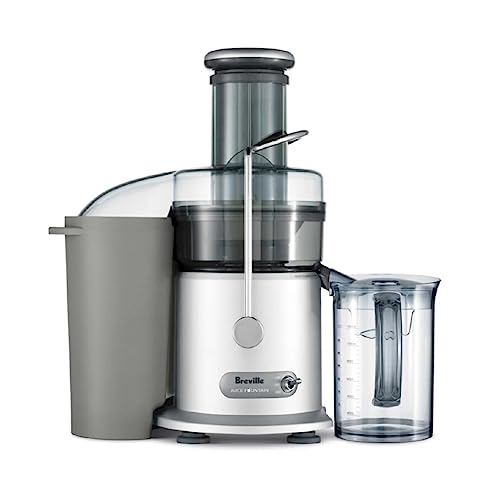
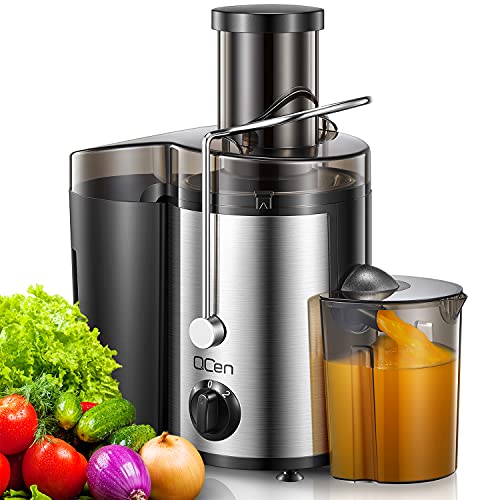
Four of these five lead with a wattage. Bestome opens with 1200 watts from a full copper motor, Hamilton Beach with 800 watts, QCen with 500 watts and HIFMGHE with 370 watts from a pure copper motor. Breville publishes 850 watts as well, but in a specification line at the foot of the listing, after the titanium reinforced cutting disc and the Italian made micro mesh filter basket, both stainless steel, that it leads with instead.
That ordering is worth noticing, because wattage is the figure most buyers use to sort this category. What it is not is a yield figure. A juicer draws power to spin a disc against fruit, and how much juice comes out depends on the disc, the mesh and how hard the pulp is pressed against it. Breville leads with the parts and lists the number last; the other four lead with the number and say less about the parts.
Two Speeds, Three Positions and the Produce Split
Breville and QCen both describe two speeds, a low setting for soft fruit and leafy vegetables and a high setting for dense produce such as carrots and apples. Bestome describes three positions, low, high and off, with the same soft and hard split. Hamilton Beach and HIFMGHE name no speed settings at all, which on an 800 watt machine and a 370 watt machine leaves a real question about how either handles spinach.
QCen is the only pick that turns its speeds into figures, publishing a range of 12000 to 18000 RPM across its two settings. HIFMGHE publishes a single 2800 RPM for its 370 watt motor, which is a different kind of machine spinning a different kind of basket. Those two numbers are the only spindle speeds anywhere in this pool, and neither can be lined up against the other three.
Where the Pulp and the Juice Go
Three Listings Publish a Pulp Bin Volume
Hamilton Beach publishes an 80 oz pulp bin and puts it front and center of its own comparison pitch. Bestome publishes a 65 oz pulp container alongside a 22 oz juice cup. Breville publishes a 2.6 qt pulp container and a 35.2 fl oz juice jug in one specification line. QCen and HIFMGHE describe removable residue containers with no volume at all, so two of these five cannot be compared on the thing that stops a juicing session.
Pulp volume decides how often you walk to the bin, and on whole fruit it fills faster than most people expect. A machine that takes a whole apple through a 3 in chute is also producing a whole apple’s worth of dry pulp within a few seconds. If you are juicing for more than one glass, the published bin figure is worth more attention than the wattage above it.
Froth, Foam and What Reaches the Glass
Three of the five say something about foam. Breville states plainly that certain fruits and vegetables create froth when juiced, and puts an integrated froth separator in the jug so that more juice and less froth pours out. Bestome describes a BPA free juice cup with a built in foam separator and links it to reduced clogging. HIFMGHE describes an automatic mechanism that separates juice from pulp for a smoother, fiber free result.
Hamilton Beach and QCen publish nothing about froth. This matters more on a centrifugal machine than on a slow press, because spinning air into juice is exactly what a high speed disc does. None of the three listings that mention separators publishes how much froth is removed, so the feature can be confirmed as present and cannot be ranked. It is a yes or no fact on this page, not a measured one.
Build, Safety and Cleaning Up
What the Cutting Parts Are Made Of
Breville is the most specific: a titanium reinforced disc and an Italian made micro mesh filter basket, both stated to be stainless steel, described as a single extraction system. Bestome states a 304 stainless steel high density filter with a corrosion resistant multi blade. HIFMGHE states food grade stainless steel in the contact areas over a light aluminum body. Hamilton Beach and QCen name no material for the disc or the basket anywhere.
That silence is worth weighing, because the basket is the part that decides both the yield and the life of the machine. A mesh that deforms lets pulp through and a disc that dulls stops cutting. Hamilton Beach backs its machine with a 3 year limited warranty, against the 1 year Breville publishes, which is a different sort of answer to the same worry and not a substitute for the material.
Locks, Cutouts and the Parts You Wash
QCen and HIFMGHE are the two picks that publish a safety story. QCen describes a locking system arm that stops the machine running without the cover in place, plus an overload system that switches off on overheating. HIFMGHE describes a lock buckle design with overheating protection. Breville, Hamilton Beach and Bestome name no interlock at all, which does not mean they lack one, only that the listing does not say.
On cleaning, Hamilton Beach is the most specific: pulp bin, juice bowl, lid and pusher are stated dishwasher safe, and a strainer cleaning brush is included. HIFMGHE states that the blades, filter and cask are detachable and dishwasher safe. QCen says detachable parts make it easy to clean without naming a method. Breville describes a cord that wraps under the base and a detachable 2.6 qt pulp container, and never mentions a dishwasher.
Which One Fits Your Kitchen
Somebody juicing spinach and kale most mornings. Breville, for the low speed aimed at soft fruit and leafy vegetables and the titanium reinforced disc behind it. It publishes 10.1 lb and 16.42 in of height, so it needs a permanent spot rather than a cupboard.
A household juicing for several people at once. Hamilton Beach, for the 80 oz pulp bin and 800 watts, with the pulp bin, juice bowl, lid and pusher stated dishwasher safe. It publishes the longer of the two warranties here, 3 year limited.
A first juicer for a cautious cook. QCen, for the locking arm that will not run without the cover closed and the overload cutout behind it. It publishes a spindle range of 12000 to 18000 RPM, and its 0.88 lb weight figure should be ignored.
Dense carrots and beets in quantity. Bestome, for 1200 watts, three speed positions and a 65 oz pulp container with a 22 oz jug. It publishes 13 in by 7 in by 10 in and no weight, so measure the counter before ordering.
An early riser in a flat with thin walls. HIFMGHE, the only pick that publishes a noise figure at 30 to 40 dB, running 370 watts at 2800 RPM. Its blades, filter and cask are stated dishwasher safe, and it publishes no weight.
What We Could Not Verify
Every figure above comes from the maker’s own listing text. These are the things we went looking for and could not source in any of them.
- Not one of the seven listings publishes a juice yield in ounces from a stated weight of produce, so the yield percentages several of them claim have no baseline to sit against.
- Bestome and HIFMGHE publish no weight at all, and QCen publishes 0.88 lb for a motorized machine, so only two of these five can be compared for bulk.
- Only QCen and HIFMGHE publish a spindle speed, and the two figures describe different mechanisms, so no speed ranking across the five is possible.
- HIFMGHE publishes the only noise figure here. The other four say nothing about noise, which on a high speed disc is the complaint buyers raise most often.
- Breville publishes 850 watts only in a closing specification line and attaches no yield claim to it, so its figure cannot be read against the yield percentages the other four print.
- No listing publishes how long the motor may run continuously before it needs to rest, which is the figure that decides whether a machine can juice for a household in one sitting.