How the Five Compare on the Numbers
Almost every avocado tool sold is a three in one: a blade edge to open the fruit, a pitter to twist out the stone, and a fan of tines to lift slices out of the skin. What separates these five is how many slices the fan makes, what the cutting edge is actually made of, and whether anything else comes in the box. Only two of the five will say how many pieces they cut.
Two listings were left off. One publishes a height and a weight that are near enough to zero to be placeholders, so there is nothing on it to compare. The other carries no brand name and swaps the slicing fan for a paring knife, which is a different combination of tools, and it publishes no weight either. Both are real products; neither is documented well enough to rank.
What the table cannot tell you is how thick a slice any of these makes, because slice count is not slice thickness and none of the five publishes the spacing between its tines. It also says nothing about how any of them copes with an underripe avocado, which is when a plastic fan flexes and a wire cuts cleanly. Nobody publishes a figure on that either.
Slice Count and the Cutting Edge
The two that count their slices
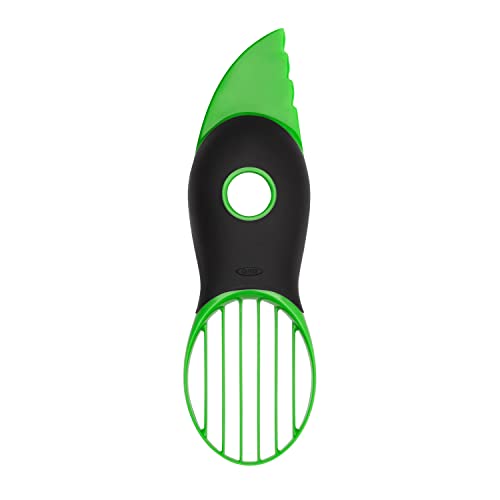
OXO states that its slicer lifts the fruit from the skin in seven pieces, which is the only slice count on this page from a tool that has been sold for years. Seven pieces out of half an avocado is a generous slice, wide enough to fan across toast without falling apart, and the number tells you the tines are spaced for structure rather than for thin cuts.
CHOHEY states eleven pieces from the same half, which is a meaningfully different tool. Eleven cuts gives you thin slices that overlap, and its listing leans on that directly with the phrase about really cutting thin slices. If you want the fanned look, the higher count is what delivers it. If you want chunks for a salad, it is working against you.
A wire against a fan of tines
CHOHEY is the only one of the five that does not slice with a molded fan. Its cutting element is a 304 stainless wire, pulled through the flesh by the handle, which is closer to how an egg slicer works than to how the rest of this category works. A wire needs no sharpening, cuts with almost no resistance, and is the part most likely to eventually go slack.
The other four use a fan, and only two say what it is made of. Ebecuoa is the most specific about its edges, naming a plastic blade for cutting through the skin and a separate fan blade for slicing and scooping. FALESHOS names food grade stainless steel and PP plastic on its cutter. OXO and Aichoof describe the fan without naming a material at all.
Twisting Out the Stone
Four stainless pitters
Four of the five use a stainless steel pitter that grips the stone and lifts it with a twist, and all four sell it on safety rather than speed. Ebecuoa is explicit about why, describing extraction without the dangerous stabbing motion, which is the accident this whole tool category exists to prevent. Aichoof and OXO both state that any size of stone comes out with one twist.
There is no published figure to separate them, so this is a design you either trust or do not. What is worth noting is that a metal pitter is the part that makes these tools worth owning over a spoon, and the only listing here that does not use metal for it has made a deliberate choice in the other direction.
The nylon exception
CHOHEY uses a nylon corer and calls it safe and durable in the same sentence, which reads as an answer to a question about metal near your hand. Nylon will not rust, cannot be sharpened and will not scratch a bowl, and on a tool whose cutting element is already 304 stainless wire, keeping the corer soft is a coherent decision rather than a saving.
Whether it grips a large stone as firmly as steel is exactly what no listing on this page will tell you. What CHOHEY does publish is that the rest of the tool is food grade stainless steel and nylon, described as rust proof and corrosion resistant, which is more material detail than three of the other four provide.
One Tool, or a Set of Three
What the three piece set adds
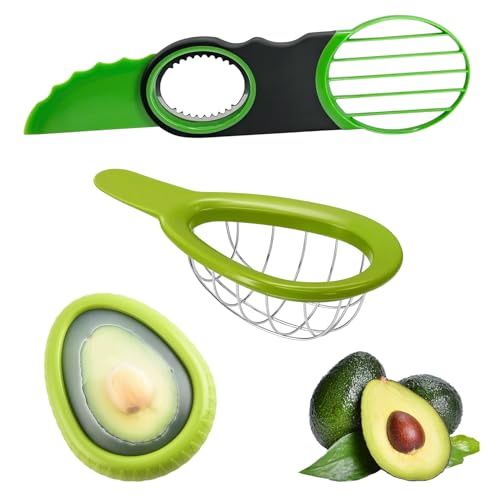
FALESHOS is the only one here that is not a single tool. Its own text lists a cutter at 8.86 by 2.36 by 0.47 inches, a cuber at 6.3 by 3.27 by 1.65 inches, and a storage container at 5.5 by 4.21 by 0.98 inches with a soft food grade silicone body and an ABS seal. At 0.55 lb for all three it is the heaviest of the five, which is what three objects weigh.
The container is the part with no equivalent on this page. Half an avocado left over is the problem this category never solves, and a sealed silicone box sized for it is a more useful third piece than another blade. The cuber is the other half of the argument: a fan slices, a cuber presses through into dice for a salad or guacamole in one motion.
Two of these five publish the same cutter
The cutter in the FALESHOS set is published at 8.86 by 2.36 by 0.47 inches, and the Aichoof tool is published at exactly the same three figures. Either these are the same molding sold two ways, or the coincidence runs to a hundredth of an inch on all three axes. Treat them as one cutter and the choice becomes simple: buy it alone, or buy it with a cuber and a container.
That is worth knowing because it turns a five way comparison into something smaller. If the shared cutter is the one you want, the only question is whether the two extra pieces earn their space in a drawer. If you want a different slicing action instead, then the wire on the CHOHEY tool and the seven piece fan on the OXO are the two genuine alternatives here.
Which One Fits Your Kitchen
Slices that hold their shape on toast. OXO. It states seven pieces from a half, lifts the fruit out of the skin in one pull, uses a stainless pitter that clears any size stone with a twist, and at 0.1 lb it is the lightest of the five. Top rack dishwasher safe.
Thin overlapping slices. CHOHEY. Eleven pieces from a half, cut by a 304 stainless wire rather than a molded fan, with a nylon corer, a body of food grade stainless and nylon, a hanging point for storage and a published length of 9.65 inches.
Opening the avocado without reaching for a knife. Ebecuoa. The only listing here that names a separate plastic blade for cutting through the skin, alongside a fan blade for slicing and scooping, on an ABS body with a heavy duty stainless pit remover.
Cubing half and saving the rest. FALESHOS. Three pieces: a cutter, a cuber at 6.3 by 3.27 by 1.65 inches, and a silicone storage container with an ABS seal at 5.5 by 4.21 by 0.98 inches. All three are stated dishwasher safe.
One tool and nothing else. Aichoof. The same 8.86 by 2.36 by 0.47 inch cutter that the three piece set is built around, on its own, in ABS with a stainless pitter, a soft non slip grip and top rack dishwasher cleaning.
What We Could Not Verify
Six things a buyer would reasonably ask that these five listings never answer.
- Slice thickness or tine spacing on any of the five, only a piece count on two of them.
- How many slices the Ebecuoa, FALESHOS or Aichoof fans cut.
- What the OXO and Aichoof slicing fans are made of.
- A published weight for the Aichoof tool, the only one of the five without one.
- How any of them handles an underripe avocado, where a molded fan flexes.
- Whether the CHOHEY cutting wire can be replaced when it loses tension.