How the Five Compare on the Numbers
Six timers are on the fact sheet and one was left off. ALBAYRAK is a mechanical dial in 304 stainless steel with a magnetic back and an 85 dB alarm, and it publishes no maximum countdown, no dial range and no interval of any kind, so on a page about how short a time can be set it has nothing to be placed against. The other five all publish either a range or a setting method, and usually both.
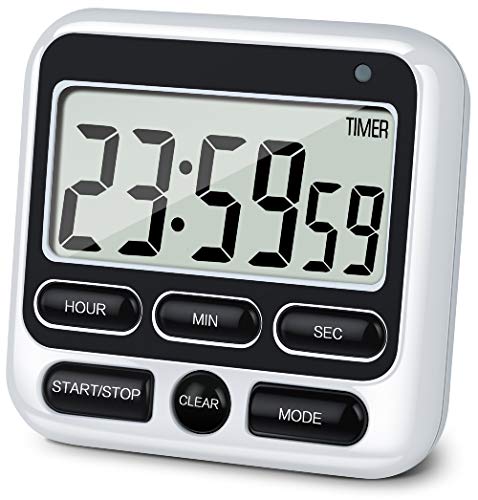
What decides this page is the smallest interval each one will accept. Antonki publishes a whole range of 99 minutes 59 seconds and sets it with M and S buttons. KTKUDY has dedicated Hour, Min, Sec and Clear buttons behind a 24 hour range. TempPro stops at 23 hours 59 minutes, with no seconds in the figure at all. Nkove names no seconds control. NUOSWEK is a dial that must be wound to 55 before anything is set.
Two of these listings need a caveat. Antonki ships two timers in one box, so its 0.1 lb covers both units and its dimension fields describe the carton, which is why the figures quoted above are the ones in the maker’s own sentence, 2.68 by 2.48 by 0.63 in. KTKUDY and Nkove also publish figures close enough to be the same device under two brands: 0.14 lb each, 3.15 in against 3.1 in across, 0.87 in against 0.8 in deep, and the same 24 hour range. The table cannot tell you the shortest time any of these will actually accept, because only the setting buttons hint at it and none of the five states a minimum.
How Short a Time Each One Can Be Set To
Two Keypads With a Seconds Button
Antonki and KTKUDY are the two that publish a way to enter seconds. Antonki describes easy M and S buttons and a whole range of 99 minutes 59 seconds, which means every setting it takes is expressed in minutes and seconds. KTKUDY lists dedicated Hour, Min, Sec and Clear buttons, one button per job, with a press and hold of 3 seconds to advance a digit quickly when a long countdown is wanted.
That matters more than the range does for anything cooked briefly. A soft egg, a blanch, a rest between kneads and a shot of espresso are all timed in seconds, and a timer that only accepts whole minutes rounds the instruction before the food gets near it. Both of these two also remember the last countdown, which is worth as much as the buttons when the same three minutes is set every morning.
The Mechanical Dial Has to Be Wound to 55 First
NUOSWEK is the one pick here with no battery, and its own listing explains the cost. It is a 60 minute wind up timer, and the maker states in two separate bullets that the dial must be wound from 0, 5, 10, 15 and so on up to 55 before the spring is engaged, and only then set back to the time wanted. The listing also says that if it does not ring, the winding step was skipped.
For a long bake that is one extra motion. For a three minute egg it means winding almost a full revolution and then bringing the dial back to the short setting, every single time. The same listing notes there is no back cover, so the alarm is very loud, and that the gears tick audibly while the timer runs. None of that is a defect, and all of it is worth knowing before a timer is bought for short cooking.
Range, and What a Long Ceiling Costs
99 Minutes 59 Seconds Against 24 Hours
KTKUDY and Nkove both publish a 24 hour countdown, and KTKUDY sells the point directly, describing itself as far beyond timers limited to 99 minutes 59 seconds. TempPro publishes 23 hours 59 minutes. Antonki publishes 99 minutes 59 seconds, which is the ceiling KTKUDY is arguing against. NUOSWEK publishes 60 minutes on a dial and cannot be set beyond it.
A long ceiling is not free. Reaching 24 hours means the setting has to pass through hours, which is why KTKUDY needs a separate Hour button and a hold to advance. Antonki reaches its ceiling with two buttons because it never has to count hours at all. If nothing in the kitchen runs longer than an hour and a half, the shorter range is the simpler tool rather than the lesser one.
Two Countdowns, or Two Timers
Two picks solve the same problem in different ways. TempPro runs two countdowns at once in one body, so a pan and an oven can be tracked on one screen, and it adds a calendar with 12 and 24 hour display. Antonki simply ships two complete timers in one box with the batteries already in them, so one can sit on the fridge and one go in a pocket.
For short cooking the two devices arguably win, because two things timed in minutes are usually in two different places. The two in one body wins when both times are read at a glance from the same spot. What neither publishes is whether the second countdown can be started while the first is running, which is the detail that separates the two ideas in practice.
Being Told, and Where the Timer Sits
Decibels on Two of the Five
KTKUDY publishes 70 to 90 dB and says the alarm can be heard from another room. TempPro publishes 70 to 105 dB across four volume settings with a silent mode as well. Antonki and Nkove both describe a loud alarm and a quiet alternative without publishing a figure for either, and NUOSWEK publishes no decibels while stating that the absence of a back cover makes it very loud.
The quiet options are not the same thing either. Antonki triggers a flashing red light and no beep. KTKUDY switches between a sound mode and a light mode. TempPro and Nkove both name a silent mode. NUOSWEK has no quiet option at all and ticks continuously while running, which on a mechanical movement is normal and is still a noise in a small kitchen.
Batteries, Magnets and a Hanging Hole
Only two of these five say anything definite about power. Antonki includes two AAA batteries in the box and tells buyers to switch the unit off at the back when it is not in use. NUOSWEK needs no power at all. KTKUDY, TempPro and Nkove publish no battery type, no battery life and no charging method, which across three digital devices is a consistent silence.
Placement is better covered. Antonki publishes three options, a magnetic back, a fold out kickstand and a hanging hole. KTKUDY publishes three rear magnets and a fold out stand. TempPro publishes a magnet and a tabletop stand behind its 2.6 in LCD. Nkove publishes a magnet. NUOSWEK publishes nothing about mounting, which for a dial that has to be turned with one hand is the awkward gap.
Which One Fits Your Kitchen
Two short things cooking in two places. Antonki, which ships two complete timers with AAA batteries fitted, a range of 99 minutes 59 seconds set with M and S buttons, and a magnet, a kickstand and a hanging hole on each.
Seconds today and a slow cook tomorrow. KTKUDY, for dedicated Hour, Min and Sec buttons behind a 24 hour range, a 2.8 in LCD, 70 to 90 dB or a silent light mode, and three rear magnets.
A pan and an oven read from one spot. TempPro, for two countdowns in one body up to 23 hours 59 minutes, a calendar and clock, and four volumes from 70 to 105 dB with a silent setting. Its range stops at whole minutes.
A plain countdown on the fridge door. Nkove, for a 24 hour countdown, a count up mode and a clock in a body published at 3.1 by 3.1 by 0.8 in, with a side switch for silence. It names no seconds control.
A kitchen with no spare batteries. NUOSWEK, a 60 minute wind up dial at 0.24 lb needing no power. Accept the maker’s own instruction: wind to 55 first, then set the time, and expect ticking while it runs.
What We Could Not Verify
Every figure above comes from the maker’s own listing text. These are the things we went looking for and could not source in any of them.
- Not one of the six listings states a minimum setting, so the shortest time each timer will actually accept has to be read off the setting buttons instead.
- Nkove names no seconds control at all, so whether its 24 hour countdown can be set to a short interval is not answerable from the listing.
- Three of the five digital picks publish no battery type, no battery life and no charging method, which on a device that has to be trusted overnight is a real gap.
- TempPro publishes two countdowns but never says whether the second can be started while the first is still running.
- Antonki and Nkove publish no decibel figure, so only two of the five can be compared on whether the alarm carries into the next room.
- KTKUDY and Nkove publish figures close enough to be one device under two brands, and neither listing says anything that separates them beyond one extra mode.