How the Five Compare on the Numbers
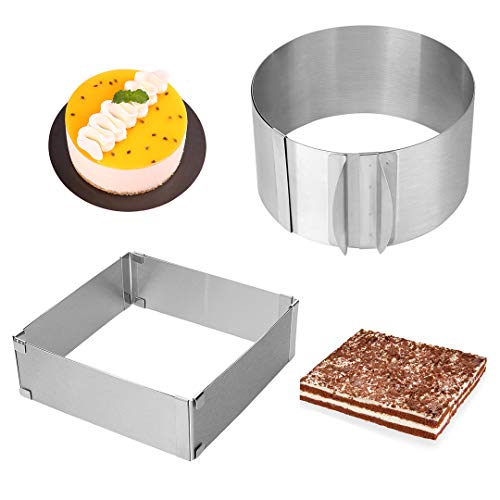
Sixteen listings sit on the fact sheet and three are off this page. Meichu adjusts as a round and as a square, which is a different purchase rather than a better one. DATANYA publishes 6 to 12 inches in its title and 6.5 to 12 inches in its own bullet, and counts its stickers twice, as two and as twenty four. YSDSDAKA publishes one height in its title and size field and a taller one in a bullet, so neither can be used.
An adjustable ring has one job that a fixed tin does not: it has to be set to a size. That makes the marks inside the wall the most useful thing any of these listings can publish, and three of the five below publish them while two do not. What comes in the box is the second question, because a ring with no base and no collar is not yet a cake tin.
The table cannot tell you what any of these scales is marked in. Three listings say there are marks and none says whether they read in inches, in centimeters, or in both, and none says whether the marks are on the diameter or the height. On a ring that adjusts through six inches of diameter, a scale marked in the wrong unit for the recipe is a scale you will read twice.
The Marks Inside the Ring
Three Listings Publish a Scale
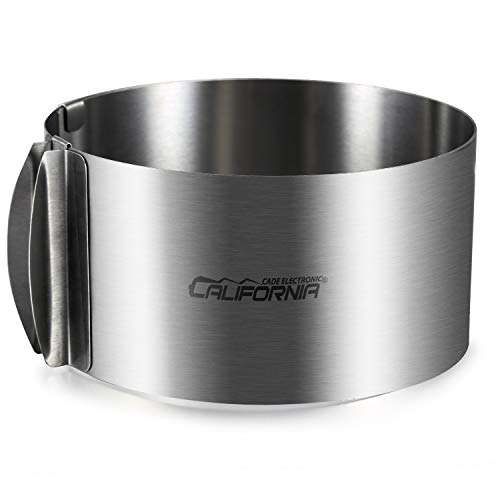
BakeMviert publishes the clearest version: a laser etched internal scale with measurement marks on the inner wall, described as allowing quick setup and strict portion control. Hushee publishes a height scale inside, which is a different axis and arguably the more useful one on a ring that stands about 6 in high. CALIFORNIA CADE says there are different numbers carved on the ring without saying what they count.
Etched, printed and carved are three different durabilities. A laser etched mark survives washing and a printed one does not, and none of these three says how the marks were made except BakeMviert. What all three share is the recognition that an adjustable ring without a reference is set by guesswork, which is the whole practical difference between a ring and a tin.
Two Publish Figures Instead
Iwinna takes the other route and publishes the numbers a scale would tell you. Its walls are 5.9 in, and it names 2.75 in as the industry standard for comparison, which is the only competitive figure quoted anywhere in this pool. It also publishes a material thickness of 0.4 mm, the only thickness figure here, and says the ring will build an eight layer cake.
Doyzee publishes nothing inside the ring and everything about the collar instead: an acetate roll 5.5 in wide and 394 in long at 125 micron, with 10 stickers to seal the collar after cutting. Those are the most precise figures on this page and they describe the consumable rather than the tool, which is a fair trade if the ring is going to be lined every time anyway.
What Is Actually in the Box
Two Sets Include the Collar, One Tells You to Buy It
BakeMviert and Doyzee both ship an acetate roll with the ring. Doyzee publishes its dimensions to the micron. BakeMviert calls its roll extra high and sturdy enough to support heavy fillings without giving a figure. Iwinna is the interesting case: its release bullet instructs you to line the collar with acetate cake tape and the listing does not include any.
That is a reasonable thing for a maker to do and a costly thing for a buyer to miss. A mousse set in an unlined steel ring is a mousse that leaves part of itself on the steel, and the instruction to line it is published in the same bullet as the promise of easy release. Hushee and CALIFORNIA CADE mention no collar at all in either direction.
A Ring With No Base, Stated as a Feature
BakeMviert publishes the fact that it has no bottom base and gives the reason, to prevent sticking during removal, and suggests pairing it with aluminum foil for a custom base. It is the only listing in this pool that addresses the base at all, and every one of these rings is a ring, so every one of them has the same gap.
Hushee’s answer is quantity instead: two rings in one purchase, at a stated 2.21 lb for the pair, so two layers can be built at once rather than one after the other. CALIFORNIA CADE’s answer is a warning, telling buyers not to put a hand on the edge of the ring when adjusting or washing it, which is the only safety note anywhere in the pool.
Where the Published Figures Stop Agreeing
A Ring Published at 3.2 Inches and 1.26 Inches
CALIFORNIA CADE publishes height: 3.2 inches in its adjustable bullet. Its size field says 3inch-Height. Its dimension fields say 2.44 by 2.44 by 1.26 in, which is a height of about an inch and a quarter and a diameter of under two and a half inches, on a ring the same listing says adjusts from 6 to 12 inches. The fields cannot be describing the ring at all.
This page uses the maker’s sentence, 3.2 inches, and records the field beside it, because the sentence is the only figure that comes with an explanation of what it measures. The 6 to 12 inch range appears in the title, the bullet and the fact sheet consistently, so the adjustment is the part of this listing that can be trusted.
Zeros, Cartons and a Range That Stops Short
Doyzee’s listing publishes a width of 5.5 in and then publishes zero for its depth and its height, which is not a measurement of anything. Hushee publishes no ring dimensions at all, only a package of 11.8 by 6.3 by 5.9 in for two rings, and its adjustment stops at 11.8 in where the other four all reach 12.
That last point is small and real. Four of these five publish 6 to 12 inches and Hushee publishes 6 to 11.8, which is the difference between fitting a 12 inch cake board and not. It is the kind of figure that only matters once, at the moment it matters, and Hushee is the only listing here honest enough to publish a range that is not a round number.
Which One Fits Your Kitchen
Setting a size without a tape measure. BakeMviert, the only pick with a laser etched internal scale, adjusting 6 to 12 in on dual side expansion handles, shipped with a clear acetate roll, stated safe for the freezer and published with no base by design.
Building two layers at the same time. Hushee, two rings in one purchase at 2.21 lb, standing about 6 in high with a height scale inside, adjusting 6 to 11.8 in. It publishes no dimensions for a single ring.
A wall with a real figure behind it. Iwinna, 5.9 in walls in 0.4 mm steel with two handles and an eight layer claim, and the only listing that names 2.75 in as what the rest of the industry does. Bring your own acetate.
A ring and the collar to line it. Doyzee Supplies, with an acetate roll of 5.5 in by 394 in at 125 micron and 10 sealing stickers, on a 6 to 12 in stainless ring at 0.4 lb. It publishes nothing about marks inside.
A shallow ring for plating and setting. CALIFORNIA CADE, 6 to 12 in with numbers carved on it and a published wall of 3.2 in, at 0.6 lb, with a stated warning to keep your hand off the edge when adjusting it.
What We Could Not Verify
Every figure above is from the maker’s own listing. These are the things we went looking for and could not source in any of the eight.
- None of the three listings with marks inside says what unit the marks read in, or whether they measure diameter or height.
- CALIFORNIA CADE publishes 3.2 in in a sentence, 3 in in its size field and 1.26 in in its dimension fields, for the same wall.
- Doyzee publishes a width of 5.5 in and then publishes zero for both its depth and its height.
- BakeMviert publishes no wall height, no weight and no dimensions of any kind, on the pick with the best described scale.
- Only BakeMviert addresses the missing base, and every ring in this pool has the same open bottom.
- Iwinna instructs buyers to line the ring with acetate and does not supply any, and never says what width of collar its 5.9 in wall needs.