How the Five Compare on the Numbers
Sixteen citrus presses are on this fact sheet and the published weights do not spread out. They cluster. Four handheld squeezers sit between 0.22 lb and 0.99 lb, the cast iron lever presses all run to double figures, and one listing on the sheet publishes no weight at all. Sopito is the only lever press among the five, and it is here because its aluminum alloy body keeps it to 6.83 lb.
So the five below are the four squeezers that publish a weight plus the single lever press that does not need a trolley to move. They are different machines doing the same job. A hinged squeezer works one half of a lemon with your hand. A lever press works a whole half orange with your body weight and a stand, and the weight of the stand is the point of it.
The column that would settle this page does not exist. Nobody publishes the force a squeezer needs or the yield it gets from one lemon, so the only figures connecting weight to effort are a leverage claim and a percentage. A press that weighs thirty times another press is not doing thirty times the work, and none of these listings gives you a way to find out what it is doing.
Two Populations With Nothing in Between
Four Squeezers Under a Pound
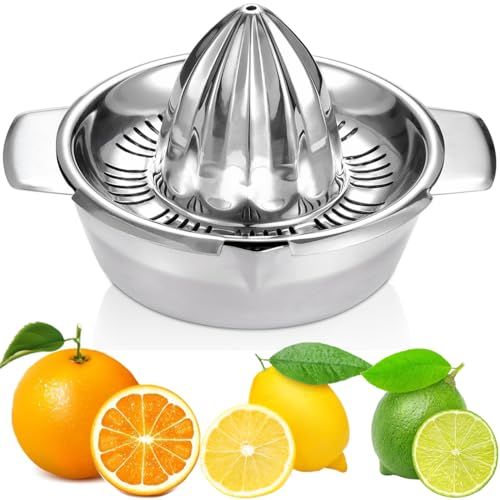
Etinslant publishes 0.22 lb, the lightest of the five, and it is the only one of the four that is not a hinged squeezer. It is a 304 stainless reamer cone over a bowl, with the cone height given as 2.75 inches and the sieve diameter as 5.43 inches, a stated 10 oz bowl, two pour spouts and an 11 tooth reamer. You twist the fruit rather than squeezing it.
The other three are hinged. Bagrox publishes 0.68 lb of food grade stainless steel, Zulay publishes 0.7 lb of coated aluminum, and Chef’n publishes 0.99 lb of nylon and stainless steel. A quarter of a pound separates them, which is far less than the difference in how they work, and none of the three publishes a single figure about the force your hand supplies.
Cast Iron Jumps Into Double Figures
Then the pool jumps. The three cast iron lever presses that publish a weight are all in double figures, many times the weight of any squeezer on this page. Two more listings describe the same kind of press and publish no weight whatsoever, which is why neither is here. On a page about a light build, that jump is the wall the shortlist runs into.
One of them contradicts itself in a way worth naming. Its weight field and its own bullet give two different figures for the same press, and nothing in the listing explains the gap. No figure from it is quoted on this page, because a press that cannot agree with itself about its own mass is not a benchmark for anything, and it is not one of the five in any case.
The One Lever Press You Can Lift
Aluminum Alloy Instead of Cast Iron
Sopito publishes 6.83 lb, the heaviest of these five and under half of every cast iron figure in this pool, and its own listing explains why. The main frame is stainless steel and the body is a heavy duty aluminum alloy rather than iron. The listing sells that as balancing durability and portability, and mentions taking it camping, which is not a claim any cast iron press in this pool makes.
The trade shows up in the cleaning line. Sopito states that all parts touching fruit are dishwasher safe stainless steel, and that the aluminum alloy body needs a quick rinse or a wipe instead. So it is the only pick here with a two part cleaning routine, which is the price of the metal that made it light enough to carry.
A Bowl Measured Against an Orange
Sopito is also the only listing in this pool that tells you whether your fruit fits. It publishes a bowl width of 4.3 inches and then gives the reason it matters: most oranges are 2.6 to 3.5 inches in diameter, so the bowl clears nearly all commercial fruit. That is the single most useful sentence on the fact sheet and no other listing here attempts anything like it.
The four squeezers say nothing comparable. Chef’n names lemons and key limes and adds that it is designed specifically for small citrus, which is a fit statement without a figure. Zulay names limes, lemons and small oranges. Bagrox names limes, lemons, citrus and oranges without qualifying size. Etinslant publishes a sieve diameter of 5.43 inches and leaves you to work out the rest.
What a Light Build Costs You
Effort, and Nobody Will Quantify It
Every listing in this pool sells effort reduction and not one publishes a measurement of it. Chef’n comes closest with a patented dual gear mechanism it says delivers up to 20% more juice than standard squeezers with less hand strain. That is a yield percentage rather than a force, and the comparison is against an unnamed standard squeezer, so it cannot be checked against anything else here.
Sopito claims an extended ergonomic lever handle, longer than most cast iron juicers, and high extraction efficiency with no figure attached. Etinslant, Bagrox and Zulay make no effort claim at all beyond calling a handle ergonomic. On a page where the whole question is what you give up by choosing a lighter tool, that silence is the answer: the listings do not say.
Folding, Drawers and Two Bowls
The lighter picks compete on storage instead, and here the figures are real. Bagrox publishes an overall length of 7.28 inches, a folded thickness of 1 inch and a juicer head height of 2.75 inches, and says it folds completely flat with no bulky humps. Its dimension field of 1 inch matches that folded figure exactly, which is unusual in this pool and makes the claim checkable.
Chef’n publishes 10.25 by 3.25 by 2.75 inches and says the compact size fits any kitchen drawer, which at 10.25 inches long is a claim about a drawer rather than a small one. Zulay publishes 2.9 by 8.7 by 2.1 inches with two bowls rather than one, and Etinslant publishes 5.43 by 4.92 by 2.36 inches for a cone and bowl that nest together.
Which One Fits Your Kitchen
The lightest thing that will do the job. Etinslant, 0.22 lb at 5.43 by 4.92 by 2.36 inches in 304 stainless steel, with a 2.75 inch cone, a 5.43 inch sieve, a stated 10 oz bowl, two pour spouts and an 11 tooth reamer, dishwasher safe.
A drawer with no room to spare. Bagrox, 0.68 lb of food grade stainless steel, 7.28 inches long, folding to a stated 1 inch thickness with a 2.75 inch head, cleaned by rinsing under water and hanging to dry.
Limes and small oranges in one tool. Zulay 2-in-1, 0.7 lb at 2.9 by 8.7 by 2.1 inches in aluminum with a food grade coating, two bowls rather than one, and stated safe in the dishwasher or under running water.
Lemons every day with less hand strain. Chef’n, 0.99 lb at 10.25 by 3.25 by 2.75 inches in nylon and stainless steel, with a patented dual gear mechanism stated to deliver up to 20% more juice, non slip handles and top rack dishwasher safety.
Whole halves and a press you can carry. Sopito, 6.83 lb at 6.5 by 9.4 by 16.5 inches, a stainless frame on an aluminum alloy body, a 4.3 inch bowl set against oranges of 2.6 to 3.5 inches, with a cleaning brush supplied.
What We Could Not Verify
Every figure above comes from the maker’s own listing text. These are the things we went looking for and could not source in any of them.
- No listing publishes the hand force a squeezer needs, so the effort a lighter build costs you is unstated everywhere.
- Only Chef’n publishes a yield claim, and it is a percentage against an unnamed standard squeezer rather than a measured volume.
- Only Sopito publishes a fruit diameter, so on the four squeezers whether a large orange fits is a guess.
- Only Etinslant publishes a bowl capacity, at 10 oz, so how much juice the other four hold before they overflow is unknown.
- One cast iron listing in this pool gives one weight in its fields and a different one in its own bullet, so no figure from it anchors anything here.
- Two cast iron presses in this pool publish no weight at all, which is why neither could appear on a page about weight.