How the Five Compare on the Numbers
A loaf you cut every day gets opened and closed twice as often as it gets stored, so the specification that matters is the closure, not the coating. Sixteen listings sit on this fact sheet and they solve that in five different ways: a wide zipper, a full length zipper, a zipper backed by a buckle, a twist tie, and a paper base you fold flat so the bag stands up on its own.
The five below cover all five methods. Three are reusable fabric bags sold in pairs, one is a pack of seventy clear plastic bags with a hundred ties, and one is a pack of fifty kraft paper bags with a window. Only three of the five publish a weight, and one of those three publishes a figure its own bullet contradicts.
What no listing publishes is how many open and close cycles a zipper or a wax coating survives, which is the whole question for daily use. Nor does anyone state a crust condition after a given number of days, only that bread stays fresh. The two bulk packs sidestep the durability question in different ways: the kraft bags are paper, and the clear PE bags are called reusable in a title that never says how to wash one. Neither states how many days a loaf lasts inside.
The Closure You Operate Every Day
Three Zippers, Three Different Descriptions
WiNDANCE calls its closure a wide zipper and ties it to easy opening and closing on a 17 by 13 inch bag. YILIHCIA goes further, publishing a full length L shaped zipper opening on a 13 by 16.7 inch bag, and explains what the shape buys: the mouth opens down one side as well as across the top, so a full size artisan boule can be lifted out rather than squeezed.
GRIN BY GRIN uses two closures rather than a better one. It states a zipper as the first lock and a buckle as the second, a design it calls a double lock, on a 12 by 17 inch bag. For a loaf that is opened daily that is an extra action every time, and the listing frames it as a freshness measure rather than a convenience.
A Twist Tie and a Seal Sticker
vivinin answers the same question with a hundred twist ties of 10 cm supplied alongside seventy clear bags of 8 by 4 by 18 inches. A twist tie is the least convenient closure here and the most forgiving, because it does not wear out and a fresh bag starts every loaf. The bags are clear throughout, so the state of the crust can be checked without opening anything.
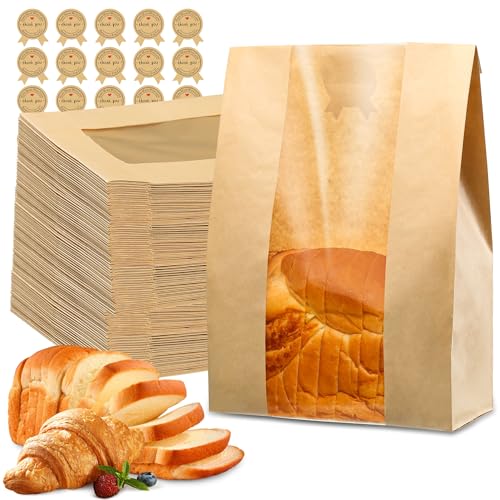
The AZLTC paper bag closes with a sticker. Its bullet states 60 seal label stickers with a tie, 20 percent larger than regular stickers, alongside a square base that flattens in 3 seconds so the bag stands up on the counter and a transparent window. A sticker closes a bag once, which suits a loaf eaten within a day or two or given away rather than one opened all week.
How Long the Bread Actually Keeps
One Listing Puts Days on a Number
YILIHCIA is the only pick that gives a figure for refrigerated storage: 3 to 7 days, with freezing mentioned as the alternative and no figure attached. That is a range rather than a claim, and it is the only day count among these five. Elsewhere in this pool a beeswax listing goes further and publishes three separate storage temperatures with days for each, which is the best documented answer in the category.
The other four say only that bread stays fresh. WiNDANCE describes a breathable cotton linen exterior with a beeswax lining that maintains humidity and airflow to stop a loaf going soggy while keeping the crust crisp. That is a mechanism rather than a duration, and for a daily loaf the mechanism may matter more, but it cannot be compared with a number.
Three Months in a Freezer, Twice Stated
Two listings agree on the freezer. WiNDANCE states up to 3 months in a frost free freezer, with the bread fully cooled before it goes in. GRIN BY GRIN states about three months frozen and adds that the bag protects against freezer burn. Those are the only two freezer figures among these five, and they match each other closely enough to read as a category norm.
Neither of the bulk packs mentions a freezer at all. On a clear PE bag with a twist tie that is an omission worth noting, because a plastic bag is the thing most households already freeze bread in. YILIHCIA says its bag works in both the refrigerator and the freezer and declines to say for how long in either case beyond its 3 to 7 day range.
Where the Figures Do Not Add Up
A Fifty Bag Pack at Two Different Weights
The AZLTC paper listing publishes 0.22 lb in its weight field. Its own first bullet says the pack of 50 weighs about 22.7 ounces. Those two figures describe the same box and they are not close: one is a fraction of a pound and the other is well over a pound. The bullet is the more believable of the two for fifty coated kraft bags, and no comparison here rests on either.
The same listing publishes a package size of 0.1 by 0.1 by 0.1 inches, which is a placeholder rather than a measurement, while its bullet gives a bag size of 13.7 by 8.3 by 3.7 inches. This page used the bullet. It is worth saying plainly that the one listing here with the most specific numbers is also the one whose fields are least usable.
What the Dimension Fields Are Really Measuring
The reusable bags publish dimension fields close to the bags themselves. YILIHCIA’s fields read 13 by 16.7 by 0.4 inches, its stated bag size plus a flat thickness. GRIN BY GRIN’s read 12 by 17 by 0.5 inches, likewise. WiNDANCE’s read 13 by 13 by 17 inches against a stated bag of 17 by 13 inches, so one of those three numbers is not measuring the bag.
vivinin’s fields read 4 by 8 by 18 inches, the same three numbers as the bag size it states, which is the tall narrow shape a sandwich loaf actually is. Of the five, it is the only one whose stated size has three dimensions that describe a gusseted bag rather than a flat one, and that shape is the reason a hundred twist ties come with it.
Which One Fits Your Kitchen
A boule you lift out whole. YILIHCIA, a stated 13 by 16.7 inches in cotton canvas with a pure beeswax interior, a full length L shaped zipper, a stated 3 to 7 days in the refrigerator, and use named for bagels, croissants, scones, cheese and firm produce.
Batch baking for the freezer. WiNDANCE, a published 0.75 lb for two bags of a stated 17 by 13 inches in beeswax lined linen and cotton, with a wide zipper, up to 3 months stated in a frost free freezer, and a buckle that doubles as a carrying handle.
A bag you close twice. GRIN BY GRIN, two bags of a stated 12 by 17 inches in polyester and recycled bottle fabric with a food grade lining, a zipper and a buckle described as a double lock, in ivory and blue gray, with about three months frozen stated.
A fresh bag every loaf. vivinin, a published 0.79 lb for seventy clear PE bags of a stated 8 by 4 by 18 inches with a hundred twist ties of 10 cm, clear throughout so the crust can be checked without opening the bag.
Bread given away, not stored. AZLTC paper, fifty kraft paper bags with a PE film and a coated lining, stated at 13.7 by 8.3 by 3.7 inches, with a transparent window, a square base folded flat in 3 seconds and 60 seal label stickers.
What We Could Not Verify
Every figure above comes from the maker’s own listing text. These are the things we went looking for and could not source in any of them.
- No listing publishes how many open and close cycles a zipper or a wax coating survives, which is the whole question for a bag used daily.
- Only YILIHCIA publishes a day count, at 3 to 7 days refrigerated, so on four of these five the shelf life is a phrase.
- Neither bulk pack mentions a freezer, so whether a clear PE bag or a kraft bag is suitable for freezing is unstated.
- The AZLTC paper listing publishes 0.22 lb in its field and about 22.7 ounces in its own bullet for the same pack of fifty.
- The same listing publishes a package size of 0.1 by 0.1 by 0.1 inches, which is a placeholder, not a measurement.
- No listing states a crust condition after a set number of days, only that bread stays fresh.