How the Five Compare on the Numbers
The dangerous moment in sourdough baking is not the bake, it is the loading: lowering wet dough into a vessel that has been in a 500 degree oven for half an hour. Two of these five remove that moment entirely by requiring no preheating at all, and the other three each publish a different way of making it survivable.
Brod & Taylor publishes a 1 pound aluminum shell that needs no preheating, the lightest published weight here. LemonRoad publishes 1.93 pounds on the same principle. Bulka publishes 8.5 pounds of carbon steel and a 15 minute preheat with a sling included. LoafNest publishes a wire mesh tray, and HAWOK a shallow cast iron base.
Two of these five publish no temperature figure, no cooling note and no cleaning instruction, which on cast iron and enameled steel is where the work actually is. The weight row also carries the one figure on this page that cannot be trusted, and the section below says which.
The Two That Never Get Preheated
A one pound shell
Brod & Taylor publishes an aluminum baking shell weighing 1 pound and a method in three steps: preheat the oven with a stone or steel, put the risen dough on the hot surface, cover it with the shell. After twenty minutes the shell comes off and the loaf browns uncovered. Nothing heavy is ever lifted hot.
The listing makes the comparison itself, contrasting 1 pound against a typical 15 pound Dutch oven and 20 to 30 minutes of scrubbing and reseasoning against a quick wipe. It publishes 550 F, no PTFE or PFOA, and the detail that it cools fast and will not crack the way ceramic or enameled cast iron can.
Two pounds and a wider dome
LemonRoad publishes the same approach in a larger vessel: an anodized aluminum dome of 6 quarts at 1.93 pounds, rated to 550 F, fitting most 10 to 12 inch boules. It states that it can be lifted with one hand even when hot, that it cools in minutes rather than hours, and that it needs no reseasoning.
Between the two, the choice is loaf shape and volume rather than method. Brod & Taylor publishes 12.5 by 8 by 5.5 inches for a batard and notes that two can sit side by side in a wide oven. LemonRoad publishes a round dome for boules. Both require a stone or a steel to bake on, which is a cost neither hides.
The Three That Do Get Hot
Carbon steel with a sling
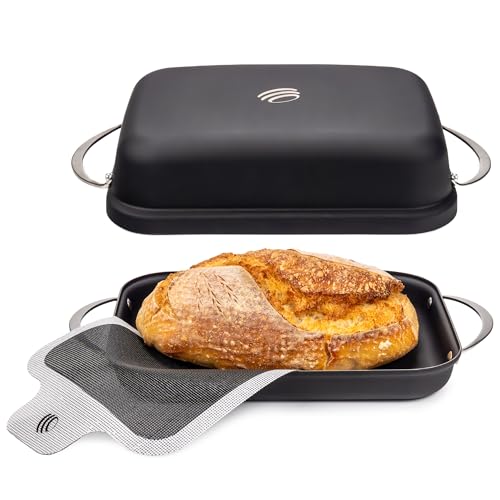
Bulka publishes 8.5 pounds of nitrided carbon steel with an aluminum core, preheating in about 15 minutes rather than the 30 to 45 a cast iron pot takes, and includes a silicone coated sling that lowers the dough in and lifts the loaf out in one motion. That sling is the accessibility feature: no hands go into the pot.
It also publishes 3.7 inches of headroom for the loaf to rise into, an overall figure of 18.7 inches to check against an oven, and a warning that because it heats faster than cast iron it may run hotter than expected, with advice to drop the temperature by about 25 F if bases brown too quickly. Nothing needs seasoning.
Trays, thermometers and a shallow base
LoafNest publishes the most equipment: a stainless wire mesh tray to carry the dough in, a water tray to add steam, a built-in oven thermometer, a top knob handle and full body side handles, across a 9 quart volume split as 4 quarts in the base and 5 in the dome. Its published weight contradicts itself.
The dimension field says 15.0 pounds and its own bullet says a fine tuned 12 pounds, described as heavy enough to retain heat but not heavy enough to be difficult to maneuver. Those cannot both be right, and either way it is the heaviest thing on this page. HAWOK publishes 7.43 pounds of cast iron with a base only 1.8 inches deep, so dough can be laid in rather than dropped.
What Each Approach Costs You
The aluminum trade
A shell that needs no preheating cannot store heat, which is the point of a Dutch oven in the first place. Both aluminum listings answer that the same way: the stone or steel underneath does the storing, and the dome only traps steam. Neither publishes a wall thickness, so how much heat the dome holds is not in the data.
What they publish instead is the whole argument for an accessible kitchen: 1 pound and 1.93 pounds against 7.43, 8.5 and at least 12, with one handed lifting, fast cooling and a wipe instead of a scrub. For a baker with any wrist or grip limitation, those are the figures that decide the purchase.
What cast iron and steel give back
HAWOK publishes a ridged cast iron base that browns the loaf underneath and can be used on its own for grilling, and a tight domed lid 4.6 inches high that traps and circulates steam. Bulka publishes even heat from an aluminum core and a patina that develops without seasoning. LoafNest publishes control: a thermometer and a water tray.
None of those three publishes a maximum temperature, a cooling time or a washing routine, which is a real gap on vessels this heavy. Between the aluminum shells and the heavy pots, the aluminum listings are the better documented ones, which is not usually how this category goes.
Which One Fits Your Kitchen
The baker who should not lift anything hot. Brod & Taylor publishes a 1 pound aluminum shell needing no preheating, rated to 550 F, cleaned with a wipe, measuring 12.5 by 8 by 5.5 inches, that doubles as a countertop bread cover between bakes.
The baker making round loaves. LemonRoad publishes a 6 quart anodized aluminum dome at 1.93 pounds, no preheating, 550 F, fitting most 10 to 12 inch boules, stated liftable with one hand while hot and cooling in minutes.
The baker who wants a real pot without the weight. Bulka publishes 8.5 pounds of nitrided carbon steel preheating in about 15 minutes, with a silicone sling included, 3.7 inches of headroom and nothing to season or reseason.
The baker who wants control over the bake. LoafNest publishes a 9 quart enameled steel baker with a wire mesh dough tray, a water tray for steam, a built-in oven thermometer and handles at the top and both sides. Check the weight before buying, because the listing gives two.
The baker who wants cast iron browning. HAWOK publishes 7.43 pounds of pre-seasoned cast iron, 7.87 inches across and 6.3 inches tall, with a base only 1.8 inches deep so dough is laid in rather than dropped, and a 4.6 inch dome that traps steam.
What We Could Not Verify
All the figures above come from these makers’ own listings. Here is what they leave out.
- No maximum temperature from three of the five.
- No cleaning instruction from two of the five, both of them heavy vessels.
- No agreement on the weight of one of the five, whose field and text differ.
- No wall thickness from any of the five, aluminum or cast iron.
- No cooling time from three of the five.
- No dough weight from any of them, only volumes and diameters.