How the Five Compare on the Numbers
A weekend bake is usually a bigger loaf, or two smaller ones, so the first question is how much room there is under the lid. Three of these five publish a capacity: Sweejar states 5 quarts, Eurita states 2 quarts, and HAWOK’s title states 0.65 quarts, a figure this page sets aside below. The other two publish dimensions only, which means measuring a dough ball against a diameter and guessing at the rest.
The dimensions themselves split the group into shapes rather than sizes. Goodview publishes 15.3 by 5.9 by 7 inches, which is a long narrow baker for a batard. HAWOK publishes 7.87 inches across and 6.3 inches tall, a small round. Flavehc publishes 9.8 inches, Sweejar 13.19 by 10.24 by 7.1 inches including the lid, and Eurita 11.75 by 6.37 by 5.25 inches.
The two lightest picks are also the two made of unglazed clay or stoneware, at 3 and 4.4 pounds, against 7.43 to 8.09 pounds for the cast iron and ceramic ones. That is not a quality ranking, it is a materials fact, and it changes what a full dish feels like coming out of an oven twice in a morning.
How Much Bread Fits
The two volumes worth planning against
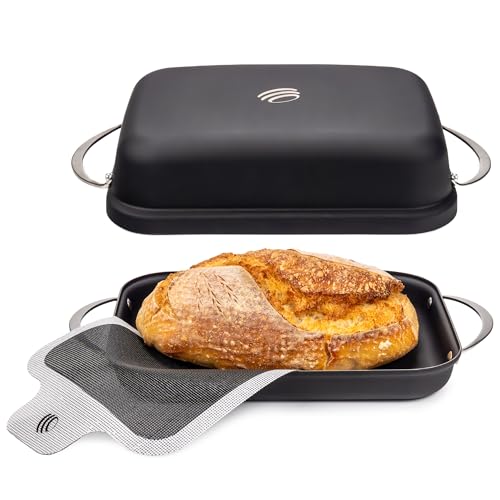
Sweejar publishes 5 quarts and states the figure covers a dish measuring 13.19 by 10.24 by 7.1 inches including the lid, describing it as enough for multiple servings of sourdough. It is also the only pick here that says the dough can be fermented directly in the dish, which removes the transfer step that beginners and weekend bakers both dread.
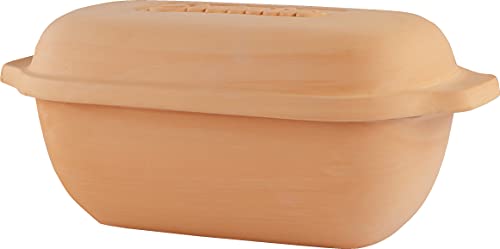
Eurita publishes 2 quarts, the other end of the scale, in a clay roaster it describes for breads and loaves as well as small dishes of chicken or pork. Two quarts is a single modest loaf. Its listing also notes that seven different models exist, so the 2 quart figure is a choice rather than a limit of the range.
The three measured by shape
Goodview publishes 15.3 by 5.9 by 7 inches and calls it a square covered baker for professional Italian bread, with the unglazed interior pulling moisture from the dough for a crackly crust. That long narrow footprint is a batard shape rather than a boule shape, which is a real difference on a weekend when you may want one of each.
HAWOK publishes the most complete set of figures of any pick here: 7.87 inches across, a total height of 6.3 inches, a dome lid 4.6 inches high and a base 1.8 inches deep. Its title also states 0.65 quarts, a figure those dimensions do not support. Flavehc publishes 9.8 inches across with field figures of 12.76 by 12.76 by 5.85 inches, which include its handles.
What Each Material Asks of You
Clay and stoneware
Eurita publishes the most specific instruction in this group and it is one nothing else here requires: the unglazed lid is soaked before use, and during cooking the water evaporates to create a blanket of steam. The listing adds that the lid is crafted to let some steam escape and is therefore not tightly fitted, which is the opposite of what every cast iron cloche claims.
Goodview publishes an unglazed interior that pulls moisture from the dough, and a fragility notice: the product is stoneware and the maker says it does its best to protect it in shipping. Both of these are porous materials that behave differently from metal, and both are published as dishwasher cleanable, which for unglazed clay is worth reading twice.
Cast iron, enameled and seasoned
Flavehc publishes enameled cast iron with a matte black interior enamel, a shallow base, a tight fitting dome lid, use on gas, electric, ceramic and induction cooktops, and the oven up to 500 degrees F. Its care instruction is the strictest here: hand washing with warm soapy water and a nylon brush, with a warning that metal tools may leave scratches.
HAWOK publishes pre-seasoned cast iron with no enamel, a shallow base with raised ridges for even browning that also mark the loaf, and a domed lid with a large bow on top. It publishes no cleaning guidance at all, which on a seasoned surface means the usual rules apply: no detergent, dry it immediately, oil it occasionally.
Steam, Which Is the Whole Point
Trapping against generating
Four of these five trap the steam the dough releases. Sweejar describes an airtight dome lid that heats the bread evenly and makes the crust crisp. Flavehc describes a tight fitting dome that adequately traps steam. HAWOK describes a domed lid designed to trap and circulate steam for a crisp crust and maximum rise. Goodview relies on the unglazed interior drawing moisture instead.
Eurita is the exception and it adds steam rather than trapping it, from the water soaked into the lid. That is a genuinely different mechanism and it explains the loose fitting lid: a dish that is generating steam has to let some go. For a weekend baker experimenting, it is the most interesting of the five and the one with an extra step in every bake.
What the base does
Two listings publish a shallow base and both explain why. Flavehc says the shallow base makes it easy to place the dough, and HAWOK says a shallow base lets you transfer dough without degassing it, publishing the depth at 1.8 inches. On a weekend with several loaves that is the difference between a clean transfer and a deflated one each time.
Eurita publishes the opposite arrangement, a glazed bottom section with a glass frit lining for easy cleaning, which means the base is smooth rather than porous. Goodview and Sweejar publish no base detail at all, so how deep the dough sits in either of them is not something their listings answer.
Which One Fits Your Kitchen
The baker making two loaves a weekend. Sweejar publishes 5 quarts in a 13.19 by 10.24 by 7.1 inch dish and is the only pick that states dough can be fermented directly in it. At 8.09 pounds it is the heaviest here, and it is dishwasher safe.
The baker shaping batards. Goodview publishes 15.3 by 5.9 by 7 inches of unglazed stoneware at 4.4 pounds, with an interior that pulls moisture from the dough. It is long rather than round, and the listing warns that stoneware is fragile in transit.
The baker who wants cast iron with a coating. Flavehc publishes a 9.8 inch enameled cast iron oven at 7.94 pounds with a shallow base and a tight lid, usable on four named hob types and rated to 500 degrees F in the oven. Hand wash it with a nylon brush and keep metal tools away from the enamel.
The baker who wants bare iron. HAWOK publishes 7.87 inches across, 6.3 inches tall, a 4.6 inch dome and a 1.8 inch base with raised ridges, pre-seasoned, at 7.43 pounds. Its title also states 0.65 quarts, which those dimensions do not support, and it publishes more detail than any other pick here.
The baker who wants to add steam. Eurita publishes 2 quarts of natural clay at 3 pounds, the least weight of the five, with a lid that is soaked before use to generate steam and a glazed base for cleaning. It is rated to 500 degrees F and hand washed.
What We Could Not Verify
All the figures above come from these makers’ published text. Here is what is missing.
- No capacity from two of the five, and a 0.65 quart title figure from a third that its own 7.87 inch dish does not support.
- No temperature figure from three of the five, and no minimum temperature from any of them.
- No dough weight or flour quantity from any of the five.
- No cleaning guidance at all from one of the five, on a seasoned cast iron surface.
- No base depth from three of the five, so how far the dough sits down is unknown.
- No soaking time for the one lid that has to be soaked before every bake.