How the Five Compare on the Numbers
A container bought for a lunch bag ends up living in the fridge. That changes which specifications matter: what sizes are in the set, whether it can be reheated, and whether the published figures describe the container or the box it shipped in. Thirteen listings sit on this fact sheet and the five below are all stainless steel with silicone lids, because that is the group that gets used at home rather than only carried out of it.
They are not the same proposition. One is six small pots of a single size. One is a graduated set of five running from 3 oz to 32 oz. One is three containers meant to stack into each other. Two are four compartment trays. Four publish a weight, from 0.38 lb to 2.5 lb, and one publishes no figure of any kind beyond a package size.
The row that would decide a fridge shelf is missing on four of five. Only two listings publish the size of a container in words and only one publishes a dimension field, so on three of these five the sole measurement is a carton. Nobody publishes a steel gauge either, which on a stainless pot is what separates one that dents from one that does not.
The Capacity Ladder
Five Sizes From Three Ounces to Thirty Two
Everusely publishes the widest ladder here: five containers at 32, 21, 13, 6 and 3 oz, given also as 950, 650, 400, 200 and 100 ml. For daily kitchen use that is the useful shape of a set, because the 3 oz pot takes a dressing and the 32 oz takes a whole meal, and both are the same material with the same silicone lid.
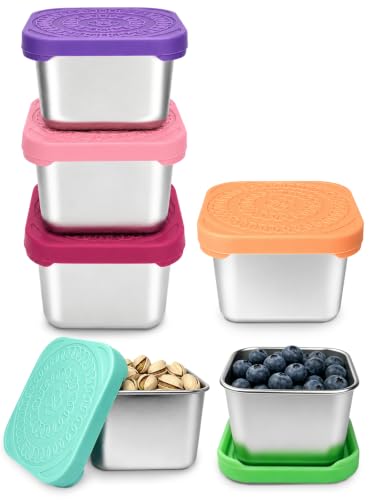
HTEVW goes the other way with six identical pots at 6 oz each, published as 3 4 of a cup and 180 ml, which suits a household packing the same snack repeatedly rather than one storing different things. Tanjiae sits between the two with a 25 oz container and two of 8 oz, and states the small ones nest inside the large one when empty.
One Set Publishes No Capacity at All
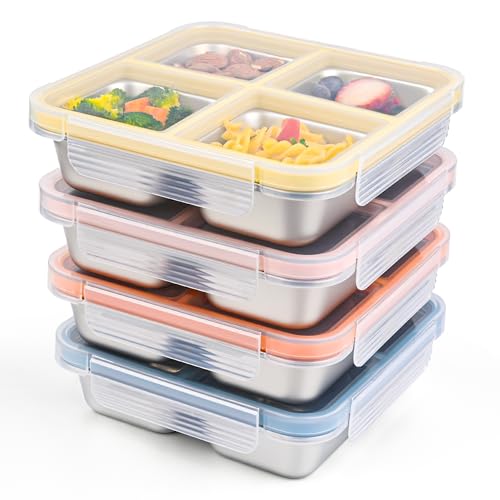
BGMAABQ describes a four compartment stainless bento box across five bullets and never says how much it holds. No ounces, no milliliters, no cup figure, and no weight either. The only measurement in the listing is a package size of 5.9 by 5.9 by 1.69 inches, which is a carton and not a specification you can plan a shelf or a lunch around.
KEABOX is the same shape of product and does publish the figure, at 3 cups or 720 ml per container across four containers, plus a published weight of 2.5 lb for the set. It is the heaviest of these five by a clear margin, which for four compartment steel trays is what you would expect, and it is the only listing here that names a testing standard.
Heat, and What the Listings Will Commit To
One Set Says Oven
Tanjiae publishes the broadest heat claim on this page, stating that the containers are dishwasher, freezer and oven safe. For a container used at home rather than only carried out that is the claim that matters, because it turns a lunch box into something you can put leftovers into and reheat properly.
HTEVW states dishwasher and freezer and stops short of an oven. Everusely and BGMAABQ state dishwasher only. KEABOX, the one listing here that names third party testing, publishes no dishwasher, freezer or oven statement at all, describing its containers as easy to carry and store and leaving the washing method entirely unstated.
A Title That Says Microwavable
The Everusely listing opens with the word microwavable in its own title and then never mentions a microwave again. Across five bullets it states premium grade stainless steel and food grade silicone with no plastics, five capacities, dishwasher safety, stackability and a leakproof seal. Not one of them supports the claim in the title.
Stainless steel is the one material in this group that a microwave manual will tell you to keep out, so the gap between that title and those bullets is the single most important thing on this fact sheet. This page treats the bullets as the listing and the title claim as unsupported, and no comparison here rests on it.
Where the Published Figures Describe the Box
A Carton Too Small for Its Contents
Everusely publishes a package size of 2.17 by 2.17 by 0.98 inches. Its own largest container is stated at 32 oz, which is nearly a quart, and a quart does not fit in a box roughly two inches square and under an inch deep. That figure describes something other than this set, so it is reported as published and used for nothing.
The other carton figures are more believable. KEABOX publishes 6.6 by 6.6 by 1.8 inches for four trays and BGMAABQ 5.9 by 5.9 by 1.69 inches, both consistent with flat stacked four compartment boxes. HTEVW publishes 3.15 by 3.15 by 2.0 inches, which is close to the 2.95 inch pot its own bullet describes.
Two Listings Measure the Container Itself
HTEVW states 2.95 by 2.95 by 1.97 inches per pot alongside its 6 oz capacity, which makes it the easiest set here to check against a fridge door shelf. Tanjiae goes further and publishes two sizes, 6.3 by 4.5 by 2.1 inches for the 25 oz container and 3.8 by 2.9 by 1.9 inches for each 8 oz one, and then describes what those sizes mean.
That description is worth quoting as a practice worth copying: the large container is compared to about two cans of soda and the small ones to a tennis or baseball. It is the only listing in the pool that translates a capacity into something a reader already owns, and it costs the maker nothing to do it.
Which One Fits Your Kitchen
Leftovers you intend to reheat. Tanjiae, a published 0.77 lb for a 25 oz container of a stated 6.3 by 4.5 by 2.1 inches and two of 8 oz at 3.8 by 2.9 by 1.9 inches, in 304 stainless with leak proof silicone lids, stated dishwasher, freezer and oven safe.
Every size a fridge needs. Everusely, a published 1.0 lb for five stainless containers at 32, 21, 13, 6 and 3 oz with food grade silicone lids and no plastics, stated dishwasher safe, stackable and leakproof. Its microwave claim appears only in the title.
The same snack six times over. HTEVW, a published 0.38 lb for six pots of 6 oz, each stated at 2.95 by 2.95 by 1.97 inches, in 18/8 stainless with flexible silicone lids a child can open, stated dishwasher and freezer safe and stackable.
Keeping four foods apart. KEABOX, a published 2.5 lb for four four compartment trays of 3 cups each, in 304 stainless steel stated as SGS tested and ISO 22000 certified, with transparent silicone sealed lids that show the contents.
A plain four compartment box. BGMAABQ, four stainless four compartment bento boxes with tight fitting leakproof lids, stated to resist stains, odors and rust and to be dishwasher safe. It publishes no capacity, no weight and no size.
What We Could Not Verify
Every figure above comes from the maker’s own listing text. These are the things we went looking for and could not source in any of them.
- The Everusely title claims the containers are microwavable and none of its five bullets mentions a microwave at all.
- Everusely also publishes a package size roughly two inches square for a set containing a stated 32 oz container.
- BGMAABQ publishes no capacity, no weight and no container size, only a carton figure.
- KEABOX publishes no dishwasher, freezer or oven statement despite naming two testing standards.
- No listing publishes a steel gauge, so which of these dents and which does not is unstated.
- Only two of the five publish the size of a container, so on three of them a fridge shelf cannot be checked.