How the Five Compare on the Numbers
Twenty six manual grinders sit on this fact sheet and only a handful publish how many beans the hopper holds. These five do, and the figures run from 20 g to 80 g. That is the whole question for a station that grinds for more than one cup: whether the maker commits to a bean weight at all, and whether the number it gives counts beans going in or grounds coming out.
Two of the five publish 80 g. One of those, BOMANSI BOMS, also gives the same figure as 2.8 oz, which is the only capacity here stated in two units. CEVING publishes 60 g and builds its product name around it. HAMILADUO publishes a 20 g bean hopper. VEVOK CHEF is the only listing that separates the two capacities a grinder actually has.
What the table cannot settle is how much brewed coffee any of these figures make. Only VEVOK CHEF turns a bean weight into cups, and it does so for the smallest hopper on the page. The two 80 g listings say nothing about cups, nothing about a brew method ratio and nothing about how full the catch jar is when the hopper is empty.
What a Published Capacity Is Counting
Beans Going In, Grounds Coming Out
A hand grinder has two volumes and most listings publish one of them without saying which. VEVOK CHEF publishes both. Its glass container holds about 48 g of coffee powder, and its hopper fills with approximately 15 to 20 g of beans, which it says makes one to two cups. Those are different numbers for the same grinder, and the larger one is the jar.
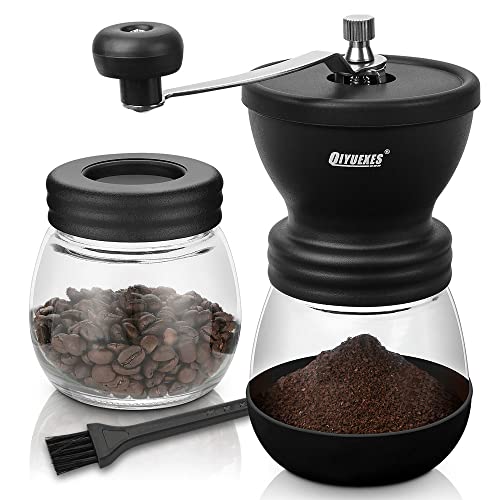
That matters when the other four are read side by side. QIYUEXES says grind up to 80 g of coffee beans at once, so its figure is beans. BOMANSI BOMS says its container can hold 2.8 oz or 80 g of coffee bean, so its figure is beans in a container. CEVING says 60 g capacity and calls it a bean figure too. None of them states what the catch jar holds once those beans are ground.
Eighty Grams, Published Twice
QIYUEXES and BOMANSI BOMS arrive at the same 80 g from different directions. QIYUEXES puts it in the product name, repeats it in a bullet as 80 g of coffee beans at once, and ships two Mason jars and a brush with the grinder. BOMANSI BOMS states a max capacity of 2.8 oz or 80 g and is the only listing here to give a capacity in ounces as well as grams.
The bodies around those identical figures are not identical. QIYUEXES publishes 2.95 by 2.95 by 7.28 inches in its own words and its dimension fields agree with that exactly, a rare thing on this fact sheet. BOMANSI BOMS publishes no size in its own words at all, leaving fields of 3.35 by 5.9 by 8.4 inches as the only description of a body holding the same weight of beans.
Cups, Clicks and Claims of Twice
One Listing Counts Cups
For a station that grinds for several people, the figure a buyer wants is cups, and exactly one of these five gives it. VEVOK CHEF says its hopper takes about 15 to 20 g of beans and makes one to two cups in a single grind, and that it takes about 45 seconds. It is the only grind time and the only cup count anywhere in this pool.
Read against the 80 g pair, that single conversion is the most useful sentence on the page and also the reason the bigger numbers stay abstract. Nothing in the QIYUEXES, BOMANSI BOMS, CEVING or HAMILADUO listings says how many cups their capacity yields, how long a full hopper takes to work through, or what brew method the figure assumes.
Twice the Beans of What
CEVING publishes 60 g and describes it as the world’s first manual grinder with a 60 g capacity, holding twice the beans of the standard grinders. The comparison is to an unnamed standard, and the same brand’s other listing on this fact sheet publishes 30 g, so the claim is at least consistent inside CEVING’s own catalog. It is still a claim about products it does not name.
What CEVING does publish, and nobody else on this page does, is the size of one adjustment step: each click on its external ring moves 0.05 mm, across 40 settings. QIYUEXES publishes 48 settings with no step size, BOMANSI BOMS 8 coarseness grades, VEVOK CHEF 6 settings with a brew method named for each, and HAMILADUO a knob with reference values and no count at all.
Where the Weight Figures Disagree
Grams in a Bullet, Pounds in a Field
Three of these five publish their weight in grams inside a feature bullet: 425 g for QIYUEXES, 416 g for CEVING and 600 g for HAMILADUO. Their weight fields read 0.69 lb, 1.1 lb and 1.3 lb. Only HAMILADUO’s two figures describe the same object. On QIYUEXES the field is the lighter of its two statements and on CEVING the field is the heavier, so a buyer comparing across units is comparing noise.
VEVOK CHEF avoids the problem by publishing pounds in its own words, 0.99 lb, which matches its field. BOMANSI BOMS avoids it by publishing no weight in words at all, leaving 1.27 lb as its only figure. This page did not convert any gram figure into pounds, because a conversion I perform is not a specification the maker published, and two of these listings would contradict it.
Weight Is Not the Deciding Number Here
By the published fields, QIYUEXES is the lightest of these five at 0.69 lb and HAMILADUO the heaviest at 1.3 lb. On a station that stays on the counter, that spread decides very little. It matters for the grinding itself: HAMILADUO publishes an aluminum alloy body and a dual bearing central shaft, and BOMANSI BOMS at 1.27 lb pairs its weight with a built in bearing for an easier handle twist.
What none of the five publishes is how hard a full hopper is to turn. There is no stated crank force, no stated number of turns for a full load and, apart from the VEVOK CHEF 45 second figure, no time at all. A station grinding 80 g by hand is a different task from grinding 20 g, and not one of these listings measures it.
Which One Fits Your Kitchen
Grinding for a full pot. QIYUEXES, which publishes 80 g of beans at once, 48 adjustable settings and a ceramic conical burr, in a body it states at 2.95 by 2.95 by 7.28 inches, with two Mason jars and a brush in the box and a 0.69 lb weight field.
A capacity in two units. BOMANSI BOMS, the only listing here to publish its maximum as 2.8 oz and 80 g, with a ceramic conical burr, 8 coarseness grades set by turning the grinding bottle, a built in bearing and a 1.27 lb weight field.
Fine control over the grind. CEVING, which publishes 60 g of capacity, 40 external click settings and 0.05 mm of movement per click, with CNC steel burrs, a stated 416 g in its bullet and a body it gives as 2.7 by 7.8 by 5.3 inches.
Knowing what a grind yields. VEVOK CHEF, the only one of the five to publish both volumes, about 48 g of powder in the glass container and approximately 15 to 20 g of beans in the hopper for one to two cups, in about 45 seconds, at 0.99 lb.
One espresso dose at a time. HAMILADUO, with a 20 g bean hopper, a hexagonal stainless steel conical burr at 55 to 58 HRC, an aluminum alloy body, a dual bearing shaft, a stated 600 g in its bullet and a 1.3 lb weight field.
What We Could Not Verify
Every figure above is quoted from the maker’s own listing text. These are the things a family station would want to know that no listing here answers.
- Only VEVOK CHEF converts a bean weight into cups, and it does so for the smallest hopper of the five.
- No listing states what the catch jar holds after a full hopper has been ground.
- QIYUEXES and CEVING publish a gram weight in a bullet and a pound weight in a field, and the two do not agree.
- BOMANSI BOMS and HAMILADUO publish no size in their own words, only dimension fields.
- Only CEVING publishes how far one click moves the burr, so 48 settings and 40 settings cannot be compared.
- No listing publishes how long a full hopper takes to grind, apart from the VEVOK CHEF figure of about 45 seconds.