How the Five Compare on the Numbers
A kitchen short of sockets has two questions about a coffee grinder: does it need one at all, and if it does, how much is it drawing while it runs. Both are answerable here. One of these five is hand cranked and names a power outage in its own listing. The other four publish a wattage, and they run from 150 W up to 180 W.
Beyond that the published detail thins out fast. Only one listing states a voltage and a frequency. Only one states a motor speed. Only one states how long the motor may run before it needs a rest. The table sets the power figures first, then the bean charge, the adjustment method and the dimension fields, and flags the one weight on this page that cannot be the product.
What the table cannot tell you is what any of these actually consumes in a working morning. A wattage is a rating, not a measurement of a thirty second grind, and none of these listings publishes a duty cycle you could multiply it by except Aromvel. Nor does any of the four electric grinders say what kind of plug arrives, which matters if the socket you have is already behind a kettle.
The One That Needs No Socket
A Hand Crank on a Mason Jar
ByteX is the only listing in this pool built to work with the power off, and it says so: the maker names camping, traveling and experiencing a power outage as the situations it is for. It is a lid attachment rather than a machine, stated to fit all regular mouth mason jars, with a ceramic burr mechanism turned by a crank and a body of stainless steel the maker describes as rust proof.
Its adjustment is mechanical and the listing spells it out: remove the gold nut, the handle and the round piece beneath it, then rotate the gear-shaped piece up or down a threaded rod to move the grinder pieces closer together or further apart. That is more detail about grind setting than any of the four electric grinders here publishes, and it needs nothing from the wall.
What You Give Up Without a Motor
ByteX publishes no bean charge, which on a mason jar grinder is arguably the jar’s business rather than the lid’s, but it does mean there is no figure to compare with the four motorised picks. It also publishes no dishwasher claim. Its cleaning instruction is unusual and specific: grind uncooked white rice through the burrs to clear residual grounds and odours.
The published fields read 2.95 by 3.74 by 4.13 inches at 0.49 pounds, which is consistent with a lid and a crank rather than a grinder. It is the smallest set of figures on this page and the only pick whose size describes a part of an assembly. The jar it screws onto is not measured anywhere in the listing.
What the Four Electric Grinders Draw
180 W Down to 150 W
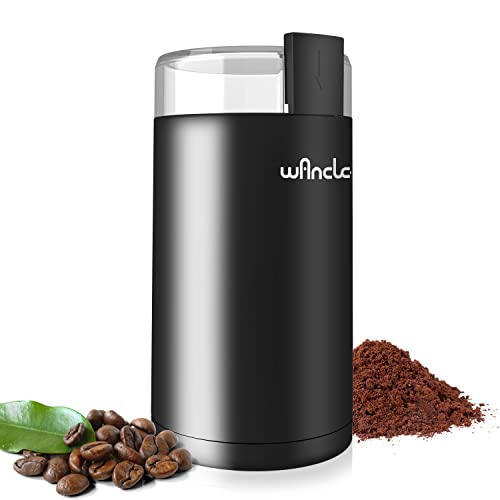
Aromvel publishes the highest figure at 180 W and is the only pick that pairs it with a rotation speed, stating 30,000 RPM. KRUPS publishes 175 W in its own product title. Wancle publishes 150 Watts and AROMA also publishes 150 W. The spread across four grinders is 30 W, which on a shared circuit is not the difference between working and tripping.
Wancle is the only listing that publishes what the socket has to supply, stating a voltage and frequency of 120 VAC and 60 HZ alongside its 150 Watt rating. None of the other three states either. For a reader working out what else can be plugged into the same strip, that is the one line on this page that answers the question directly.
How Long the Motor Is Meant to Run
Aromvel is the only electric pick that publishes a limit, asking you not to run the motor continuously for more than 40 seconds, and it gives grind times by brew style so the number means something: coarse at 12 to 15 seconds, medium at 20 to 25, fine at 35 to 40. A 180 W motor held for 40 seconds is a very different load from one held for four minutes.
KRUPS, Wancle and AROMA publish no run limit at all. Wancle describes a one button operation where grinding starts when you press and stops when you release, and AROMA the same with a wooden button on the front. Neither says how long is too long, so on those two the only guide to consumption is the rating itself.
What Else the Listings Commit To
Bean Charges in Three Units
Four of the five publish how much goes in and they do not agree on a unit. Aromvel states 2.3 oz, given also as 65 g, and calls it ideal for 1 to 2 cups. Wancle states up to 60 g. AROMA states 40 g and says that is right for single cups and full pots. KRUPS states a 3 oz bowl and claims a yield of up to 12 cups from it.
So the largest published charge on this page belongs to KRUPS, and it is the only one of the four expressed in ounces without a gram equivalent. ByteX publishes nothing, because the volume belongs to whichever mason jar you screw it onto. Nobody here defines what a cup means, so the yield claims cannot be lined up against the charges.
Noise, Bowls and a Weight That Cannot Be Right
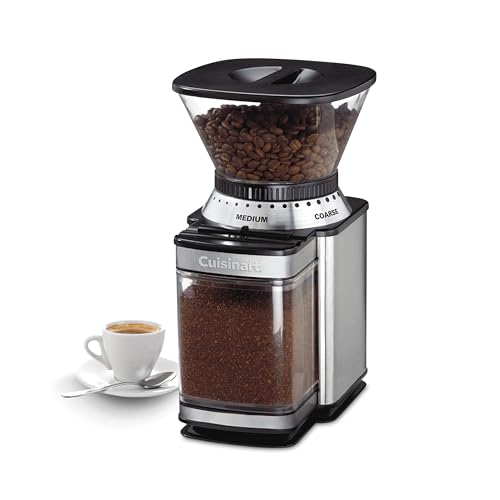
KRUPS is the only pick with a noise claim, stating that its patented Silent Vortex technology grinds 5 times more quietly, and the only one that clears a part for a dishwasher: a removable stainless steel grinding bowl, supplied with a storage lid. It is also the one with real mass behind it, publishing 2.43 pounds, the heaviest of these five.
AROMA’s published weight is the problem figure on this page. Its fields give 4.0 by 4.0 by 8.0 inches and 0.09 pounds, and an object of that size cannot weigh an ounce and a half. The dimensions are plausible for a 40 g grinder with a 150 W motor and the weight is not, so this page quotes the size and discards the mass.
Which One Fits Your Kitchen
The kitchen with no free socket at all. ByteX. It is the only pick that works with the power off, a hand crank on ceramic burrs that screws onto a regular mouth mason jar, and the only listing here that names a power outage.
The reader who wants to know what the socket must supply. Wancle. It is the only pick that publishes a voltage and a frequency, 120 VAC and 60 HZ, next to its 150 Watt rating, and it takes up to 60 g of beans.
The cook who would rather have the fastest motor. Aromvel. It publishes the highest wattage here at 180 W and the only rotation speed, 30,000 RPM, with a 40 second ceiling and grind times for coarse, medium and fine.
The household grinding early without waking anyone. KRUPS. A stated 5 times quieter Silent Vortex on a 175 W motor, with a 3 oz bowl the maker says yields 12 cups and a removable dishwasher-safe bowl.
The smallest electric grinder on the strip. AROMA. It publishes 150 W, a 40 g charge described as right for single cups and full pots, 304 stainless blades and a one-touch wooden button on the front.
What We Could Not Verify
These are the things we went looking for in the published listings and did not find:
- Any voltage or frequency for Aromvel, KRUPS or AROMA, which only Wancle publishes.
- Any run limit for KRUPS, Wancle or AROMA, so their ratings cannot be turned into a load.
- What kind of plug or cord length arrives with any of the four electric grinders.
- Any bean charge for ByteX, whose capacity belongs to the jar it screws onto.
- What a cup means in the KRUPS claim of 12 cups from a 3 oz bowl.
- A believable weight for AROMA, whose field reads 0.09 lb for a body of 4.0 by 4.0 by 8.0 inches.