How the Five Compare on the Numbers
Stated capacity spans more than a factor of two. The AROMA takes 27 pounds, the Xilei 25 pounds across five compartments, the Lenwi 22 to 25 pounds, the Peaoop 22 pounds and the UFORU 13 pounds. Only two makers give a metric figure as well: Peaoop says 5 to 10 kilograms and Xilei says 10 kilograms. None of the five states the grain it used to arrive at a pound figure, and rice, oats and flour do not pack alike.
Empty weights, where they are given, run from 2.56 pounds on the UFORU to 4 pounds on the AROMA, with the Lenwi at 2.89 and the Peaoop at 3.31. Xilei publishes no weight, which matters more for that one than the others because it is the pick designed to hang on a wall. Footprints are the sharpest split: 5.67 inches across for the Xilei against a Peaoop that is 11 inches on every side.
The table cannot tell you the thing a rice dispenser lives or dies on, which is whether the mechanism jams on long grain, on short grain and on brown rice with its rougher hull. Every listing describes a button or a lever and only one of them says how much comes out. Nor does any maker state the opening diameter for refilling, so whether a 20 pound bag pours in cleanly or has to be decanted is unknown for all five.
What One Push Actually Gives You
The Only Published Dose
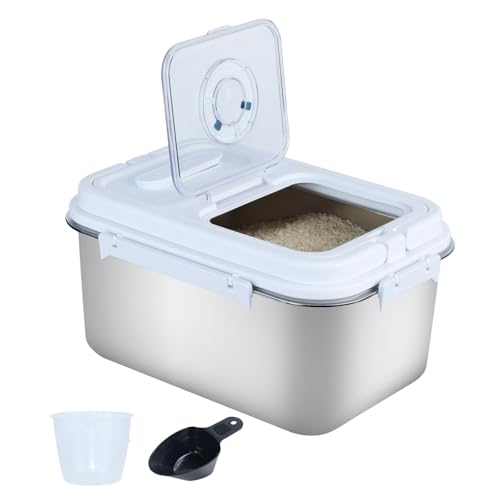
The AROMA is the only dispenser here that puts a number on its own mechanism. Push the lever and it funnels 180 milliliters into a dispensing drawer. That is a fixed dose, which means the container is doing the measuring rather than handing you a cup and hoping. For anyone cooking the same amount of rice most nights, a repeatable dose is the entire argument for buying a dispenser instead of a lidded bin.
It is also the figure that makes the rest of the page comparable. A dose of 180 milliliters is near enough one Japanese rice cup, so two pushes is a normal dinner for two. No other maker on this page states a volume, a stroke length or a flow rate, so there is no way to know whether their one touch delivers a spoonful or a third of a pound without owning one.
One Touch, No Number
Lenwi, Peaoop and UFORU all describe a push button that releases grain without lifting the lid, and all three include a separate measuring vessel: a cup on the Lenwi and the UFORU, a measuring cylinder on the Peaoop. That combination tells you something. If the button dispensed a known quantity, the cup would be redundant, so the cup is there because the button is a tap rather than a measure.
UFORU adds the only mechanical detail any of the four give, an internal sloped slide that its listing credits with a smooth controlled release and no clumps. Xilei describes a funnel you press, and adds a point the others do not, that its design is first in first out so old grain leaves before new grain. That is a claim about layout rather than a figure, but it is the right claim to make about a refillable bin.
Footprint: Column, Cube or Wall
Narrow Columns for a Counter End
The Lenwi is 6.6 inches across and 16.3 inches tall, and the UFORU is 7.09 inches across and 12.4 inches tall. Both are columns that stand at the end of a run of counter or inside a cabinet, and both trade height for width. On a standard counter with wall cabinets above, the useful check is the Lenwi’s 16.3 inch height against the roughly 18 inches of clearance most kitchens have, because the lid has to come off from the top to refill.
The UFORU is the short one at 12.4 inches, and it is also the lightest of the four that publish a weight at 2.56 pounds. Its 13 pound capacity is half of what the others hold, and that is the honest trade: a container you can lift with one hand and stow in a cabinet, refilled more often. For a household of one or two buying five pound bags, the larger picks would hold rice long enough to go stale.
A Cube and a Wall Mount
The Peaoop is published as 11 inches in every direction, which is an unusual set of figures for a rice bin and reads like a rounded package measurement rather than the vessel. Its listing calls the mouth a large caliber with a removable top cover, and a wide mouth is genuinely useful for tipping in a bag, but a container 11 inches front to back eats far more counter depth than the columns do.
The Xilei is the outlier of the five, a five compartment dispenser 5.67 inches across that can lie flat, sit on a table or hang on a wall, with its listing recommending wall mounting. Five grids for 25 pounds in total means roughly 5 pounds a grain, so this is the pick for a kitchen that keeps white rice, brown rice, lentils, oats and sugar rather than one sack of rice.
Keeping Weevils and Damp Out
Insect Boxes and Fresh Boxes
Two of the five build in a compartment for a deterrent. The UFORU calls it an insect box at the top and says to put garlic or star anise in it. Lenwi calls its version a built in fresh box and makes the same argument, that grain stored carefully still attracts damage and moisture. Neither maker claims the box kills anything; both are holders for something aromatic, which is a traditional method rather than a tested one.
The AROMA, Peaoop and Xilei publish no such compartment. They rely on the seal instead, which is a defensible position: an airtight container that was filled with clean grain does not need a deterrent. The risk in every case is the same, that the infestation arrives inside the bag, and no dispenser on this page claims to do anything about that.
What the Seals Actually Claim
AROMA states a sealed lid and a sealed dispenser drawer, which is the more complete claim because the drawer is the second opening on any dispenser and the one people forget. Peaoop puts a sealing ring inside the top cover, Lenwi advertises an extra sealing ring and calls the container dustproof, UFORU states a moisture proof seal, and Xilei says it isolates water vapor and dust.
What none of them publishes is a test, a standard or a number: no moisture transmission rate, no gasket material, no statement about how long a seal stays effective. Two of the five do not even name the plastic. Peaoop and Xilei say PP, Lenwi says BPA free without naming the polymer, and AROMA and UFORU say nothing about material at all on the listings used here.
Which One Fits Your Kitchen
The household that cooks rice most nights. The AROMA is the only pick that dispenses a known dose, 180 milliliters per push into a drawer, holds the largest stated capacity at 27 pounds, and rolls on hidden wheels. It is also the heaviest empty of the four that publish a weight, at 4 pounds.
The cook with a narrow gap beside the counter. The Lenwi is 6.6 inches across, holds a stated 22 to 25 pounds and includes a fresh box for a deterrent. Check the 16.3 inch height against the clearance under your wall cabinets, because the lid lifts off the top.
The one or two person kitchen. The UFORU holds 13 pounds, stands 12.4 inches tall and is the lightest of the four with a published weight at 2.56 pounds. The insect box takes garlic or star anise, and the sloped internal slide is the only release mechanism any maker describes.
The kitchen that stores five different grains. The Xilei has five compartments in a body 5.67 inches deep that mounts on a wall or lies flat, with 25 pounds total across the grids. It publishes no weight, which is worth knowing before you drill into plasterboard.
The cook who refills from big sacks. The Peaoop has a wide mouth with a removable top cover and states 22 pounds, or 5 to 10 kilograms. Its published 11 inch depth is more than the other four claim, so it suits a pantry shelf better than a work surface.
What We Could Not Verify
Four of these five sell a dispensing mechanism and describe it only in adjectives:
- How much grain one push releases on four of the five. Only the AROMA publishes a figure, 180 milliliters.
- Whether any mechanism handles brown rice, whose rougher hull flows differently from polished white rice. No maker mentions grain type.
- The diameter of the refill opening, so whether a large bag pours in without decanting is unknown for all five.
- The plastic used in the AROMA and the UFORU. Neither listing names a polymer, and the Lenwi says only BPA free.
- The empty weight of the Xilei, which is the one pick meant to be fixed to a wall.
- Any seal performance figure. Five different sealing claims appear here and not one is backed by a standard or a rate.