How the Five Compare on the Numbers
A household baking two or three loaves a week needs more starter than one making a single boule, and it usually needs a second jar so one culture can sleep in the fridge while the other works on the counter. Both of those are published figures here: a capacity in ounces, and a count of jars in the box. They split this pool cleanly.
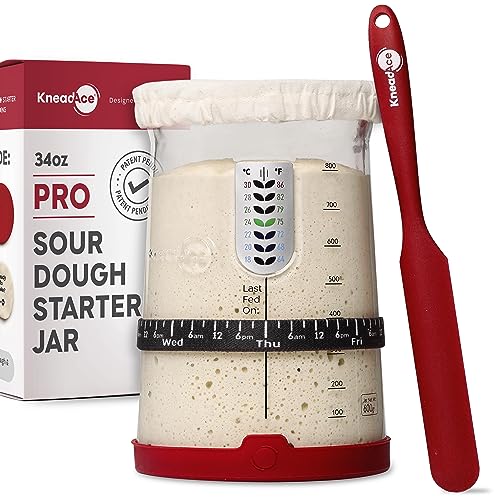
Howasai publishes 50 oz in one jar with a 5 inch mouth. Farielyn-X publishes two complete kits at 40 oz each. Weck publishes two 1 liter tulip jars with glass lids. Mfacoy publishes two jars at 24 oz and states each holds enough starter for 3 loaves. KNEADACE publishes one 34 oz jar with the fullest kit of tools.
What the table cannot tell you is how much starter any of these jars actually holds in use, because a starter doubles and the working volume is roughly half the jar. Only one listing in this pool puts a number on that, and it is not one of these five: a 32 oz jar elsewhere in the pool states it is designed for up to 300 g of fully active starter without overflow.
Capacity, and What a Family Actually Draws Down
Fifty Ounces in One Jar
Howasai publishes 50 oz, the largest single capacity in this pool, and explains it the way a busy kitchen would want: room for the starter to expand without overflow, for maintaining an active culture, larger batches, or several loaves through the week. It publishes 5 inches by 5 inches by 5.9 inches and 1.46 pounds, and states high borosilicate glass with a non slip silicone base.
The 5 inch mouth is the part that matters when several people use the jar. The listing states straight sides and less buildup around the rim than a narrow mouth jar, which is the difference between scraping a jar clean in one pass and picking dried flour paste out of a shoulder. It ships two cotton covers, a bamboo lid, a feeding band and the silicone base.
Twenty Four Ounces, Twice, and Three Loaves
Mfacoy takes the opposite route: two jars at 24 oz each, with the listing stating that one is large enough to provide starter for 3 loaves of bread while not taking up too much space in the fridge. That is the only loaf count published anywhere in this pool, and for a family that bakes on a Saturday it is a more useful sentence than a capacity in ounces.
What it does not publish is any dimension or weight at all, so how the two jars sit in a fridge door or on a shelf is unstated. The kit includes a long handled spatula, a temperature sticker, a feeding indicator strip, a breathable cloth cover and an aluminum lid that the listing states keeps the jar airtight for a week or longer in the refrigerator.
Why a Second Jar Changes the Routine
One on the Counter, One in the Fridge
Farielyn-X is two complete 40 oz kits, and its listing makes the argument directly: keep one starter actively fermenting on the counter while the other rests in the fridge, so there is always a ready to use culture and no downtime. It also suggests maintaining two different starters, rye and wheat, which is the other reason a household ends up wanting a pair.
Each kit is stated to include a wide mouth 40 oz jar with measurement markings, a breathable cloth cover, a thermometer, a flexible spatula and a day marked elastic band, in thermal shock resistant soda lime glass with food grade silicone, all components dishwasher safe. That is a lot of small parts for one purchase, and two of everything to keep track of.
The Weight Figure That Cannot Be Right
The Farielyn-X listing publishes 0.26 pounds, and that figure is discarded on this page. Two 40 oz glass jars plus two silicone lids, two thermometers and two spatulas cannot weigh a quarter of a pound, and the single glass jars in this pool publish 1 pound to 1.98 pounds each. Its size string of 2.9 inches by 4.7 inches is too small for a 40 oz jar as well, so neither figure is used here.
This is worth flagging rather than quietly ignoring, because a weight field is the sort of number a comparison page leans on. A near identical 40 oz kit appears in this pool under another brand, with the same list of contents and the same wording, and it publishes three dimensions of 2 inches each, which is a placeholder rather than a measurement. Neither listing is picked on its published figures.
What the Jars Do When They Are Not Holding Starter
Weck, and a Jar With a Second Life
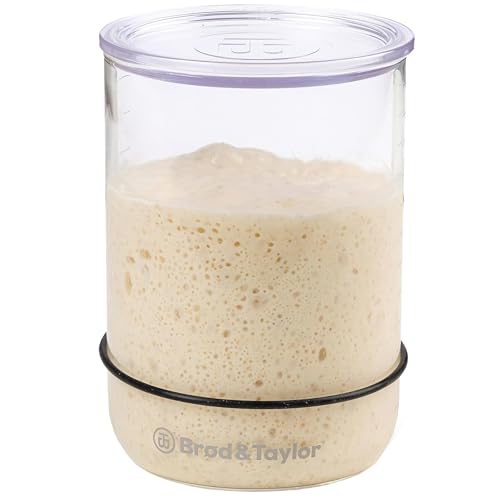
Weck ships two 1 liter tulip jars with glass lids, published at 4.5 inches by 4.5 inches by 7 inches and 1 pound, in glass the listing calls thick and sturdy, and states they suit home canning and food storage as well as a starter. For a family kitchen that is a real argument: the jars do not become useless if the sourdough habit lapses in February.
The trade is that this is a jar rather than a kit. There is no thermometer, no feeding band, no cloth cover and no measurement markings stated anywhere in the listing, so tracking a rise is on you with a rubber band and a marker. A glass lid also seals rather than breathes, which matters during active fermentation.
KNEADACE, and the Fullest Set of Tools
KNEADACE publishes one 34 oz jar at 4.13 inches by 4.13 inches by 6.7 inches and 1.98 pounds, the heaviest of these five, with a funnel shaped opening and a silicone cover that doubles as an anti slip base while the cloth cover is in use. Its marks include volume, net weight and feed lines, which is more marking than anything else here publishes.
It also ships a thermometer, a cloth cover, a spatula, a day marked elastic band, and a video guide with recipes and support. For a household where one person is teaching two others to feed a starter, that is the pick, provided 34 oz is enough. It is a single jar, so the fridge and counter rotation the two jar kits offer is not available.
Which One Fits Your Kitchen
One big active starter. Howasai is 50 oz with a 5 inch mouth, published at 1.46 pounds in high borosilicate glass, with two cloth covers, a bamboo lid, a feeding band and a silicone base. It is the one pick sized for several loaves a week in a single jar.
Two starters, or a rotation. Farielyn-X is two 40 oz kits so one culture can rest in the fridge while the other works. Its published weight and size string cannot be right for two glass jars, so buy it for the pairing rather than the figures.
A Saturday bake and a full fridge. Mfacoy is two 24 oz jars, stated to hold enough starter for 3 loaves each, with an aluminum lid for a week or more in the refrigerator. No dimensions or weight are published at all.
Jars you will use for other things. Weck is two 1 liter tulip jars with glass lids at 4.5 inches by 4.5 inches by 7 inches, stated for canning and storage too. No markings, thermometer or cloth cover are included.
Teaching the household to feed it. KNEADACE is 34 oz with volume, net weight and feed line marks, a thermometer, a cloth cover, a spatula, a band, and a video guide. At 1.98 pounds it is the heaviest here, and it is a single jar.
What We Could Not Verify
These are the figures a household baking several loaves a week would want, and that these listings do not publish.
- Only one listing in the whole pool states a working starter mass, and it is not among these five, so the usable volume of a 50 oz or 40 oz jar is unstated.
- Farielyn-X publishes 0.26 pounds for two glass jars and a size string of 2.9 inches by 4.7 inches, and neither figure can describe the product.
- Mfacoy publishes no dimensions and no weight, so two 24 oz jars cannot be measured against a fridge shelf.
- Weck publishes no measurement markings, no thermometer and no cloth cover, so a rise has to be tracked by hand.
- Only Mfacoy states a loaf count, at 3 loaves, so the other four capacities cannot be converted into bread.
- KNEADACE publishes no glass type, which is the one material question a jar that goes from fridge to counter raises.