How the Five Compare on the Numbers
Most baguette pans in this category are built for four loaves at 15 by 13 inches, and one of these five ships two of those pans for eight loaves at a time. A household baking two or three baguettes on a Saturday needs the opposite, and the published widths show why: a two loaf pan is 6.3 inches across and a three loaf pan 9 or 9.5.
The other figures that separate a small pan from a big one are the channel dimensions and the weight. Only one listing here publishes a channel width and depth, at 2.72 inches by 0.94. Weights run from 0.46 pounds for a two loaf pan to 1 pound for a two pack, and three of the five publish an oven rating of 446 degrees Fahrenheit while two publish nothing at all.
What the table cannot tell you is how long a loaf each channel takes, because only one listing publishes a channel figure at all and none publishes a channel length. Every pan here states 15 or 16 inches on its long side, and the usable dough length is shorter than that by however much the end of the channel curves up, which nobody states.
Two Loaves, and the Two Pans That Do It
Fifteen Inches by Six and a Third
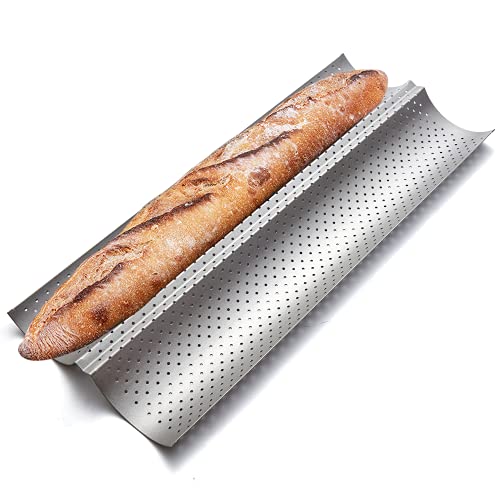
KITESSENSU publishes 15 by 6.3 inches in its title with fields of 15 by 6 by 0.91 inches and 0.46 pounds, which is the lightest pan in this shortlist. Its listing is the only one here that argues the small batch case directly, saying you can make French bread whether your oven is big or small, and that the pan replaces proofing baskets, cloth and parchment.
Yupjlia publishes the same 15 by 6.3 inches with fields of 6.3 by 15 by 0.94 inches and 0.59 pounds. The two pans are as close as two listings get, and the differences are in what each maker chooses to publish: KITESSENSU states a 10 year warranty and no material at all, Yupjlia states thickened carbon steel, BPA free food grade materials and 446 degrees Fahrenheit.
Which of the Two to Take
On published specification Yupjlia is the better documented pan, because a material and a temperature rating are facts you can act on and a warranty is a promise. KITESSENSU publishes 0.46 pounds against 0.59 for Yupjlia, a 0.13 pound gap, and states curved grooves that shape the base of the loaf into an arc, plus pores distributed evenly across the whole pan rather than only along the base.
Neither publishes a channel width, which for a two loaf pan is the figure that decides whether you get a baguette or a ciabatta. Neither publishes a cleaning instruction in KITESSENSU’s case, and Yupjlia recommends hand washing. If you bake two loaves and want the specification, take Yupjlia. If you want the guarantee, take KITESSENSU.
Three Loaves, and Two Different Metals
Carbon Steel at 446 Degrees
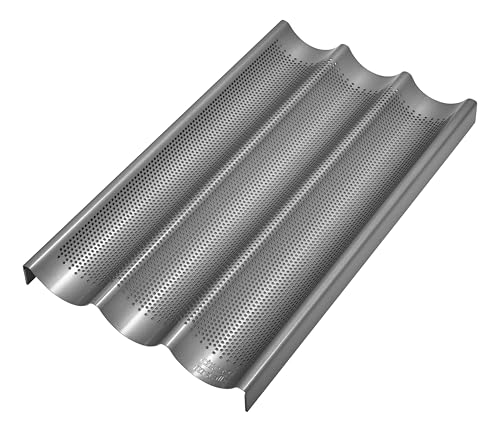
Gicyiit publishes 15 by 9.5 inches with fields of 9.5 by 15 by 0.98 inches and 0.8 pounds, in thickened carbon steel rated to 446 degrees Fahrenheit, with perforations along the base, a BPA free nonstick coating and hand washing recommended. Its own listing argues that a 3 slot design fits most home ovens better than a wider pan, which is the small batch argument stated plainly.
Three loaves on a 9.5 inch pan is the most useful compromise on this page: more bread than a two loaf pan and a footprint that still turns in a domestic oven. The 446 degree figure is worth noting because baguettes are usually baked hotter than that, and this pan and two others on this page publish the same ceiling.
Aluminum, Dishwasher Safe, and a Height That Disagrees
Chicago Metallic is the outlier and the most interesting pan here. It is heavy weight aluminum rather than carbon steel, with a two layer nonstick coating, and it is the only pan on this page stated dishwasher safe, though the listing recommends hand washing to preserve the coating. It publishes three loaf channels and 0.86 pounds.
Its size statements do not agree: the title and a bullet both state 16 by 9 by 1.5 inches, and the dimension field reads 1 inch for the height. Where a field and the maker’s own sentence conflict this page uses the sentence, so treat it as 1.5 inches, which is more than any other height figure on this page, and it is one of the two pans here publishing no oven temperature at all.
When a Four Loaf Pan Still Makes Sense
One Pan Now, Two When You Need Them
Kbiykuy is a two pack of 4 slot trays, and its listing is the only one on this page that writes the small batch instruction itself: use one pan for a smaller bake, or both when you need more for family meals, parties or weekly bread prep. That is a genuinely different purchase from a single large pan, because the second tray stays in the cupboard most weeks.
It is also the only listing that publishes channel dimensions, stating each of the four rounded grooves is about 2.72 inches wide and 0.94 inches deep, and that the grooves support dough during proofing as well as baking. Carbon steel with a PFOA free nonstick coating, oven safe to 446 degrees Fahrenheit, at 15 by 13 inches per tray.
The Weight Figure to Ignore
Its published weight of 1 pound is discarded here. A single three loaf pan on this page weighs 0.8 pounds for Gicyiit and 0.86 pounds for Chicago Metallic, and a 15 by 13 inch four slot tray is a bigger object than either, so 1 pound for two of them cannot be right. The figure is reported and nothing on this page rests on it.
The wider point for a small batch baker is that 15 by 13 inches is a large pan. None of these five states the oven capacity it needs, so there is no published figure to check a tray against, and the 15 by 6.3 inch and 15 by 9.5 inch pans are the ones that will turn in a small oven. That is the reason the two and three loaf pans lead this page.
Which One Fits Your Kitchen
You bake two loaves and want the figures. Yupjlia publishes 15 by 6.3 inches, fields of 6.3 by 15 by 0.94, 0.59 pounds, thickened carbon steel, 446 degrees Fahrenheit and hand washing. It is the best documented small pan here.
You want a guarantee instead. KITESSENSU publishes 15 by 6.3 inches, 0.46 pounds and a 10 year warranty, with curved grooves that arc the base of the loaf. It names no material, no temperature and no cleaning method.
Three loaves in a normal oven. Gicyiit publishes 15 by 9.5 inches and 0.8 pounds in thickened carbon steel to 446 degrees Fahrenheit, and states that a 3 slot pan fits most home ovens better than a wider one.
You put your bakeware in the machine. Chicago Metallic is heavy weight aluminum with a dual nonstick coating and the only dishwasher claim here, at 0.86 pounds. Its stated 16 by 9 by 1.5 inches conflicts with a 1 inch height field.
Sometimes two loaves, sometimes eight. Kbiykuy ships two 4 slot trays at 15 by 13 inches with channels stated at 2.72 inches wide and 0.94 deep, to 446 degrees Fahrenheit. Its 1 pound weight for two trays is not credible.
What We Could Not Verify
These are the figures a small batch baker needs, and that these listings do not publish.
- Only one of the five publishes a channel width or depth, so the loaf shape the other four produce is unstated.
- No listing publishes a channel length, so how much of a 15 inch pan is usable dough length is unknown.
- KITESSENSU publishes no material, no oven temperature and no cleaning instruction.
- Chicago Metallic states 16 by 9 by 1.5 inches in its title and a bullet against a 1 inch height field, and publishes no oven temperature.
- Kbiykuy publishes 1 pound for two 15 by 13 inch trays, when a single three loaf pan here publishes 0.86 pounds.
- Not one of the five publishes the oven capacity it needs, so pan to oven fit is guesswork.