How the Five Compare on the Numbers
A shallow cabinet punishes the long handle and rewards anything that hangs, nests or lies flat. Forty six listings sit in this pool and most of them publish three dimension fields and nothing about storage. These five all say something about where the tool goes when it is not in use, and that is the specification this page is built on.
Three publish a hanging loop, in three different words. One publishes a nesting ring that gathers four scoops into a single object. One publishes only a flat silicone body with a 1.0 in field to its name. The capacity figures are barely comparable: one cup on one, 3 oz each on another, 18 oz on a third, and cup fractions on the set.
What the table cannot tell you is which published figure is the one that has to clear the shelf. RSVP International names its three: 11.5 in by 3.75 in by 2 in, in that order, and its fields repeat them. Every other listing here leaves a buyer to guess whether its largest number is a handle, a bowl or a carton, and two of the five publish no third figure at all.
What Each Maker Says About Putting It Away
Three Loops, Described Three Ways
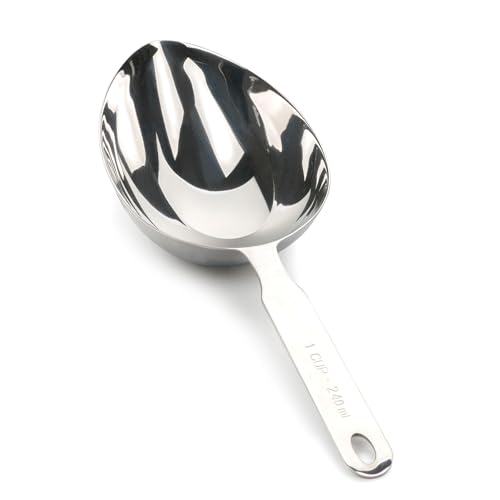
RSVP International publishes hanging loops, plural, under the heading of functional design and calls them easy and accessible storage. OLESBUR publishes a built in hanging loop and, separately, a handy hook, and it says what the hook is for: hanging the scoop next to the ice maker. E-far publishes a small hanging loop as part of its handle description and says it is convenient to store.
Those are three different promises. A loop on a 11.5 in oval scoop asks for a hook on a cabinet wall. A loop on a 18 oz ice scoop with fields of 3.74 by 10.43 in is aimed at the appliance it serves rather than the cabinet. A loop on a pair of scoops that each measure about 6.5 by 2.3 in will fit almost anywhere, which is the point of a mini scoop.
Four Scoops That Become One Object
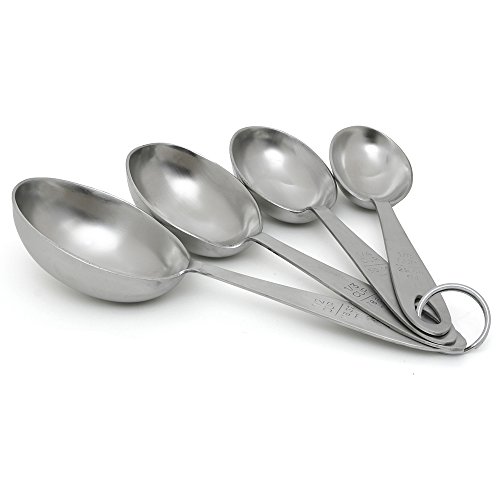
Lindy’s takes the other route out of a shallow cabinet. Its four scoops nest together and a metal ring holds them, which the listing calls a space saving nesting design. The four are 1/2 cup, 1/3 cup, 1/4 cup and 1/8 cup, and the bullet states the largest spoon is 9 in long. Stored, they are one thing on the shelf rather than four.
The listing publishes no loop and no hook, and no dimension fields at all. What it does publish is a package figure of 2.8 by 9 by 1.5 in for the set, which is the carton and not the scoop. At 0.9 lb it is the heaviest of these five, which is unsurprising for four steel scoops sold as one purchase.
The Figures That Do Not Line Up
Maker’s Words Against the Fields
HIC Kitchen states 3.6 by 8.6 in for its taco scoop in the same bullet that gives its material, and its dimension fields read 3.25 by 8.5 by 1 in. Two numbers are close and one is missing from the sentence entirely, so the only thickness figure this page can cite for it, 1 in, exists only in a field. This page quotes the maker’s 3.6 by 8.6 in and names the field separately rather than blending them.
RSVP International is the only one of the five where the two agree outright. Its bullet reads 11.5 in by 3.75 in by 2 in with a one cup capacity, and its fields carry the same three figures. OLESBUR publishes fields of 3.74 by 10.43 in and no third figure, and no size in its own words at all, so there is nothing to check it against.
A 0.04 Inch Thickness Is Not a Scoop
E-far’s published dimension fields are 2.3 by 6.5 by 0.04 in, and the third of those cannot belong to a steel scoop weighing 0.4 lb. What the listing says in words is that each scoop measures approximately 6.5 by 2.3 in and holds 3 oz, and those two figures match the first two of the three, so the third is the one to discard.
That is the useful reading for a shallow cabinet. Two of the published numbers describe a real pair of mini scoops that hold 3 oz each, and the third describes nothing. This page ranks E-far on the 6.5 by 2.3 in the maker wrote out, not on a carton thickness, and it does not build any comparison on the 0.4 lb that sits beside it.
Capacity, In Four Different Units
One Cup, Three Ounces, Eighteen Ounces
RSVP International publishes a one cup capacity and puts it in the product name. E-far publishes 3 oz and says it twice, once as its size attribute and once in a bullet, for each of the two scoops. OLESBUR publishes 18 oz, again in the name and again as the size attribute. Three listings, three units, and no listing converting between them.
For a shallow cabinet that matters more than it looks. A one cup oval scoop and a 18 oz ice scoop are different objects with overlapping numbers, and the only way to compare them here is by the figures that measure the body rather than the bowl: 11.5 by 3.75 by 2 in against 3.74 by 10.43 in with no third figure published.
The Set Measures Instead of Holding
Lindy’s is the only listing of the five that publishes marked measurements, and the only one whose capacity is a set of four fractions rather than a single figure: 1/2 cup, 1/3 cup, 1/4 cup and 1/8 cup. The listing calls them accurate measurements for precision cooking. It publishes no ounce figure anywhere, so it cannot be compared with the 18 oz or the 3 oz scoops on volume at all.
HIC Kitchen publishes no capacity of any kind. What it publishes instead is a working surface, 3.5 by 2.5 in, with deep angled sides, and a heat limit of 500 degrees Fahrenheit that no other listing here states. It is the one pick of the five meant to go into a hot pan, which is a different job from portioning a measured amount.
Which One Fits Your Kitchen
A shelf with a hook on the wall. RSVP International, published at 11.5 by 3.75 by 2 in in the maker’s words and again in its fields, with hanging loops, a one cup capacity, 18/8 stainless steel and a 0.49 lb weight, and stated dishwasher safe.
Four measures in one slot. Lindy’s, a four piece set of 1/2, 1/3, 1/4 and 1/8 cup scoops that nest on a metal ring, with each scoop marked, the largest stated at 9 in long, a 2.8 by 9 by 1.5 in package figure and 0.9 lb for the set.
Hanging beside the ice maker. OLESBUR, an 18 oz 304 stainless steel scoop with a built in hanging loop and a separate hook, published fields of 3.74 by 10.43 in with no third figure, a mirror polished finish, 0.44 lb, and stated safe to rinse or put in the dishwasher.
Canisters and jars, not bins. E-far, a pair of mini scoops the maker measures at approximately 6.5 by 2.3 in each, holding 3 oz each, in food grade stainless steel with a small hanging loop on the handle, 0.4 lb for the two and cleaned by hand.
Lying flat in a drawer or a pan. HIC Kitchen, a silicone scoop with a steel core stated at 3.6 by 8.6 in, fields of 3.25 by 8.5 by 1 in, a 3.5 by 2.5 in contoured surface with deep angled sides, heat safe to 500 degrees Fahrenheit, 0.25 lb and dishwasher safe.
What We Could Not Verify
Every figure above is quoted from the maker’s own listing. These are the things a shallow cabinet raises that no listing here answers.
- No listing states which of its published figures has to clear a shelf, or how far the tool projects when it hangs on its loop.
- OLESBUR and Lindy’s publish no third dimension, so neither can be laid flat on paper.
- E-far’s published height field of 0.04 in cannot belong to the 0.4 lb beside it, and the listing does not resolve it.
- HIC Kitchen’s stated 3.6 by 8.6 in and its fields of 3.25 by 8.5 by 1 in are not the same two numbers.
- Capacity appears as one cup, 3 oz, 18 oz and four cup fractions, and no listing converts between them.
- Two products in this pool were left out for being the wrong tool: a set of glass storage jars that happens to include a wooden spoon, and a sliding bin lid whose scoop is an accessory to it.