How the Five Compare on the Numbers
Family meal prep is a long run of moving chopped food from a board to a pot, and the part of a scoop that decides how well that goes is its leading edge. Four of these five listings make a claim for it. HIC states a front edge that slides under food with raised sides to hold the juices. VITEVER states a beveled silicone head. E-far states a thick smooth rim. LorisArm measures its edge.
No two of those four mean the same thing by it. HIC is talking about getting under a pile of diced onion, VITEVER about not scratching a coated pan, E-far about not cutting the hand that holds it, and LorisArm about the shape that makes scooping work. OXO is the fifth and says nothing about its edge at all, describing only a head that moves through dense ingredients.
What the table cannot tell you is how much any of these carries in one pass. Only E-far puts a volume on it, and only HIC publishes a figure that is the scooping surface rather than the whole tool, because on a flat sided scoop the tool and the head are the same object. On the other three the published length includes a handle, which is not the part that does the work.
Four Edges, Four Different Jobs
Getting Under the Food
HIC makes the claim that matters most for prep. Its front edge is stated to slide under food, which is what lets a board of diced vegetables leave in one pass rather than three, and it pairs that with raised sides said to contain food and juices so the counter stays cleaner. It is the only pick here whose edge and whose sides are described as doing two halves of one job.
The figures support it. HIC publishes 6 by 6 by 1.25 inches in both its own sentence and its fields, which agree exactly, and that figure is the scooping surface because the tool has no separate handle. It also publishes a flat base said to stay steady on a countertop or a cutting board, which no other pick on this page mentions.
Protecting the Pan, and Protecting the Hand
VITEVER turns the edge outward. Its smooth, flexible beveled silicone head is stated to be gentle on nonstick, ceramic, cast iron and coated cookware, preventing scratches, which makes the edge a feature of the pan rather than of the scoop. Three spoonulas arrive in the purchase, each formed in one piece, with a hanging hole and a dishwasher clearance.
E-far turns it inward. Its rim is stated to be smooth and thick with no burrs, so it will not be sharp enough to cut the hand holding it, and the scoop head is described as slightly curved with a wide body for holding dry goods. It is the only pick here publishing a capacity, 3 oz a scoop, across two scoops of 6.5 by 2.3 inches each.
The Only Edge With a Figure
A Measured Edge and a Measured Bowl
LorisArm is the only listing on this page that puts a number anywhere near its edge. It states a deeper bowl at 1.5 cm, which is 0.59 inches, and sharper flat silicone edges at 0.2 cm, and ties both to scooping and to serving more food than similar spoons. Those are the two figures a reader would actually want and nobody else publishes either.
It is also the only pick with two materials: platinum cured food grade silicone on a solid wood handle, with a stated heat resistance of 600 F. That wood handle is the one joint among these five, and the listing calls the whole thing dishwasher safe without addressing what repeated washing does to wood, which is the question a joint always raises.
The Pick That Never Mentions It
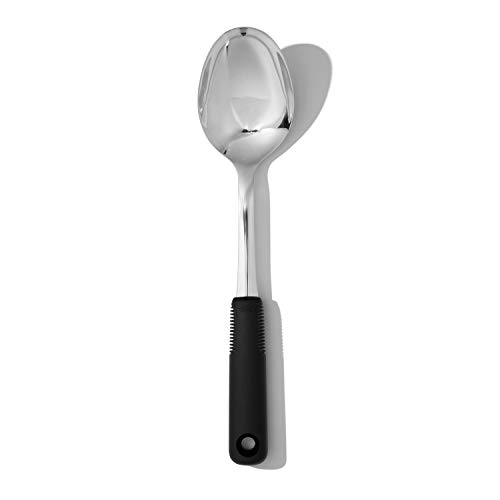
OXO says nothing about its edge. What it publishes instead is a head described as optimized to move easily through thick, dense ingredients, a spoon stated to be ideally sized for large batches of soup, sauce and pasta, and a soft non slip grip that works when wet. For stirring a full pot that is the right set of claims; for clearing a board it is the wrong one.
It publishes no size in its own words either, so its fields are the only description of it, and they read 2.75 by 2.15 by 12.35 inches. The sheet also carries an EIKS storage jar with a wooden spoon hanging on its side and a Rubbermaid sliding container lid with a scoop and a hook, both left out of these five because neither is a scoop you buy on its own.
Figures on These Listings Worth Doubting
A Weight That Cannot Be the Spoon
OXO publishes 0.07 pounds for a stainless steel spoon its own fields put at 12.35 inches long. A foot of steel with a molded grip does not weigh that, and the comparison on this page makes the point: the HIC steel scoop publishes 0.37 pounds and the E-far pair 0.4 pounds. The 0.07 figure is reported here rather than used, and no claim on this page rests on it.
The same listing has the only other flagged figure. Its height field of 12.35 inches sits against a median of 1.5 inches across this shortlist, which is what happens when a field holds the length of a long handled spoon rather than a depth. That one is almost certainly right and it is the label that is wrong, which is the usual way round.
A Field That Cannot Be a Scoop, and a Set With No Figures
E-far publishes a height field of 0.04 inches. Nothing that shallow holds 3 oz of flour, and its own sentence gives 6.5 by 2.3 inches for each scoop without a third figure, so the field is reporting something other than the depth of the bowl. The two usable figures come from the maker and the field is noted rather than used.
VITEVER goes the other way and publishes almost nothing. No dimension fields, no weight, and one figure in the whole listing: 11.4 inches, which appears in its size slot and again in its package. For a three piece purchase that leaves a reader unable to tell whether the three are the same size or three different ones, and the listing never says.
Which One Fits Your Kitchen
You prep on a board and move it to a pot. HIC states a front edge that slides under food and raised sides that hold the juices, at 6 by 6 by 1.25 inches and 0.37 lb in 18/8 steel. Its fields and its sentence agree exactly, which one other pick here manages.
You cook in coated pans. VITEVER states a beveled silicone head gentle on nonstick, ceramic, cast iron and coated cookware, three to a purchase, each formed in one piece with a hanging hole. It publishes no weight and no dimensions at all.
You want the edge and the bowl measured. LorisArm publishes 0.2 cm of flat silicone edge over a 1.5 cm bowl and 600 F of heat resistance, on a solid wood handle at 12.5 inches overall. It is the only pick here with a joint to keep dry.
You portion dry goods out of canisters. E-far publishes two scoops of 6.5 by 2.3 inches holding 3 oz each, with a thick smooth rim stated not to cut your hands and a small hanging loop. It publishes no dishwasher statement.
You mostly stir big pots. OXO publishes a head stated to move through thick, dense ingredients and a soft grip that holds when wet. It says nothing about its edge, publishes no size in words, and its 0.07 lb weight should not be trusted.
What We Could Not Verify
Six things a reader would want and no listing among these five supplies.
- How much any of these carries in one pass, except E-far, which publishes 3 oz a scoop.
- Any edge figure from HIC, VITEVER, E-far or OXO, where LorisArm publishes 0.2 cm.
- What the OXO spoon actually weighs, since 0.07 lb cannot be a foot of stainless steel.
- What the E-far height field of 0.04 inches is measuring, since no scoop is that shallow.
- Whether the three VITEVER spoonulas are one size or three, which the listing never says.
- What repeated dishwasher cycles do to the LorisArm wood handle, which the listing clears without comment.