How the Five Compare on the Numbers
Sixteen fine mesh strainers sit on the fact sheet for this topic and five are here. Seven listings in the wider pool are the same flat filter for one named cold press juicer, in 304 stainless with a handle on each side, and only one of those seven reaches the fact sheet with a full set of its own dimensions. The rest of the sheet is cone strainers and filter bags, and both forms are represented below.
The thing that should separate these products is mesh fineness, and two of the five publish it. Worse, the two that do use different systems: one publishes a mesh count and one publishes microns. So even among the listings that answer the question, the answers do not line up, and on the other three the word fine is doing all the work.
What the table cannot tell you is how long any of these keeps straining at the rate it started. A fine mesh blinds over as pulp builds on it, and the useful property is not the initial aperture but how quickly it clogs and how completely it clears when rinsed. Nothing in these five listings addresses that, and the two that publish a fineness figure publish it as a static aperture with nothing about flow.
The Two Listings That Measure Fineness
Three Mesh Counts, Each With a Job
PRINKROOMY publishes 100, 200 and 300 mesh and then does the thing that makes those numbers worth having: it says what each is for. 100 mesh for fruit juices, 100 or 200 for cold brew coffee, 200 or 300 for nut milks, and 300 for herbal tinctures. That converts a specification into a decision, and nothing else in this pool attempts it.
The bags are nylon with double stitched edges stated to take vigorous squeezing and an adjustable drawstring that closes onto different containers. Its weight field reads 0.06 lb, which is flagged as too light for the 9.8 by 9.8 by 13.78 inch size published in the same listing, so this page does not rank on it. Its bullets give no bag size of any kind, so whether it fits over your jug has to be read off those fields rather than out of anything the maker writes.
Eighty and a Hundred and Eighty Microns
WMKGG measures the same property in the other unit, publishing food grade cotton sewn from 80 and 180 micron mesh. It is the only micron figure in this pool, and it comes with the one piece of hardware here: a reinforced stainless frame 5.6 inches across with a 5.1 inch handle, onto which the bag zips so the mouth stays open over a jug.
It publishes the bag at approximately 8.3 by 9.8 inches and puts a hanging hole in the handle for drying. Three bags come with one frame. Its cleaning bullet is a genuine instruction rather than a claim: spread the bag flat in the sink, rinse both sides, turn it inside out and repeat, then scrub gently with a soapy sponge. Hand washing only, and cotton will hold odor.
Cones, Counted and Measured
Four Sizes and a Reinforced Join
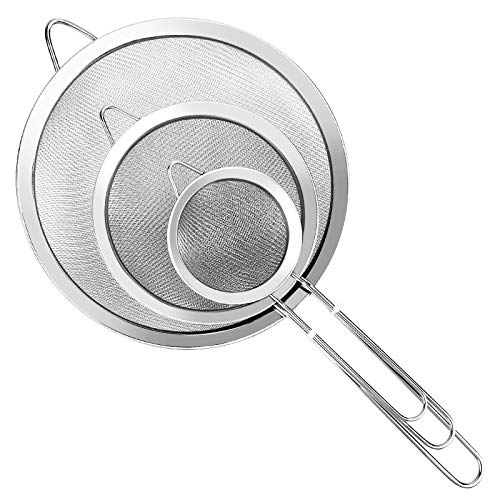
Ninsula publishes four diameters, 2.8, 3.2, 3.9 and 4.7 inches, which covers a cocktail glass through to a jug, and it publishes the detail most cone strainers leave out: the mesh is set into a reinforced frame specifically to prevent food trapping. The seam where mesh meets rim is where pulp collects and stays, so naming it is worth more than another adjective about fineness.
The handles are long and double riveted, stated slip resistant and stated to keep hands clear of hot water, with a built in hanging loop so the set stores above a pot. It is 304 stainless with a mirror finish and dishwasher safe. It publishes no mesh fineness and no weight, and four cones is four things to find room for.
Three Sizes, Up to Nearly Eight Inches
YLYL publishes 3.15, 5.5 and 7.87 inches, a longer spread of sizes than anything else on this page, and the largest of those will sit over a mixing bowl to strain a pan of stock rather than a glass of juice. Its mesh is twill rather than plain weave and its screen is described as mirrored and burr free so it does not catch your hand during cleaning, which is a real irritation on cheap cone strainers.
It is 304 stainless, stated not to rust or bend, and cleans in a dishwasher or under a tap. At 0.26 lb for the set it is the heaviest published weight of these five, which for three strainers is not much. Its size field is the untidiest thing in this pool, running three diameters and three metric equivalents into one unpunctuated string.
The Strainer That Publishes the Jug
An Inside Diameter, Not an Outside One
KANSHENDH-US answers a different question and answers it well. Rather than publishing only its own size, it publishes the vessel it fits: a recommended inside diameter of 4.0 to 5.4 inches. For a strainer designed to sit on a rim and be left there while you pour, that is the figure that decides whether it works in your kitchen, and it is the only listing here that gives it.
It also publishes 1.6 inch handles on each side, given in centimeters too, and a full set of its own dimensions at 6.5 by 4.95 by 1.97 inches. It is 304 stainless, rinsed or put in the dishwasher. It publishes no mesh fineness and no weight, and it is a single size, so the vessel range is the whole of its compatibility.
Why Only One of Its Kind Is Here
Six other listings in this pool are the same idea: a flat 304 stainless filter with a handle on each side, sold as a secondary filter to use after a cold press juicer. Only this one reaches the fact sheet carrying a complete set of its own figures, so treating the rest as separate products would be padding a page rather than comparing anything.
What the listing still leaves unanswered is fineness. For a filter whose entire purpose is catching residual pulp and foam, it says fine mesh and smooth and publishes no count and no aperture, and it publishes no weight either. The two figures it does give, 6.5 by 4.95 by 1.97 inches and a vessel inside diameter of 4.0 to 5.4 inches, are the ones that decide whether it fits.
Which One Fits Your Kitchen
Making different drinks and wanting the right mesh for each. PRINKROOMY, nylon bags in 100, 200 and 300 mesh with the listing naming 100 for fruit juice, 200 or 300 for nut milk and 300 for tinctures, on an adjustable drawstring closure.
Nut milk, and not wanting to hold a bag open. WMKGG, three unbleached cotton bags at 80 and 180 microns, 8.3 by 9.8 inches, zipping onto a 5.6 inch stainless frame with a 5.1 inch handle. Hand wash it the way the listing says.
One set for cocktails and cooking alike. Ninsula, four 304 stainless cones at 2.8, 3.2, 3.9 and 4.7 inches with double riveted handles, a hanging loop, and mesh set into a reinforced frame so nothing lodges at the join.
Straining a pan rather than a glass. YLYL, three 304 stainless strainers at 3.15, 5.5 and 7.87 inches with twill mesh and a burr free rim, dishwasher safe, at 0.26 lb for all three.
Always straining into the same jug. KANSHENDH-US, a 304 stainless filter at 6.5 by 4.95 by 1.97 inches with 1.6 inch handles, resting on any vessel between 4.0 and 5.4 inches inside diameter.
What We Could Not Verify
Every figure above comes from the maker’s own listing text. These are the things we went looking for and could not source in any of them.
- Three of these five publish no mesh fineness at all, on a product whose only job is fineness.
- The two that publish a figure use different systems, so neither can be checked against the other.
- A bag size in PRINKROOMY’s own words, since only its dimension fields of 9.8 by 9.8 by 13.78 inches say which jug or jar it suits.
- No listing publishes a temperature limit, which matters for cotton and nylon rather than steel.
- No stainless listing publishes a wire gauge, so how easily the screen dents is unstated.
- No listing says anything about how quickly the mesh blinds over or how well it clears.