How the Five Compare on the Numbers
A fish spatula goes into a drawer or a shallow cabinet on its side, and the figure that decides whether it lies down is the smallest of the three, not the length. All five publish a third dimension field, and on four of them it is usable, running from half an inch to a full inch. The fifth reads 0.04 inches, which cannot be the thickness of a spatula, so that maker’s own stated figure has to stand in its place.
The other problem is that these listings measure two different objects. Two of the five publish a blade size and a whole tool size. Two publish only a blade. One publishes only the whole tool. The table below keeps those apart deliberately, because a 6.5 inch blade and a 6.5 inch spatula are not the same thing and one of these listings gives you no way to tell which it means.
What the table cannot tell you is where each of those small figures is measured. A fish spatula is a thin blade, a bend and then a handle, so the thickest point is almost never the part that touches the fish. Not one of these five says whether its figure describes the blade, the offset or the grip, and that is exactly the number a shallow drawer needs.
Blade Figures and Whole Tool Figures
Two Listings Publish Both
MIU France is the most complete of the five. Its title states a 9 inch blade and a size of 13 inches, so the blade and the tool are named separately and the difference between them is four inches of handle. Its dimension fields read 3.5 by 13.5 by 0.5 inches, which agrees with the 13 inch figure to within half an inch and gives a width the title does not.
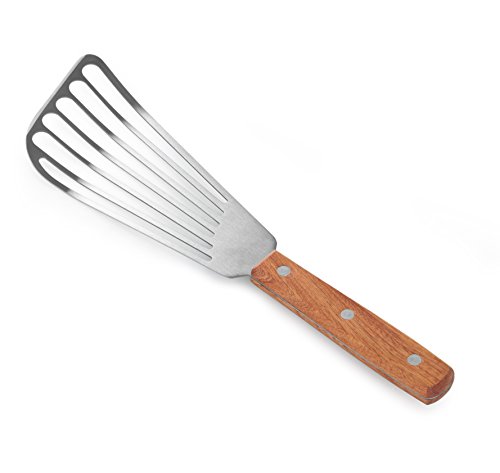
New Star Foodservice does the same thing in its last bullet. It states a precision 6.5 inch blade and then gives the overall size as 11 inches long by 3 inches wide. Its dimension fields read 3.0 by 11.2 by 0.5 inches, which matches both. That is three sources agreeing, which no other listing on this page manages, and it is the only one with a width stated in words.
The Rest Publish One Figure or the Other
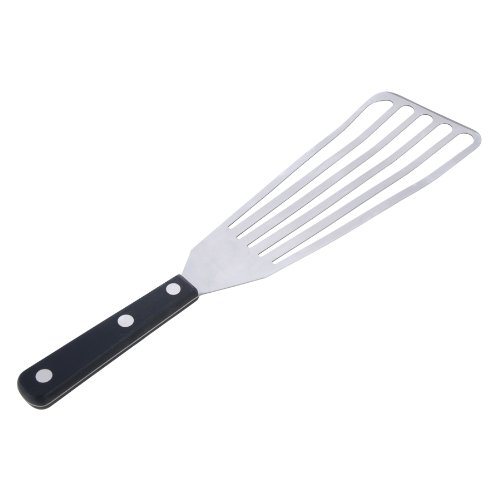
Mercer Culinary publishes a blade and stops. Its title and its size line both give 3 inches by 6 inches, and nothing anywhere says how long the tool is with the handle attached. Its dimension fields read 2.8 by 11.5 by 1.0 inches, so the tool is presumably around 11.5 inches, but that figure appears in a field rather than in a sentence the maker wrote.
Winco publishes only 6.5 inches and never says what it describes. Its fields read 3.13 by 11.25 by 0.63 inches, and 6.5 is not among them, so 6.5 inches is almost certainly the blade. Cualork is the mirror image: it publishes 12.8 by 3.1 by 0.6 inches for the whole tool and no blade figure at all, which leaves the working end unmeasured.
The Figure a Drawer Closes On
Half an Inch to a Full Inch
All five publish a third dimension field and four of them are usable. MIU France and New Star both read 0.5 inches. Winco’s reads 0.63 inches. Cualork’s reads 0.04 inches, which cannot be the thickness of a spatula, so its own stated 0.6 inches stands in instead. Mercer Culinary’s reads 1.0 inch, which is twice what two of the others publish and the only figure here that would stop a tray closing on the tool.
Mercer is also the one with an obvious explanation. Its Hell’s Handle is a molded, sanitary sealed grip rather than a riveted flat tang, and a handle like that has to be thick enough to keep heat out of your hand. The listing never says the 1.0 inch figure is the handle, but it is the only part of a fish spatula that could plausibly be an inch through.
The Handle Is Usually the Thick Part
Handle construction explains most of that spread. MIU France states a riveted polyoxymethylene handle, New Star a smooth wooden handle reinforced with three stainless steel rivets, and Winco a wooden handle with a satin finish blade. A riveted handle is two scales pinned to a flat tang, which is why those listings can publish half an inch and mean it.
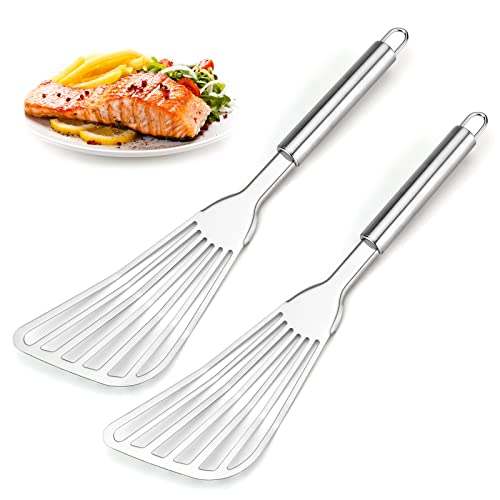
Cualork publishes fields of 3.1 by 12.8 by 0.04 inches, and since 0.04 inches cannot be the thickness of a spatula its stated 0.6 inches is the only usable figure, and the listing adds that the handles are non-slip and that there is a loop at the end. A loop is a hanging provision rather than a storage figure, but for a shallow cabinet it is the more useful of the two, because a tool on a hook takes up no shelf.
What the Handles Commit To
Heat, Rivets and Wood
Mercer Culinary is the only listing in this group that publishes a heat claim, and it publishes two: a handle designed to withstand up to 450 degrees without melting, and a dual-textured finish the maker says absorbs 50 percent less heat and stays cool to the touch. That is aimed at commercial use, and it is the reason the tool is thicker than the rest.
No other pick publishes a temperature figure at all. MIU France says only that the handle is riveted polyoxymethylene. Winco and New Star both say wood, which has its own heat behavior and no published rating. Cualork describes non-slip handles on brushed stainless and publishes nothing about how hot they get, which on an all-metal spatula is a real omission.
Washing Up and Hanging Up
Three of the five say something about a dishwasher and they do not agree. Winco states dishwasher safe for easy and quick cleaning. New Star states that its commercial-grade construction is dishwasher safe. Mercer Culinary rules it out in plain words, asking you to wash by hand with warm water and mild soap and not to place it in a dishwasher or submerge it for long periods.
MIU France and Cualork publish nothing either way. Cualork says only that the polished surface cleans with water, which is a claim about ease rather than permission. Cualork is also the only pick with a published way to hang the tool, a loop at the end of the handle, so it is the only one of the five that can stay out of the cabinet entirely.
Which One Fits Your Kitchen
The drawer that is genuinely shallow. MIU France or New Star Foodservice. Both publish a third figure of 0.5 inches, and both name a riveted handle, which is the construction that stays flat rather than a molded grip that does not.
The cook who wants the blade and the tool both measured. MIU France. Its title states a 9 inch blade and a 13 inch overall size, so the handle length is the difference between them and neither figure has to be inferred.
The kitchen that leaves a spatula on a hot pan. Mercer Culinary. It is the only pick publishing a heat claim, up to 450 degrees, with a handle stated to absorb 50 percent less heat, at the cost of a 1.0 inch field.
The buyer who wants two sizes and a hook. Cualork. It publishes 12.8 by 3.1 by 0.6 inches, arrives as two spatulas at 0.29 pounds for the pair, and is the only pick with a loop at the end of the handle.
The busy kitchen that puts everything in the dishwasher. Winco or New Star Foodservice. Both state dishwasher safe outright, both publish a 6.5 inch blade, and New Star publishes 0.1 pounds, the lightest of these five.
What We Could Not Verify
These are the things we went looking for in the published listings and did not find:
- Where any of these five measures its smallest figure: the blade, the offset or the handle.
- What Winco’s 6.5 inch figure describes, since the listing never names it.
- Any blade figure at all for Cualork, which publishes only a whole tool size.
- Any overall length for Mercer Culinary or Winco in the makers’ own words.
- Any heat rating for four of the five, Mercer’s 450 degrees being the only one.
- Whether MIU France or Cualork may go in a dishwasher, which neither states.