How the Five Compare on the Numbers
The qualifier here is a single measurement. A kitchen drawer is wide and long and almost never deep, so the figure that decides whether a timer lives in one is how far it stands off the base. Three of the six listings in this pool publish that figure in a form you can hold a tape against. The other three publish a body size and leave you to work out which number is which.
One listing was left out for not fitting the page. TempPro publishes 4.0 by 4.5 by 1.5 inches, which is a desk clock rather than a drawer item, and it is the one listing here with a calendar, dual countdowns and a volume range running to 105 dB. It is a good timer for a counter. On a page about a tight drawer it is the wrong tool, and its 1.5 inch figure is the reason.
What the table cannot tell you is which published figure is the front face and which is the side, because the fields arrive as three numbers with no labels. On KTKUDY the size field spells it out. On the others the reading above comes from taking the two similar numbers as the face and the odd one as the depth, which is an inference rather than a published fact. Nobody publishes a magnet pull, a case radius or a button height.
The One Measurement a Drawer Cares About
Three Listings Publish It Clearly
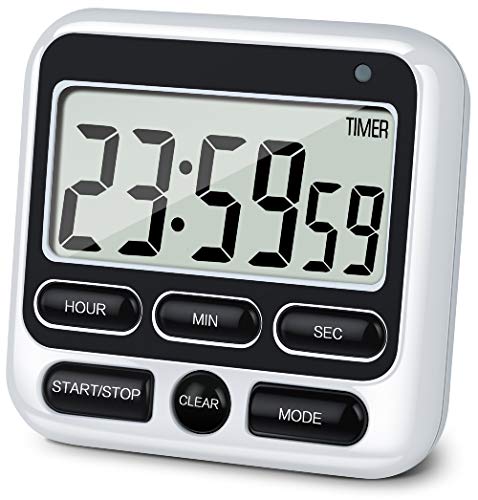
Antonki states 2.68 by 2.48 by 0.63 inches for each of the two timers in its pack, written into the listing text rather than left in a field, and 0.63 inches is the lowest depth figure anywhere in this pool. Nkove’s published field reads 0.8 inches on a body of 3.1 inches square. KTKUDY’s size field reads 3.15 x 3.15 x 0.87 inch, which is the only listing here stating its three numbers in order with a unit attached.
Those three sit flat under a drawer of almost any depth. The gap between 0.63 and 0.87 inches sounds trivial and is not, because a drawer that already holds a spatula and a thermometer has a working clearance rather than a measured one. Where it matters most is a drawer under a countertop lip, where the face of the drawer front and the runner between them decide what closes.
Where the Mechanical Dials Land
NUOSWEK publishes 3.0 by 1.2 by 3.4 inches and ALBAYRAK 2.7 by 1.7 by 2.7 inches. Both are round dials in cases that have to hold a spring, a gear train and a bell, so neither is going to approach an LCD panel. The ALBAYRAK’s 1.7 inch figure asks the most clearance of the five, and that is the price of a device that needs no battery.
That is a real trade and not a fault. A wound timer works after six months in a closed drawer, which is exactly where a battery timer fails. If your drawer has the clearance, the mechanical pair are the ones that are ready when you open it. If it does not, the choice narrows to the three digital panels and their battery compartments.
Two Listings, One Product
The Figures Line Up Too Well
KTKUDY and Nkove publish the same weight to the hundredth of a pound, 0.14, on bodies of 3.15 and 3.1 inches square, both with a countdown, a count up and a clock, both with a 24 hour range, both with a magnet on the back and both with a memory function. Two different brand names sit on top of figures that close. Neither listing mentions the other and neither states a manufacturer.
This is worth saying out loud because it changes what you are choosing between. The difference is not the hardware but what each listing publishes about it. KTKUDY publishes a screen size at 2.8 inches, an alarm output of 70 to 90 dB, a count of three rear magnets, a fold out stand and a button layout with dedicated hour, minute, second and clear keys. Nkove publishes none of those.
What KTKUDY Says That Nkove Does Not
KTKUDY adds a daily alarm on top of the clock, which is a fourth function and the only one of its kind in the pool. It also documents behavior rather than features: holding the hour, minute or second button for three seconds advances the digits quickly, and the countdown memory recalls the last setting so a repeated recipe does not need setting twice. That is a listing written by somebody who has used the thing.
Nkove’s bullets are shorter and describe the same three modes, the same magnet, the same memory and a side switch between silent and loud, which is a physical control rather than a menu and is genuinely easier to use with wet hands. Its published thickness of 0.8 inches is the better figure of the two. On this page that is enough to keep it, and not enough to put it first.
Power, Range and the Way They Fail
The Battery Question Nobody Answers
Of the three digital picks only Antonki names its cells, stating two AAA batteries pre included and ready out of the box, and adding that you should switch the unit off on the back when it is not in use. KTKUDY and Nkove both need a battery and neither says which, which for something stored in a drawer and used monthly is the detail most likely to be wanted at an awkward moment.
The two mechanical picks sidestep it. ALBAYRAK states no batteries required alongside its 304 stainless steel case and its 85 dB alarm. NUOSWEK states that it needs no batteries and is energy saving, and is the more honest of the pair about what a spring costs you: you must wind from zero through to 55 every time to activate the spring, and it ticks while running.
Range Splits the Pool in Half
KTKUDY and Nkove both state 24 hours, and KTKUDY makes the point explicitly, naming slow cooker meals and smoking as the reason a timer needs to run past 99 minutes 59 seconds. Antonki stops at exactly that, which covers a bake and a boiled egg and not a brine. NUOSWEK runs to 60 minutes and no further.
ALBAYRAK publishes no range at all. For a mechanical dial that is unusual and it means the one specification a buyer would check first is missing from a listing that otherwise spends five bullets on steel, magnets and satisfaction. It publishes its alarm at 85 dB and its material as 304 stainless, and then stops short of saying how long it counts.
Which One Fits Your Kitchen
You want the time and a timer from one device. KTKUDY is the only pick with four functions, publishing a 12 hour clock, a daily alarm, a count up and a countdown to 24 hours, with a size field reading 3.15 x 3.15 x 0.87 inch, a 2.8 inch screen and a 70 to 90 dB alarm with a light only silent mode.
Your drawer is genuinely tight. Antonki states 2.68 by 2.48 by 0.63 inches per unit and supplies two of them with AAA cells installed, each with a magnet, a kickstand and a hanging hole. It has no clock and stops at 99 minutes 59 seconds, and its published pack weight is not believable.
You want a clock and a flat body with a physical switch. Nkove publishes 3.1 by 0.8 by 3.1 inches and 0.14 pounds, with countdown, count up and clock modes, a 24 hour range, a side switch between silent and loud, a magnet and a memory function, and publishes no alarm output figure.
You forget to replace batteries. NUOSWEK is a wound spring at 3.0 by 1.2 by 3.4 inches and 0.24 pounds that runs to 60 minutes and needs no power. The listing tells you it ticks, that it has no back cover, and that you must wind through to 55 before setting the time.
You want it on the fridge door, not in the drawer. ALBAYRAK publishes 2.7 by 1.7 by 2.7 inches and 0.28 pounds in 304 stainless steel with a magnetic back stated for a fridge or a microwave and an 85 dB mechanical alarm. It publishes no timing range and no clock.
What We Could Not Verify
Half of what a buyer would check on a drawer timer is either absent or self contradictory in this pool.
- Antonki publishes 0.1 pounds for two timers with two AAA batteries already installed, which cannot be the real figure.
- Antonki’s dimension fields describe the carton, published as 2.9 by 0.7 by 2.7 inches for the pair rather than one unit.
- KTKUDY and Nkove publish near identical figures under two brand names, and neither names a manufacturer.
- ALBAYRAK publishes no timing range, no dial graduations and no clock, only its material and its alarm output.
- Only Antonki states a battery type, so the other two digital picks cannot be stocked for in advance.
- No listing publishes a magnet pull, so how well any of these holds on a painted steel door is unstated throughout.