How the Five Compare on the Numbers
Four of these five publish a cut standard and the fifth does not. NoCry cites EN388:2016 Level 5 and ANSI 105-2016. Mercer Culinary cites ANSI Level A5. TruChef cites EN388 Level 5. A generic HDPE glove cites nothing at all, only the fiber. The VEKAYA is a mandoline slicer supplied with cut resistant gloves, and its listing publishes no standard, no fiber and no size for the gloves in the box.
The figures that do exist mostly describe packaging. NoCry publishes 4.33 by 8.66 by 0.2 inches and 0.09 pounds, Mercer 5 by 8 by 1 inches, TruChef 0.7 by 5 by 9 inches. Those are packets, not hands. Only Mercer publishes a full size range, and only Mercer publishes wash and dry temperature limits, at 180 F and 160 F with a ten minute dryer ceiling.
What the table cannot give you is fit, and fit is what makes a cut glove safe. Not one of the five publishes a hand circumference, a palm width or a finger length behind its size labels, so a medium from one maker and a medium from another are not the same medium. A loose glove on the hand that feeds a mandoline is worse than no glove, because the fabric can catch on the carriage.
Cut Standards, and What They Leave Out
EN388 and ANSI Are Two Different Scales
NoCry cites EN388:2016 Level 5 together with ANSI 105-2016. TruChef cites EN388 Level 5. Mercer Culinary cites ANSI Level A5. These are separate test regimes with separate grading letters and numbers, and a level from one does not convert into a level from the other. Reading the three claims as a single ranking is the mistake this page exists to prevent, because the listings invite exactly that.
None of the four gloves publishes the underlying test result behind its grade, only the grade itself. That is the norm for consumer listings, and it means the gap between two gloves inside the same band is invisible from the outside. NoCry also claims its material is four times more cut resistant than leather and ten times better than steel, which is a comparison against nothing in particular and no standard at all.
The Glove That Cites Nothing
The generic HDPE glove names its fiber, a high performance HDPE yarn in an elastic nylon blend, and stops there. No EN388 level, no ANSI grade, no test, no warranty. What it does publish is a fit claim, a soft blend that conforms to the hand for knife control, and a wash claim, that it launders like ordinary kitchen textiles and dries quickly. Those are real properties and they are not protection figures.
The VEKAYA goes one step further in the wrong direction for a glove buyer. Its listing sells a stainless steel mandoline with a knob adjustable to 9 millimeters and julienne settings at 4.5 and 9 millimeters, and mentions cut resistant gloves and a food pusher as included safety items. Nothing else about the gloves appears: no standard, no fiber, no size, no count.
Fiber, Knit and the One Glove With Steel In It
Stainless Steel Reinforced Knit at 10 Gauge
Mercer Culinary is the only pick that describes its construction in trade terms: a stainless steel reinforced knit at 10 gauge, which it calls medium weight. Gauge here is stitch density rather than thickness, and a 10 gauge knit is the middle ground between a thick glove that kills dexterity and a thin one that a blade can press through. It is the most specific construction statement on this page.
Mercer also prints the warning nobody else does. Its listing states the glove is not cut proof and not puncture resistant, and says not to use it with moving or serrated blades. A mandoline blade is fixed rather than moving, so the warning does not rule this glove out, but it is the only listing here honest enough to describe where the protection stops.
Polyethylene Yarns and the Thin Glove Argument
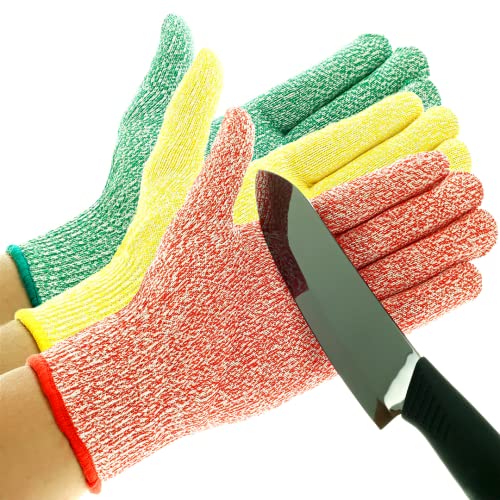
TruChef names high performance polyethylene fiber and sells thinness as a feature, describing gloves that are flexible and ultra thin for precision handling. It is also the only pick that ships more than one glove, three in three colors, with the listing recommending one color for raw meat, one for vegetables and one for general prep. For a mandoline that is a side benefit, because slicing is usually the vegetable color.
NoCry never names its fiber. It calls the material the highest level of cut resistant material on the market and leans on its EN388 and ANSI citations instead, plus a limited lifetime warranty and an ambidextrous cut that suits either hand. That warranty is the longest commitment on this page, and for a glove that will be washed repeatedly it is worth more than another adjective.
Sizing, Washing and the Glove That Comes With a Slicer
Sizes, Colors and Which Hand
Mercer publishes the sizing system the others do not: extra small, small, medium, large and 1X, with a color coded cuff for each so a busy kitchen can tell them apart, and a cut that fits either hand. NoCry is ambidextrous as well. TruChef and the generic glove publish a single size on the listings used here, small and medium, with no range and no hand measurement.
Washing is where the data thins out again. Mercer gives limits, machine wash at water not exceeding 180 F and machine drying not above 160 F for no longer than ten minutes, and allows the dishwasher. NoCry and TruChef say machine washable, TruChef adding air dry. The generic glove says hand or machine and quick drying. Only one maker tells you the temperature that damages the glove.
Why the Bundled Glove Is a Different Purchase
The VEKAYA is on this page because it is the one route to a slicer and a glove together, and it is the best documented of the slicer bundles: 6.7 by 16 by 5.12 inches, 1.79 pounds, a removable drum, a blade adjustable up to 9 millimeters, julienne at 4.5 and 9 millimeters, and a body that folds flat for a drawer. Everything specified belongs to the slicer.
Two other slicer bundles were left out of the comparison. Both publish the same 16.14 inch length, the same 6.5 inch height and the same 1.9 pound weight within a hundredth of an inch of each other, which suggests one slicer sold under two names. Putting both in a table of five would have filled two columns with one product, and neither says anything about its gloves either.
Which One Fits Your Kitchen
The cook who wants the most citations. The NoCry is the only pick naming two standards, EN388:2016 Level 5 and ANSI 105-2016, is ambidextrous, and carries a limited lifetime warranty. At 0.09 pounds packaged it is the only glove here with a usable weight figure, and it never names its fiber.
The cook who wants to know the limits. The Mercer Culinary is the only pick that states what it will not do, and the only one with a full size range and published wash and dry temperatures. Its stainless steel reinforced 10 gauge knit is the most specific construction claim on the page.
The household that preps meat and vegetables in one session. The TruChef ships three gloves in three colors so raw meat and vegetables never share fabric, cites EN388 Level 5 and sells itself on being thin enough for precision work. The listing used here publishes a single size, small.
The cook who wants a spare pair and nothing more. The generic HDPE glove names its fiber and its nylon blend, washes like a kitchen cloth and dries fast. It cites no cut standard at all, so treat it as a second layer for light knife work rather than mandoline protection.
The cook buying a first mandoline. The VEKAYA arrives as a slicer with gloves and a food pusher, 1.79 pounds, adjustable to 9 millimeters with julienne at 4.5 and 9 millimeters, and folds flat. Budget for a rated glove separately, because nothing about the included pair is specified.
What We Could Not Verify
For a product category whose entire purpose is protection, the gaps here are large:
- Hand measurements behind the size labels. No maker publishes a circumference, a palm width or a finger length, so sizes cannot be compared across brands.
- The fiber in the NoCry, which cites two standards but never names the material they were tested on.
- How many gloves are in the pack for three of the five. Only TruChef states a count.
- Anything at all about the gloves bundled with the VEKAYA slicer: no standard, no fiber, no size, no count.
- A usable weight for three of the five. Two glove listings carry a weight figure that rounds to zero, which cannot be right, so no figure is used for them.
- Whether any of these gloves resists a puncture. Only Mercer addresses it, and only to say that it does not.