How the Five Compare on the Numbers
Two listings were left out of this five before anything was compared. Urbanstrive repeats KitchenAid’s five feature bullets almost word for word, down to the same 4.5 mm wire figure, so counting both would be counting one set of claims twice. Maclia and FYCQER are two piece sets whose only published figure is a weight covering both tools, which cannot be lined up against a single masher.
What is left is four hand mashers and one ricer. Three of the five state a length of 10.24 or 10.25 inches, which means overall length is not a deciding specification here: a potato masher is about ten inches long and every maker knows it. The figures that actually separate these tools are the head design, the wire gauge where it is stated, and the weight.
The column that table cannot fill is the one every cook wants: how much force the head needs and how wide the gaps between the wires are. Only two of the five publish a wire gauge at all, and none publishes the spacing between wires, which is what actually decides whether a lump survives. PriorityChef is the single listing here that publishes a hole size, and it is a ricer.
Four Heads, Four Different Mashes
Wire, Plate, and Honeycomb
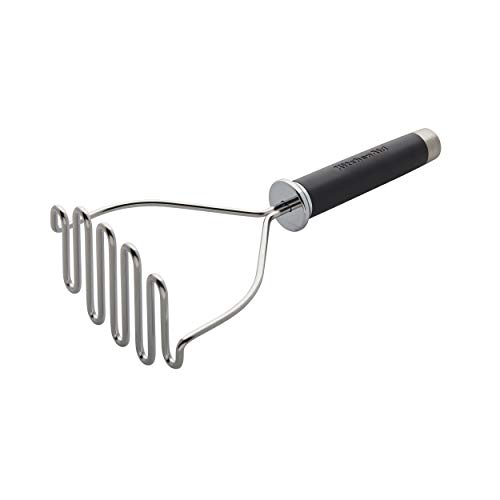
A zigzag wire head is the shape most people picture. KitchenAid states 4.5 mm stainless wire and Qbily states 5 mm, and that half millimeter is the only material difference either maker bothers to publish. A thicker wire resists bending when you lean on a cold potato, and it also shoves more starch aside per stroke, which is why wire mashers are the fast option rather than the fine one.
A plate head works the opposite way. Joyoldelf describes an integrated stainless mashing plate on a solid rubber handle, and Chef Craft describes a sturdy plate that it says is safe to use on stainless steel and cast iron pans. A perforated plate pushes food through holes instead of between wires, so it produces a denser mash and takes more downward force to do it.
The Ricer Is a Press, Not a Masher
PriorityChef is in this pool because it is sold as a masher and a ricer in one title, but mechanically it is neither a wire nor a plate. It is a hinged basket you fill and squeeze, with a stated capacity of 15 oz and 3 mm holes, which makes it the only tool here with any published figure about what the food is forced through.
That changes how you use it and how much you can do at once. A masher works in the pot, a ricer works in batches of one basket at a time, and at 1.3 pounds it is the heaviest of the five. It is also the only one of these five that publishes a capacity, so it is the only one where you can work out how many passes a five pound bag will take.
Where the Published Figures Fall Apart
The Length Field Is Not Always the Length
Chef Craft publishes 3.5 by 3.25 by 10.25 inches, and its 10.25 inch overall length is sitting in the height field. KitchenAid publishes 4.8 by 10.24 by 0.1 inches, with the same length in the middle field and a 0.1 inch figure that cannot describe any part of a masher you can hold. The fields are consistent only in being unlabeled.
Joyoldelf is the one to watch. Its fields give 3.9 by 4.7 by 3.1 inches, and no figure in that set is longer than 4.7 inches, which is roughly the head of a masher rather than a masher. Nothing in its five bullets states a length, so this page quotes no length for it and reports the fields as they were published rather than guessing which axis is which.
A Two Pack Weight Is Not a Masher Weight
Qbily publishes 0.4 pounds, and Qbily ships two tools, so the honest reading is 0.4 pounds for a wire masher and a honeycomb masher together. Set against KitchenAid at 0.49 pounds for one tool, that number would flatter Qbily badly if it were read as a single item, and the same trap sits in the two listings this page excluded.
Among the four single tools, Chef Craft is the lightest of the five at 0.22 pounds and it says so in a useful way: it calls itself great for mashing beans and other smaller foods. Light and plate headed is a combination for soft food. Joyoldelf at 0.38 pounds and KitchenAid at 0.49 pounds sit between that and the ricer.
What the Listings Repeat Word for Word
Two Listings, One Set of Claims
Urbanstrive and KitchenAid publish the same five claims in nearly the same words: ideal for mashing root vegetables, avocados, apples and nuts; a well balanced, ergonomically designed handle for smooth operation under heavy use; a head of thick 4.5 mm stainless wire that will not rust; and dishwasher safety for quick clean up. The wire figure is identical to the decimal.
Qbily’s opening bullet runs the same way, promising a masher suitable for crushing root vegetables, avocados, apples and nuts, before it departs to claim 5 mm wire instead of 4.5 mm. When three listings share a sentence, the sentence is not telling you about the product. It is telling you which supplier wrote the copy, and that is worth knowing before you treat a bullet as a specification.
What a Shared Bullet Costs the Buyer
The practical cost is that the pool of real information is smaller than the number of listings suggests. Eight listings were on the table for this page and they contain perhaps four independent descriptions between them. Urbanstrive was excluded here for exactly that reason, and its own dimension data made the decision easier: one of its fields came through at 0.04 inches and had to be dropped.
What survives the duplication is the handful of figures a maker had to measure itself. KitchenAid’s warranty terms, a one year replacement plus a lifetime limited, appear on no other listing here. PriorityChef’s 15 oz basket and 3 mm holes appear on no other listing. Chef Craft’s claim about stainless steel and cast iron pans appears on no other listing. Those are the specifications worth weighing.
Which One Fits Your Kitchen
Big batches of potatoes. KitchenAid states 4.5 mm stainless wire and a 10.24 inch length with a matte handle and a steel endcap, and it is the only tool here carrying a stated warranty: a one year replacement plus a lifetime limited. Wire heads move fast through a full pot.
Beans, avocado, and baby food. Chef Craft is a plate head at 0.22 pounds that names beans and smaller foods in its own bullet, and it is the only one here stated as safe to use on stainless steel and cast iron pans. Soft food needs less steel, not more.
Genuinely smooth mash. PriorityChef is a press rather than a masher, with a 15 oz basket and 3 mm holes, and it is the only tool of the five that publishes any figure about what the food passes through. It works in batches, weighs 1.3 pounds, and its handles are silicone.
Two jobs, one purchase. Qbily ships a zigzag wire head and a honeycomb head together, states 5 mm wire, gives a 10.25 inch length and says the tools can be suspended for storage. Its 0.4 pound figure covers both tools, so treat it as a pair weight.
A masher that lives in a drawer. Joyoldelf is an integrated plate on a solid rubber handle at 0.38 pounds. It publishes no length and no dishwasher claim, promising only that it rinses clean under the tap, so it is the least documented of the five picks.
What We Could Not Verify
These are the figures a maker could have published for a masher and did not.
- No listing publishes the spacing between the wires or the plate holes, which is what decides whether a lump gets through.
- Only two of the five publish a wire gauge, and one of those two shares its figure with an excluded listing.
- No hand masher here publishes a head width you can trust, because the dimension fields are unlabeled and one gives 0.1 inches.
- Joyoldelf publishes no length anywhere, and its largest field is 4.7 inches, which reads as a head rather than a tool.
- Qbily publishes one weight for two tools and never splits it, so neither head can be weighed on its own.
- No maker states how much force the head takes, whether the joint between head and handle is welded or riveted, or the steel grade beyond food grade.