How the Five Compare on the Numbers
Six listings sit on the fact sheet and one is left off. DOQAUS is a tray and bin system rather than trays sold on their own, and its dishwasher claim is made for the entire kit including the bucket, which is not the same statement as a claim about a tray. On a page comparing what a tray will survive, it would be answering a different question with a wider answer.
What decides this page is what each maker says about water and heat. One tells you to clean the molds before you ever freeze anything in them. Two say dishwasher safe outright, one of those adding microwaves and refrigerators. One gives a temperature range instead of an instruction and says a rinse is enough. One builds a rigid frame around the silicone and calls the result effortless to clean.
The table cannot tell you what happens to any of these in a hot cycle, because only Azxb publishes a temperature it survives and only Azxb is not claimed as dishwasher safe. That is the wrong way round: the listing with a number gives no permission and the listings with permission give no number. It also cannot compare tray sizes, because four of the five publish only a package figure.
What Each Maker Says About Getting It Clean
The One That Says Wash It Before You Use It
PET Hous publishes a first time use tip that no other listing in the pool matches: boil the molds for 15 to 20 minutes, or run them through the dishwasher, before the first freeze. The stated reason is that this refreshes the silicone so the first cubes come out fresh and odor free. It is the only maker here that admits new silicone can taste of itself.
That instruction is worth more than the odorless claim every other listing makes, because it is actionable. It also tells you something the cleaning row does not: PET Hous is confident enough in its silicone to send it through a dishwasher and to boil it, which is a harder test than a top rack cycle. The listing never repeats the permission for routine washing, so it is stated only as a prep step.
Two That Name the Machine, One That Names a Rinse
Weftnom publishes BPA free, non toxic, dishwasher safe silicone as a single claim. Vethwal goes further and says its trays work for dishwashers, microwaves and refrigerators, which covers every appliance one of these is likely to meet. Both are plain permissions and neither is qualified by rack position or temperature.
Azxb takes the other route. It publishes a range, -40 F to 428 F, says that makes the trays safe for freezing and microwaving, and then says a simple rinse with water is all it takes after use. Microwaving is named and a dishwasher is not, which on a tray rated to 428 F reads like an omission rather than a restriction, and the listing does not clear it up.
What the Tray Is Made Of Changes the Cleaning
Rigid Frames Against Fully Flexible Molds
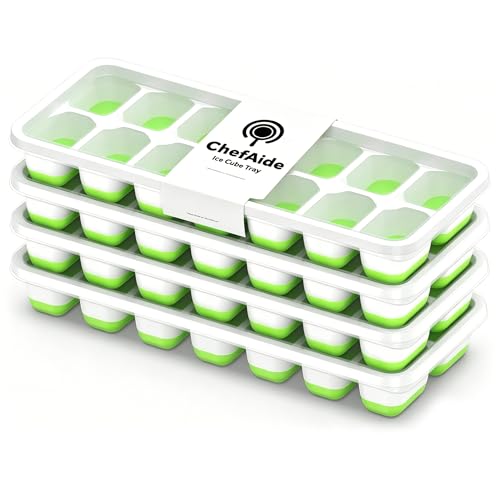
ChefAide and Weftnom both put the silicone in a frame. ChefAide describes a dual material construction with a rigid plastic upper half to hold the shape, against what it calls fully silicone molds, and a flexible silicone bottom for release. Weftnom describes a soft food grade silicone bottom with a sturdy PP frame and the same push from underneath action.
A frame is a cleaning decision as much as a filling one. A fully flexible tray folds in a dishwasher basket and can end up holding water in its own cavities, and a framed tray sits flat and drains. PET Hous, Vethwal and Azxb are all described as flexible silicone throughout, and all three rely on that flexibility for release.
Lids, and Where the Water Sits
Every one of these five has a lid and they are not the same object. Weftnom’s snaps on and is described as spill resistant when trays are stacked or carried. PET Hous supplies an independent tight sealing lid. Vethwal’s is removable silicone with small holes in it for hanging. Azxb’s is tight fitting silicone. ChefAide’s is removable and comes with an instruction to wait about 30 seconds after freezing before opening.
The hanging holes on Vethwal’s lid are the only feature in the pool aimed at drying rather than freezing. A silicone lid that has been through a wash holds water in its rim, and something to hang it from is a small answer to a real problem. Nothing else here publishes anything about drying at all.
Where the Published Figures Stop Agreeing
Four Packs Boxed Thinner Than Their Own Cubes
Four of these five publish a package figure instead of a tray. ChefAide’s four tray set is published at 3.94 by 9.84 by 1.18 in, and Vethwal’s three tray set at 4.6 by 7.4 by 1.45 in. Vethwal also publishes a cube measuring 1.2 by 1.2 by 1.2 in, so three trays deep enough to hold one cannot go into a box 1.45 in through, and four ChefAide trays cannot go into one 1.18 in through either.
These figures are real in the sense that the makers published them, and they describe cartons that were measured flat or not measured at all. Nothing on this page is ranked against them, and where a tray size is quoted above it is labeled as the package. Azxb is the exception: it publishes 7.3 by 5.1 by 1.2 in for the tray in its own sentence, and its fields carry the same three numbers.
A Cube That Is Not a Cube
PET Hous and Vethwal both publish 1.2 by 1.2 by 1.2 in, which is a cube. Azxb publishes 1.5 by 1.2 by 0.7 in, which is a slab, and still calls the output uniform ice cubes. That is not an error so much as a difference nobody would notice from the photographs, and it changes how fast the ice melts in a glass and how many fit in one.
Weftnom and ChefAide publish no cube size at all, so three of the five cannot be compared on the thing they exist to produce. Between them the five publish 15, 14, 15, 15 and 14 cubes a tray, and the totals run from 30 to 70, so the count is well covered and the size of what is counted is not.
Which One Fits Your Kitchen
Silicone you do not want to taste. PET Hous, the only listing that tells you to boil the molds for 15 to 20 minutes or run them through the dishwasher before the first freeze. Four trays, 15 cubes each at 1.2 by 1.2 by 1.2 in, 60 in a set.
The most ice per batch. Weftnom, five trays making 70 cubes, with a soft silicone bottom in a sturdy PP frame, snap on spill resistant lids and dishwasher safe stated plainly. At 0.64 lb it is the lightest set here.
Every appliance covered in one sentence. Vethwal, three trays of 15 cubes at 1.2 by 1.2 by 1.2 in, published as working for dishwashers, microwaves and refrigerators, with removable lids carrying small holes for hanging them to dry.
A published temperature rather than a promise. Azxb, two trays of 15 cubes rated from -40 F to 428 F, the only pick that publishes its own tray size, 7.3 by 5.1 by 1.2 in. Its cubes measure 1.5 by 1.2 by 0.7 in.
A tray that will not fold in the basket. ChefAide, four trays making 56 cubes with a rigid plastic upper half and a silicone base, a marked max fill line, and an instruction to wait about 30 seconds after freezing before lifting the lid.
What We Could Not Verify
Every figure above is from the maker’s own listing. These are the things we went looking for and could not source in any of the six.
- Only Azxb publishes a temperature range, and Azxb is the one pick that never names a dishwasher, so no permission here comes with a number behind it.
- Four of the five publish a package figure instead of a tray size, and two of those cartons are thinner than the cubes the trays are said to make.
- Weftnom and ChefAide publish no cube size, so three of the five cannot be compared on the ice itself.
- PET Hous names the dishwasher only as a first use prep and never repeats it as routine care.
- Nothing in the pool says whether a silicone lid should be washed separately from its tray, or how either is meant to be dried.
- No listing publishes a rack position or a cycle temperature, so dishwasher safe here means whatever each maker means by it.