How the Five Compare on the Numbers
Seven live pages on this pool rank by heat range, footprint, cavity count and size, what arrives in the set, cleaning, cabinet fit and what the published height figure measures. Every one of those is about what goes into the mold. None is about the moment that actually defeats people, which is getting a set chocolate back out of flexible silicone using nothing but fingers.
Read that way these five split four ways. Two publish a choice of movement, a push from underneath or a twist. One publishes a full sequence ending in a pressed finger. One publishes a single press. One publishes the word effortless and no movement at all, on the one mold here its maker calls thicker and deeper.
What the table cannot tell you is how deep any cavity is except on one listing. Cavity depth is what decides whether a push from underneath reaches the whole piece or only its base, and only SAINT NIEVE publishes a figure that speaks to it, its 2.6 cm overall. On the other four the release instruction has no dimension behind it.
The Movement Each Maker Asks For
A Push, a Twist, or Either
BTYMS publishes the most useful version of this in a single sentence: easy to use, with just a little push from the bottom or simply twist the tray to get the cubes out. Two movements, two different demands on a hand, and the buyer chooses. A twist works the whole sheet and needs grip; a push needs one fingertip and some force behind it.
LLchunyun publishes the same pair in two separate places. Its safety materials bullet states that the molds are soft and release easily after a gentle twist, and its easy to remove bullet states that once the contents cool and solidify you can easily remove them with a gentle push. Neither bullet mentions the other, but between them the choice is there.
One Sequence and One Press
Lerykin publishes the clearest procedure on this page and publishes it twice. Its quick release bullet states that after cooling the pieces just pop out with a pressed finger, and its easy to use bullet gives the whole sequence: fill the mold, wait until completely cooled, turn it upside down, and pop it right out with a little push from the bottom. That is an instruction someone can follow the first time.
Fimary publishes one sentence and one movement: you can simply press the bottom of the mini chocolate bar mold to pop out your treats easily. On a mold published at 0.22 pounds, the lightest purchase here, a single press is plausible, because there is very little silicone resisting the finger. It is still one option rather than two.
The Mold That Admits Its Own Weakness
Not Rigid Like Plastic Trays
BTYMS closes its listing with a tip that no other maker in this pool matches: the trays are silicone, so not rigid like plastic trays, and it suggests putting the tray on a tray or using the lids as a base to transfer filled trays to the freezer, then as covers once the contents are set. That is a maker naming the failure mode of its own material and supplying the fix in the same sentence.
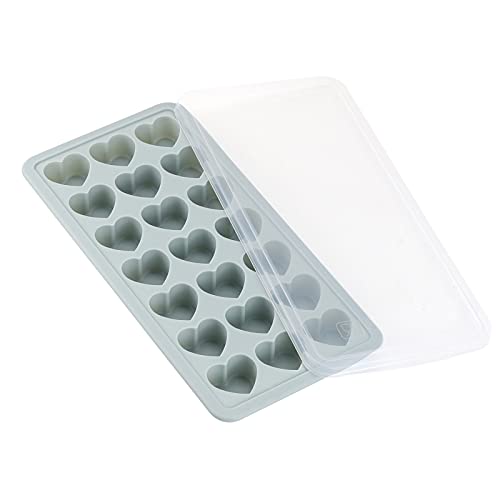
For the reader this page is written for that is the whole game. A 21 cavity tray at 10.47 by 5.1 inches filled with liquid chocolate is a floppy sheet, and carrying it flat across a kitchen is harder than any release movement. BTYMS is also the only listing here whose lid is stated to double as the rigid base, so the fix arrives in the box.
Stiffness Claimed Four Other Ways
Lerykin makes the closest thing to a structural claim, stating that these durable silicone molds are not easily deformed or torn. That is the property a mold needs if it is going to be twisted every time it is used, and no other listing here claims it. SAINT NIEVE states it is thicker and deeper than regular chocolate molds, which is stiffness by implication.
The other two go the opposite way and say so. LLchunyun states its molds are soft, twice, because soft is what makes a small flower shape release without tearing. Fimary states flexible silicone allows easy release. All three of those are honest descriptions of a mold that will bend when you pick it up full, and none of them says what to do about that.
Where the Figures Support the Instruction and Where They Do Not
Two Molds With No Size At All
Lerykin and LLchunyun publish no dimension anywhere: no mold size, no cavity size, no dimension fields, and size labels reading Mini and s. On a page about release that matters, because a pressed finger reaching into a semi sphere cavity has to be able to reach the bottom of it, and neither listing gives a depth or a diameter for anyone to judge by.
Fimary publishes 10 by 6.7 inches in a bullet against published fields of 0.59 by 6.65 by 10, which is the same object with the thickness first. SAINT NIEVE publishes about 30 by 20 by 2.6 cm in a bullet against fields of 7.88 by 11.82 by 1 inches, and those two agree once converted, which makes it the best documented mold here on size and the worst on release.
Temperature Ranges and One Unusual Warning
All five publish a range and three of them land in the same place, at 446°F. LLchunyun publishes its range in Celsius first, minus 40 to 220 degrees, given also as minus 40 to 445°F. BTYMS publishes a lower limit of minus 104°F, which converts from no Celsius figure the listing states.
SAINT NIEVE is the outlier in both directions. Its ceiling is 392°F, the lowest on this page by 53 degrees, and it adds a second limit nobody else has: keep the chocolate temperature below 50°C to maintain the holographic effect. That is a constraint on the work rather than the tool, and it is the only one of its kind in this pool.
Which One Fits Your Kitchen
Wanting a choice of movement. BTYMS, the only mold that publishes a push from below or a twist in one sentence, and the only one that tells you to stand a filled tray on something. Twenty-one cavities with a lid that doubles as a base.
Following an instruction the first time. Lerykin, which publishes the whole sequence twice, from filling to a pressed finger after complete cooling, and states the molds are not easily deformed or torn. Two packs of 15 cavities at 0.35 pounds.
Making small detailed shapes. LLchunyun, five soft flower molds stated to release after a gentle twist and separately with a gentle push, rated minus 40 to 220°C. Accept that no dimension of any kind is published.
Working with the least resistance. Fimary, at a published 0.22 pounds, the lightest here, with one clear instruction to press the bottom and a stated 10 by 6.7 inch size. One movement rather than two.
Making thick premium bars. SAINT NIEVE, stated at about 30 by 20 by 2.6 cm across three deep cavities at a published 0.73 pounds. It names no release movement, and it asks you to keep the chocolate below 50°C.
What We Could Not Verify
Every item below was looked for across all five listings and is not published:
- A cavity depth on four of the five, which is what a finger pushing from below has to clear.
- Any release movement from SAINT NIEVE, which calls itself thicker and deeper than regular molds.
- Any dimension at all from Lerykin or LLchunyun, for the mold or its cavities.
- A cooling time on any listing, including the two that require complete cooling first.
- Any transfer or support advice from Lerykin, LLchunyun, Fimary or SAINT NIEVE.
- Any Celsius figure behind BTYMS’s stated lower limit of minus 104°F.