How the Five Compare on the Numbers
A hand grinder is not just stored on a shelf, it is used on one. You hold the body and turn a crank over the top, which needs the height of the grinder plus a hand plus the arc of the handle. That makes the published height the figure to read first, and this pool spans 4.13 inches to 8.66, with most of the field clustered around 6.7.
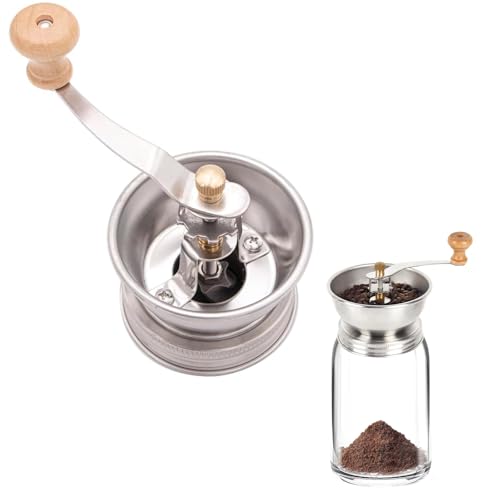
The second figure is the bean capacity, because a low grinder that holds 20 grams is two grinds for one brew. HAMILADUO publishes 20 g, HZBSGZR and CEVING’s mini both 30 g, and CEVING’s larger model 60 g, which it describes as twice a standard grinder. ByteX publishes none at all, because the hopper is a mason jar you already own.
The row this table cannot fill is the one that decides whether you can actually use the thing where it lives: the height with the crank on, and the radius the crank sweeps. Every grinder here except the Milih has a handle standing above the lid, and not one of the sixteen listings publishes either figure. Add two or three inches to every height above before measuring a cupboard.
The Crank Is the Part Nobody Measures
One Listing Folds It Away
Milih publishes a set of three brass Turkish mills and states that the handle folds neatly inside after grinding for easy storage and transport. That is the only folding crank in the pool, and on a low shelf it is worth more than any body dimension, because the stored height becomes the body height and nothing else.
It also publishes three heights, which is unusual: 22 cm or 8.7 inches for the largest with a width of 4.5 cm or 1.8 inches, 7 inches or 18 cm for the medium, and 8.5 cm or 3.3 inches for the mini at 3.5 cm or 1.4 inches wide. One of those three suits almost any gap, and all three arrive together at a published 2.7 pounds.
What Everyone Else Leaves Out
HZBSGZR, HAMILADUO, both CEVING grinders and BOMANSI all have a crank on a shaft above the lid, and every one of them publishes a body height that does not include it. HZBSGZR publishes 6.7 by 2.3 by 6.7 inches, HAMILADUO 1.9 by 6.3 by 6.7 and BOMANSI 3.35 by 5.9 by 8.4. None mentions the handle in a dimension at all.
The practical consequence is that a 6.7 inch grinder wants perhaps nine inches of gap, and a shelf measured against the published figure will trap the handle. ByteX sidesteps it by being a lid: the crank still stands above, but the whole assembly starts 4.13 inches up from the jar rather than 6.7 inches up from the shelf.
Capacity Against Height
Twenty Grams to Sixty
CEVING’s larger grinder publishes the case for a bigger body plainly: a 60 g capacity described as the world’s first at that size and twice the beans of a standard grinder, so one session replaces two. It publishes 40 external settings with each click at 0.05mm, CNC stainless burrs, and a stated 416 g weight with a footprint of 2.7 by 5.3 inches in the maker’s own words.
HAMILADUO is the opposite trade at the same height as the mini grinders: a 20 g hopper in a full aluminum alloy body at 1.9 by 6.3 by 6.7 inches, with a stainless conical burr at a stated 55 to 58 HRC and a dual-bearing shaft. For one cup a morning that is enough, and for a French press it is two grinds.
Settings You Can Repeat
Two brands publish a settings count and only one publishes what a setting is worth. CEVING publishes 40 external settings on both its grinders and states each click adjusts by 0.05mm, which is the only increment figure anywhere in this pool. HZBSGZR publishes 40 settings and no increment. HAMILADUO publishes a knob turned clockwise to a stop and then counterclockwise by reference values.
On a shared shelf that matters more than it sounds, because a grinder that gets knocked or borrowed has to be reset. A numbered external click ring can be counted back. A threaded rod, which is what ByteX publishes, is adjusted by dismantling the handle and moving the burrs by hand, which is precise and not repeatable.
Materials, Water and the Figures That Disagree
Four Bodies, Four Answers
HAMILADUO publishes a full metal aluminum alloy body and argues it protects the internal parts. Milih publishes brass. ByteX publishes stainless steel with ceramic burrs. HZBSGZR publishes ABS with a glass jar, which is the lightest and the least robust of the four, and the glass is also why it is the only grinder here you can watch working.
None of the four may be rinsed, on their own instructions. HAMILADUO says do not rinse with water. CEVING says water is not recommended because moisture may impact the coffee flavor. Milih asks for a dry or slightly moist cloth and forbids the dishwasher and bleach. Only ByteX publishes a positive method: grind uncooked white rice through it.
Three Listings Whose Numbers Swap Places
CEVING’s 60 g grinder publishes fields of 2.72 by 5.31 by 7.87 inches and a sentence reading 2.7 by 7.8 by 5.3 inches. Those are the same three numbers in two orders, and which one is the height is never said. Its mini publishes a field height of 6.7 inches against 7.4 inches in its own words. HZBSGZR publishes 6.7 by 2.3 by 6.7 in words and 2.3 by 6.7 by 6.7 in its fields.
For most purposes that is harmless. For a page about a fixed gap it is the whole problem, because 5.3 inches and 7.87 inches are different shelves. This page quotes both and treats the larger figure as the one to measure against, which is the only safe reading when a listing will not say which way up the grinder stands.
Which One Fits Your Kitchen
The gap is under six inches. ByteX publishes a 4.13 inch crank lid with a ceramic burr that screws onto a regular mouth mason jar, at 0.4 pounds. Add the jar, and pick a squat one.
You want to see it working. HZBSGZR publishes 6.7 by 2.3 by 6.7 inches, 40 settings, a 30 g hopper and a glass jar, at 11.3 oz. ABS and glass rather than metal.
Same height, metal body. HAMILADUO publishes 1.9 by 6.3 by 6.7 inches in aluminum alloy with a stainless conical burr at 55 to 58 HRC and a 20 g hopper. Two grinds for a large brew.
One grind, one French press. CEVING publishes a 60 g capacity with 40 external settings at 0.05mm a click. Its published dimensions appear in two orders, so measure against the larger figure.
You want the handle out of the way. Milih publishes three brass mills at 8.7, 7 and 3.3 inches with a crank that folds inside the body. Three objects on the shelf at a published 2.7 pounds.
What We Could Not Verify
Every figure above is a manufacturer’s own published number or sentence. These are the things we went looking for across all sixteen listings and did not find.
- A height with the crank fitted, on any listing, although the handle is the highest point of every grinder here but one.
- A crank radius or swing, so the room needed beside the grinder to turn it is unstated everywhere.
- A total height for the ByteX on a shelf, since that is 4.13 inches plus a mason jar the listing does not supply.
- A resolved orientation for the CEVING 60 g model, published as 2.72 by 5.31 by 7.87 inches in its fields and 2.7 by 7.8 by 5.3 in its own words.
- A bean capacity for ByteX or the Milih set, neither of which publishes one.
- Any burr material or size for the Milih brass mills, which publish a tuning screw and nothing about what it adjusts.