How the Five Compare on the Numbers
On a weeknight you want two cubes, not fourteen. That is the whole problem with a silicone tray: the flexibility that makes it easy to empty also makes it hard to take one cube out and leave the rest frozen, because twisting the tray cracks every cube at once. Only one of these five publishes a design that addresses it directly.
These five split into three approaches. One states independent cavities, so a single cube can be pushed up on its own. Two build a rigid plastic frame around a flexible silicone base so the tray holds its shape while one corner flexes. One gives up on the tray entirely and supplies a storage bin and a scoop. One simply says twist or push.
The second row is the one that matters and it has one entry. Four of these five describe pushing a cube up from below without ever saying whether the cube beside it stays frozen and intact. That is the difference between a tray you visit twice an evening and a tray you empty into a bag, and only one listing addresses it.
Getting One Cube Out
The Only Listing That Names Independent Cavities
PET Hous states that its trays are crafted from soft flexible silicone and feature an independent cavity design that ensures effortless ice release: wriggle gently and a perfectly shaped cube comes out. Independent is the operative word, because it is the claim that one cavity flexes without disturbing its neighbors.
It publishes the most detail on the cubes too: fifteen uniformly sized cubes per tray, up to 60 per set across four trays, and a cube stated at 1.2 by 1.2 by 1.2 inches. At 1.34 lb it is the heaviest purchase here, which for four all silicone trays with silicone lids is consistent with there being no rigid plastic in it.
Two Trays That Add a Rigid Frame
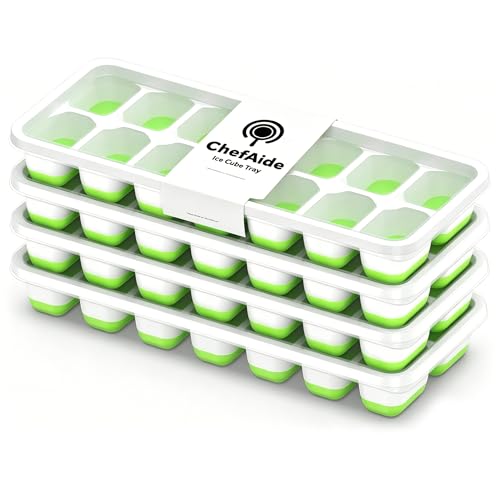
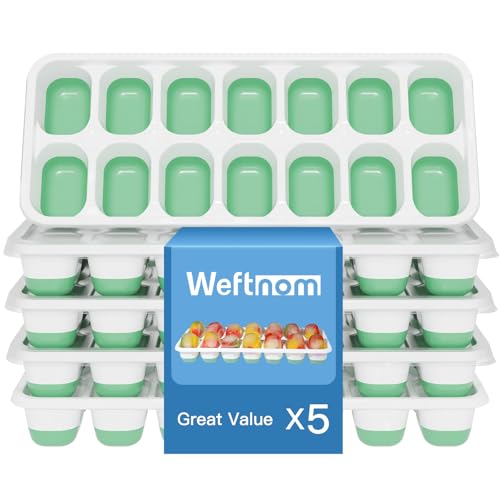
ChefAide argues the opposite case explicitly. Its release bullet describes a dual material construction with a rigid plastic upper half to maintain stable shape, stated as unlike fully silicone molds, over a flexible silicone base that is pushed. Weftnom publishes the same idea in fewer words: a soft food grade silicone bottom with a sturdy PP frame, pushed up from underneath.
A rigid frame is a real advantage when a full tray is carried to the freezer and a real limitation at the moment one cube is wanted, because the frame is what stops the tray flexing. Neither listing says which way that trade falls, and neither claims independent cavities.
The Purchase That Changes the Question
A Bin and a Scoop Instead
DOQAUS answers differently and honestly. Its set is four silicone trays plus a central storage container and a scoop, described as a complete ice system that solves freezer clutter. The intended routine is to empty a whole tray into the bin once and then take cubes out with the scoop, which removes the single cube problem rather than solving it.
It is also the only pick that publishes an assembled size, at 8.2 by 4.5 by 3.6 inches, and it publishes top rack dishwasher safety for the entire set. What it does not publish is a cube count per tray or a cube size, so how much ice the bin actually receives is unstated.
What the Extra Container Costs
The bin is another object in a freezer that is already full, and DOQAUS publishes stackability for the trays without saying where the bin goes. Its published set weight of 0.86 lb covers four trays, a bin and a scoop, which is lighter than the four all silicone PET Hous trays alone at 1.34 lb.
For a weeknight the trade is time shifted rather than saved. Emptying a tray into a bin is a job done on a Sunday, and the payoff is that a Wednesday takes two cubes out with a scoop rather than pushing them out of silicone. No listing in this pool publishes how long ice keeps in an open bin.
Lids, Odors and What Stacks
Four Different Lids and One Hanging Hole
Every pick here publishes a lid and no two describe them the same way. PET Hous publishes an independent silicone lid, ChefAide a removable lid stated to shield ice from unwanted freezer odors, Weftnom a snap on lid stated spill resistant and odor sealing, DOQAUS a lid with lift tabs stated non spill, and Vethwal a removable silicone lid with small holes for hanging.
The Vethwal hanging holes are the only storage feature on this page that is not stacking. Elsewhere in this pool a second DOQAUS listing is explicit that its lids are not airtight, which is worth reading against the odor claims the other listings make without qualification.
Every One Stacks and None Publishes a Stack Height
All five publish stackability and not one publishes the height of a stack. The package figures are the closest available: 4.7 inches deep for four PET Hous trays with lids, 1.18 for four ChefAide, 3.2 for five Weftnom, 3.6 for the DOQAUS set with its bin, and 1.45 for three Vethwal.
Those five numbers are not comparable because two of the cartons hold a bin or a deeper tray and two are flat packs. What a freezer shelf needs is the height of the stack in use, and that figure appears nowhere in this pool.
Counts, Sizes and What Is Missing
Three Publish a Batch Figure, Two Do Not
PET Hous publishes fifteen cubes per tray and up to 60 per set. ChefAide publishes fourteen per tray and up to 56. Weftnom publishes fourteen per tray and 70 per batch across five trays. Vethwal publishes fifteen per tray and no set total, and DOQAUS publishes no cube count at all.
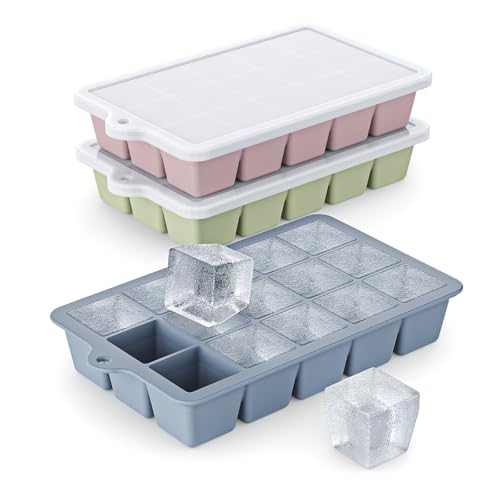
Only two of the five publish a cube size, and both publish the same one: 1.2 by 1.2 by 1.2 inches from PET Hous and from Vethwal. For a weeknight drink the cube size matters as much as the count, and three of these five never state it.
Nobody Publishes a Freezing Time
Not one of these five silicone picks publishes how long a tray takes to freeze. ChefAide comes closest with an instruction rather than a figure, asking you to fill each tray to the marked max line and to wait around thirty seconds after freezing before removing the lid, which is about the lid rather than the ice.
Elsewhere in this pool a stainless steel tray publishes a freezing speed claim, which makes the absence on the silicone side conspicuous rather than accidental. Silicone insulates, steel conducts, and no silicone listing here mentions the consequence.
Which One Fits Your Kitchen
The cook who wants two cubes at a time. PET Hous is the only pick that states an independent cavity design, so one cube can be wriggled out without the rest. Four trays of fifteen cubes at 1.2 by 1.2 by 1.2 inches, up to 60 per set, published at 1.34 lb with silicone lids.
The cook who fills a tray at the sink and carries it. ChefAide publishes a rigid plastic upper half over a flexible silicone base, a marked max fill line, and a removable lid stated to shield ice from freezer odors. Four trays of fourteen cubes at 0.75 lb.
The cook who runs out of ice. Weftnom publishes five trays of fourteen cubes, 70 per batch, on a silicone bottom in a sturdy PP frame with snap on lids, at 0.64 lb, the lightest purchase here. It is the most ice per order on this page.
The cook who would rather scoop. DOQAUS supplies four silicone trays plus a central storage bin and a scoop, published at 8.2 by 4.5 by 3.6 inches and 0.86 lb, top rack dishwasher safe. Empty the trays once and take cubes from the bin all week.
The cook with no freezer shelf to spare. Vethwal publishes three trays of fifteen cubes at 1.2 by 1.2 by 1.2 inches with removable silicone lids whose small holes let the trays hang instead of stack, at 0.8 lb.
What We Could Not Verify
These are the figures a weeknight cook wants and this pool does not publish.
- Only one of the five says whether a single cube can be released without disturbing the others.
- Not one of these five silicone picks publishes a freezing time or a freezing speed.
- No listing publishes the height of a stack of its own trays in use, only a carton depth.
- DOQAUS publishes no cube count and no cube size for a set sold with a storage bin.
- No listing says how long loose ice keeps in an open storage bin.
- Three of the five publish no cube size at all, and the two that do publish the same figure.