How the Five Compare on the Numbers
A starter jar is picked up, tilted, fed, scraped and put back several times a week, usually with one hand while the other holds a spatula. That makes the published weight and whatever the maker says about grip the specifications that matter, and this pool treats both as an afterthought. Twenty two listings sit behind this page and two of them name a grip at all.
The published weights across these five run from 0.39 lb to 9.57 lb, and the spread is not the whole story: two of the five figures cover two jars rather than one. Four publish a complete dimension triple. Two supply something to stop the jar sliding on a counter. One publishes the size of the jar in its own sentence and contradicts its own fields doing it.
What the table cannot tell you is how heavy any of these is once there is starter in it, because none of the five publishes a filled weight and the capacities run from 12 oz to a gallon. The empty figures are still the right place to start, and they are the only place any of these makers gives you a number that bears on lifting at all.
What the Published Weight Actually Covers
Two of the Five Figures Are for Two Jars
WECK publishes 1.0 lb and its title sells two jars with glass lids. Ritayedet publishes 9.57 lb and sells two one gallon jars. Neither figure is the weight of a jar you would lift, and read as product weights they would rank WECK second lightest here and Ritayedet far behind everything else, which is a comparison between a delivery and a jar.
Ritayedet’s figure is flagged as an outlier against the pool median of 1.46 lb, and it is the one place on this page where a large figure is exactly what you would expect. Two one gallon glass jars with airtight lids weigh what they weigh. This page does not rank on that number, and the Ritayedet entry stands on what its bullets say about the hand instead.
The Single Jars Run From 0.39 lb to 1.98 lb
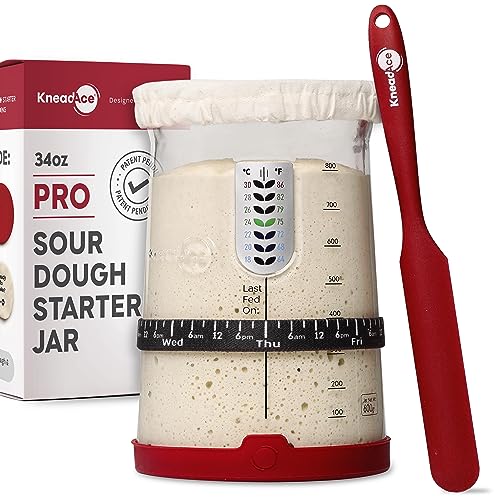
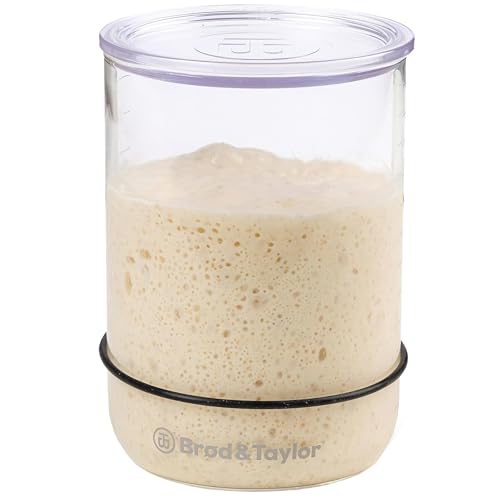
Brod & Taylor publishes 0.39 lb, the lightest figure on this page, for a 12 oz jar that holds up to 100 g of fully risen starter. Howasai publishes 1.46 lb for a 50 oz jar. KNEADACE publishes 1.98 lb for a 34 oz jar that arrives with a thermometer, a spatula, a cloth cover and a silicone cover that also works as a base.
That last comparison is the one to look at. KNEADACE publishes a heavier figure than Howasai for a jar holding less, because the KNEADACE weight covers a box of tools and the Howasai weight covers a jar and its covers. Neither listing separates the jar from what ships with it, so the two figures are not the same measurement.
Only Two Listings Say Anything About Your Hand
One Handle and One Funnel
Ritayedet is the only listing in this pool that publishes a handle. Its bullet names an ergonomic lid and a smooth grip round handle, and then says outright that the design is meant to be easy for everyone, kids and seniors alike. That is the only sentence anywhere on these sixteen listings that addresses a reader who finds jars hard to manage.
KNEADACE is the only other listing to raise the subject. It states that a funnel shaped opening enables effortless handling, which is a claim about pouring and scraping rather than about holding. There is no figure behind either statement, no grip diameter and no weight limit, so both are wording rather than specification.
Three Jars That Leave the Grip Unstated
Brod & Taylor, WECK and Howasai publish nothing about how the jar is held. Brod & Taylor comes closest by accident: its bullets describe smooth walls and a curved bottom so a spatula reaches everything, which makes the jar easier to work in without making it easier to hold. Howasai describes a 5 in wide mouth for the same reason.
WECK is the outlier in the other direction. Its jar arrives as separate pieces, a glass lid, a rubber gasket and small stainless steel clips, and the listing presents that as an advantage for pouring and washing. For a reader with limited hand strength it is the opposite: more parts to align and more clips to work each time the jar is opened.
What Keeps the Jar Still While You Feed It
Two Silicone Bases, and What They Also Do
Howasai supplies a non slip silicone base and states it helps keep the jar secure on a counter. KNEADACE supplies a silicone cover for the fridge that doubles as an anti slip base while the jar ferments under its cloth cover. Those are the only two listings among these five that supply anything to stop a jar moving when a spatula is pushed against its side.
The KNEADACE arrangement is the more interesting of the two because one piece does two jobs, which for a small kitchen is one fewer object. It also means the base is only under the jar when the cover is not on it. Neither maker publishes a friction rating or any figure at all, so both claims are statements and not specifications.
The One Jar Whose Own Words Contradict Its Fields
Brod & Taylor publishes dimension fields of 3.6 x 3.6 x 4.6 in and then writes in its own bullet that the jar is 3 in wide and 3.6 in tall. Those are not the same object. House rule here is that the maker’s sentence wins over the fields, so the working figures for this jar are 3 in across and 3.6 in high, and the field triple is reported but not used.
The gap matters on an accessibility page because a jar 3 in across is a jar most hands can close around, and a jar 4.6 in high is a different reach into the bottom than 3.6. The listing also says up to four of these jars fit inside the maker’s own Sourdough Home, which is a figure about a second product rather than this one.
Which One Fits Your Kitchen
Anyone who wants the lightest jar to lift. Brod & Taylor publishes 0.39 lb for a 12 oz jar holding up to 100 g of risen starter, with smooth walls, a curved bottom and a jar and lid both stated 100 percent dishwasher safe. Its own bullet gives 3 in wide against fields of 3.6.
A reader who needs a grip named in writing. Ritayedet is the only pick publishing a handle, describing an ergonomic lid and a smooth grip round handle and naming kids and seniors. The catch is scale: two one gallon jars at a published 9.57 lb for the pair, and no size for a single jar.
A counter where the jar gets knocked. Howasai supplies a non slip silicone base with a 50 oz jar, publishes 1.46 lb and 5 x 5 x 5.9 in, and states a 5 in wide mouth with straight sides. It publishes nothing about a grip and nothing about a dishwasher.
Someone who wants the tools in the same box. KNEADACE publishes 1.98 lb and 4.13 x 4.13 x 6.7 in for a 34 oz jar arriving with a thermometer, cloth cover, spatula, elastic feeding band and a silicone cover that doubles as an anti slip base. It states a funnel shaped opening for handling.
Two jars and a canning closure. WECK publishes 1.0 lb and 4.5 x 4.5 x 7 in for tulip jars sold in twos, with glass lids, rubber gaskets and stainless steel clips, dishwasher and microwave safe. The separate pieces are more to handle, not less.
What We Could Not Verify
These are the things I went looking for in the five listings and did not find.
- Not one of the five publishes a filled weight, so there is no figure for what you actually lift once the jar holds starter.
- Three of the five publish nothing at all about how the jar is held, and the two that do publish no figure behind it.
- WECK publishes one dimension triple and sells two jars, and never says whether the triple describes a jar or the pair.
- Ritayedet publishes no size for a single jar, only 6.5 x 6.5 x 9.8 in for the two together.
- Brod & Taylor publishes 3.6 x 3.6 x 4.6 in in its fields and 3 in wide by 3.6 in tall in its own bullet, and does not reconcile them.
- Howasai and KNEADACE say nothing about a dishwasher, which for a jar handled wet several times a week is the one cleaning question that matters.