How the Five Compare on the Numbers
A drawer closes on the tallest point, and for a flexible sheet that point is the stack, not the sheet. None of these twelve listings publishes a stack height. What they do publish is a flat footprint, and in three cases an instruction for making that footprint smaller once the sheet is out of the machine, which is the nearest thing this category has to a drawer figure.
So the ranking below is built on two things: the footprint each maker states in its own words, and whether the maker commits to rolling, folding or trimming. The dimension fields come second here, because only one of these five publishes a height that could belong to a single sheet and another publishes the same number in all three slots.
What the table cannot tell you is how thick the pile gets. A pack of ten mesh sheets and a pack of six lipped trays are not the same object in a drawer, and the only clue any of these listings gives is the weight: 0.4 lb covers eight mesh sheets and 2.5 lb covers six lipped trays. Lipped trays hold their shape, which is useful in the machine and the opposite of useful in a drawer.
The Figure That Decides a Drawer
Three Makers Say the Sheet Can Be Made Smaller
Afcabakila is the only listing of the twelve that treats storage as a feature. Its bullet states that when the tasks are complete the flexible mats can be rolled for space-efficient storage, which is the one sentence in this pool that addresses a drawer directly. It states 11 x 11 inches in its own words, against 13, 13, 13.5 and 14 inch figures from the other four, and publishes 0.35 inch containment edges on six of its twelve pieces.
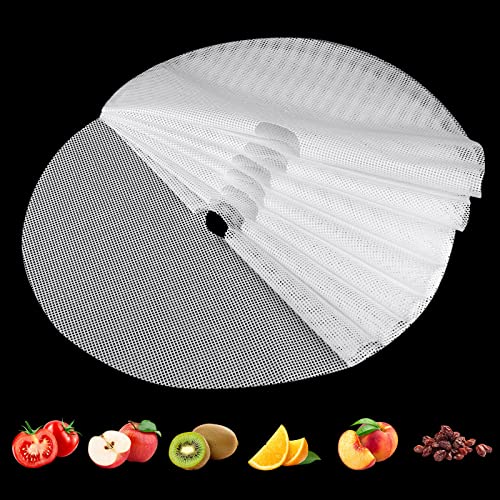
DOSTK gets to a similar place for a different stated reason. Its bullet says that when drying is done you fold the sheet in half and pour the contents into canning jars, so the fold is published for decanting rather than for a drawer, and what it proves is that the sheet bends double while loaded. A round 13 inch sheet folded in half is a half circle, and that is a shape a shallow drawer will take when a flat 13 inch disc will not.
Trimming Is a Permanent Answer
COKUMA states that the flexible material can be easily trimmed to customize for different dehydrator sizes and air dryer racks, from a stated 13 x 13 inch sheet. Trimming is the only one of these three instructions that cannot be undone, so it suits a reader with one machine and one drawer rather than someone who may change either. No tool is named for the job.
The other two publish nothing about storage at all. Generic states 13.5 x 13.5 inches and plaCredgai states 14 x 14 inches, and both describe a raised lip without putting a figure on it. For a lipped tray that silence matters more than it would for a mesh sheet, because a lip is the part that stops the stack lying flat.
What the Dimension Fields Are Really Describing
The One Field Set That Could Be a Sheet
Generic publishes 13.5 by 13.5 by 0.1 inches and states 13.5 x 13.5 in its own bullet, so field and sentence agree on the footprint and the third figure is plausible for one silicone tray. That is the only height figure on this page a reader can plan a drawer around. It is also the only one of these five that publishes no brand name, with the field reading Generic.
plaCredgai publishes 14.0 in all three slots. Its own bullet states 14 x 14 inches, so the first two figures are confirmed and the third is the same number repeated into a slot nobody filled. A 14 inch thick stack of eight silicone sheets is not a real object. The maker’s words win and the height field is set aside, which is the house rule and also plain sense.
A Carton Figure Standing In for a Product
COKUMA publishes no product dimensions. What it publishes is a package figure of 13.0 by 13.0 by 0.01 inches, and that figure is worth reading twice. The first two numbers match the 13 x 13 inch sheet size the maker states in words, so they are almost certainly the sheet rather than a box. The third cannot be either: a hundredth of an inch will not hold ten sheets, and nothing is that thin.
So this listing publishes a real footprint in the wrong field and an impossible height beside it. A reader can use the 13 inch figure with some confidence and should ignore the 0.01. This page cites it as the package figure it is filed as, and notes that the package and the product seem to be the same object here, which is how a multipack ends up with its carton quoted as the product.
What One Purchase Puts in the Drawer
Counting Objects, Not Sheets
The piece counts run from six to twelve, and they are not counting the same thing. Afcabakila’s twelve is six lipped trays and six mesh sheets, which is two stacks of two different thicknesses. COKUMA’s ten and DOSTK’s eight are mesh only, which stacks thin. Generic’s six are lipped trays only. plaCredgai’s eight trays arrive with a silicone scraper and a cutter wheel.
Those two tools are the detail a drawer plan should include. A scraper and a cutter wheel are rigid objects that do not stack with the sheets and have to live somewhere, and plaCredgai is the only one of these five that adds them. It also publishes the heaviest weight field here, 3.64 lb, against 2.5 lb from Generic for six trays.
Where the Weight Figures Help and Where They Mislead
DOSTK publishes the lowest weight field on this page, 0.4 lb for eight mesh sheets, and COKUMA publishes 0.77 lb for ten. Those two numbers are the best available proxy for how thin a mesh pack stacks, because neither maker publishes a thickness and both publish a count. Afcabakila publishes no weight at all, in a field or a sentence, which on a twelve piece mixed set is the gap that costs a reader most.
The figures do not compare across types. A weight covering six lipped trays and a weight covering eight mesh sheets answer different questions, and dividing either by its count would produce a number no maker published. Read 2.5 lb as six trays and 0.4 lb as eight sheets, which is what the listings actually say, and treat the lipped sets as the bulkier purchase because of the lip rather than because of the pound figure.
Which One Fits Your Kitchen
The drawer is shallow and already full. Afcabakila, at a stated 11 x 11 inches, and the only listing here that says the mats roll for storage. Accept that it publishes no weight and no temperature figure of any kind.
You dry small fruit and decant it. DOSTK. A 13 inch round mesh sheet the maker tells you to fold in half and pour into jars, 0.4 lb for eight, with a stated -40 F to 428 F.
One machine, and you will cut to fit. COKUMA, stated at 13 x 13 inches, trimmable by the maker’s own instruction, 0.77 lb for ten sheets. Its only published measurement sits in a package field.
You want a height figure before you buy. Generic, the only pick here publishing 13.5 by 13.5 by 0.1 inches with a matching sentence. Six lipped trays, 2.5 lb, and no storage instruction at all.
You want the tools in the same box. plaCredgai, a stated 14 x 14 inches with eight trays, a scraper and a cutter wheel, 3.64 lb. Ignore the 14.0 inch height field, which the maker’s own words contradict.
What We Could Not Verify
These are the specifications we went looking for in all five listings and did not find.
- A stack height for any of these packs, which is the figure a drawer actually closes on.
- Any weight for Afcabakila, in a field or in a sentence, across twelve mixed pieces.
- A thickness for any single sheet, stated as a thickness by the maker rather than left to a height field.
- What COKUMA’s 0.01 inch package height is meant to describe, since ten sheets cannot be that thin.
- A raised lip figure from Generic or plaCredgai, both of which name a lip and neither of which measures it.
- Whether Afcabakila’s rolled mats stay rolled, since no band, tie or sleeve is mentioned anywhere in the listing.