How the Five Compare on the Numbers
One of these five publishes three distinct figures for one bowl. On the others the field block has been filled in by something other than a tape measure. One listing repeats a figure and drops the one its own sentence publishes. One publishes the same number three times. One mixes a bowl diameter with the height of a stack of five. One has no fields at all.
Every one of them publishes a capacity, which for a bowl is the specification that matters most, and four of the five give it in quarts rather than an adjective. Only two publish a weight. Two listings come from the same maker and describe the same three quart bowl, which is what makes the dropped figure on one of them provable rather than suspected.
What the table cannot show is which of the two Glad triples to believe, because the answer is both: the figures in the carton slot of the four bowl set are the same three numbers the single bowl publishes in a sentence. That is also what the table cannot say about Priority Chef, where a height of 12.3 inches sits above a width of 10.3 inches on a set whose largest bowl holds 5 quarts.
One Maker, One Bowl, Two Field Blocks
The Figure That Disappeared
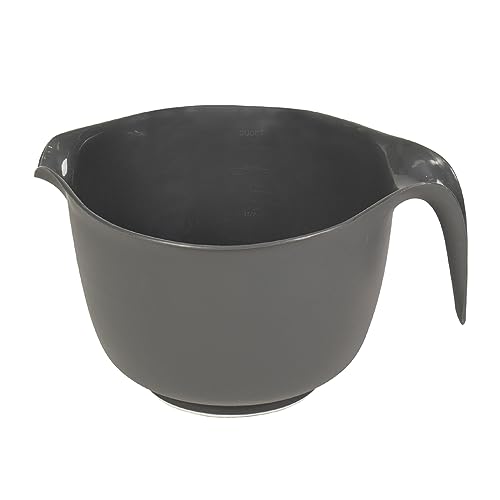
Glad sells a three quart bowl with a handle and a pour spout, and the last line of its fifth bullet publishes the measurement: 11.125 by 8.75 by 6.37 inches. Its own third bullet repeats the 6.37 inches as the depth. So two of those three figures are confirmed inside the listing, and all three describe a bowl that is longer than it is wide because the handle sticks out.
The dimension fields then read 11.13, 11.13 and 6.37 inches. The first figure is the 11.125 rounded, the last is the 6.37 exactly, and the middle one is the first one again. The 8.75 inch figure, the only one that tells you how wide the bowl actually is, is not in the field block at all. A round bowl would have two equal figures; this one is not round.
The Figure That Survived Next Door
Glad’s four bowl set includes, by its own first bullet, a 1.2 quart, a 1.9 quart, a 2.8 quart and a 3 quart bowl, and its second bullet says the largest of those has a full handle. That is the same three quart bowl. Because the purchase is a set, its figures are filed as a package, and that triple reads 8.75 by 11.13 by 6.37 inches.
Those are the three numbers the single bowl listing publishes in words, 8.75 included. Four nested bowls whose largest is already 6.37 inches deep do not fit inside 6.37 inches of carton, so this triple is not a box. It is the biggest bowl in the set, measured correctly, sitting in the slot a carton would use, while the listing that sells that bowl alone lost one of its three figures.
What a Complete Field Block Looks Like
Three Figures, None of Them Repeated
OXO publishes 7, 5.5 and 7.75 inches, and it is the only listing of the five with three different numbers in the three slots. That shape is exactly what a batter bowl with a handle and a spout should produce: wider one way than the other and taller than either, because the sidewalls are high. Its own bullet says those high sidewalls are there to stop splatter under an electric mixer.
The trade off is that nothing confirms them. OXO publishes no measurement in any of its six bullets, so the field block is the only linear record and there is no second source to check it against. What it does publish is a capacity twice, as 2 quarts in the size row and as 8 cups in a bullet, plus a weight of 0.98 lb, which only one other listing here matches.
Where the Height Belongs to the Set
Priority Chef publishes 10.3, 10.3 and 12.3 inches for a set of five stainless bowls running from 1.5 to 5 quarts. The first two are equal, which is right for a round bowl, and the third is larger than either. No 5 quart mixing bowl is taller than it is wide, so the 12.3 inches is the five bowls nested with their lids on rather than a measurement of anything you mix in.
That makes two of its three figures usable and one of them answering a different question. For a cupboard that is arguably the more useful pair, since the stack is what goes on the shelf, but the listing never labels either. Nothing in its five bullets gives a measurement, so as with OXO there is no sentence to check the fields against.
When the Fields Say Nothing At All
The Same Number Three Times
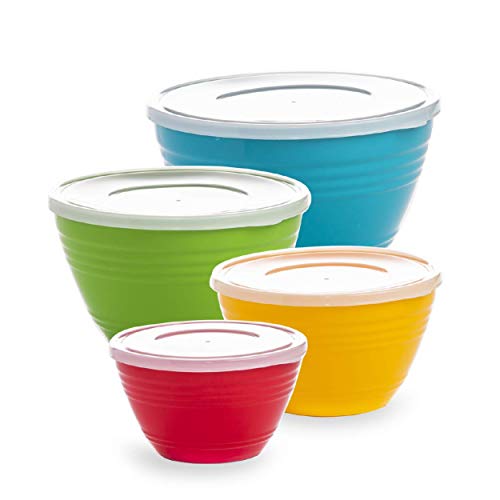
BINO publishes 7 inches, 7 inches and 7 inches. A block of three identical figures is an unpopulated field rather than a cube, and this one is labeled as a package because the purchase is a set of four. Its own first bullet says those four bowls range from 1.8 to 6.3 quarts, and a 6.3 quart bowl does not fit inside a 7 inch box with three others in it.
So BINO publishes no usable dimension in any form. Its size row is the single word Large, its title says various sizes, and its only numbers are the capacity range and a weight of 1.9 lb. The capacity range happens to be the widest on this page, from 1.8 to 6.3 quarts, which is a real advantage and the only thing here to decide on.
Where the Capacity Does the Work Instead
Every one of these five publishes a capacity, and four give it in quarts. OXO gives 2 quarts and restates it as 8 cups. Glad gives 3 quarts and restates it as 12 cups. Glad’s set counts out 1.2, 1.9, 2.8 and 3 quarts separately. Priority Chef gives a range of 1.5 to 5 quarts and BINO gives 1.8 to 6.3 quarts.
That is the slot this category fills in properly, and it is a reasonable place to put the weight of a decision. A quart figure says what a bowl holds, which is the question most buyers are asking, and on two of these five it is the only figure on the listing that has survived contact with a database.
Which One Fits Your Kitchen
The buyer who needs the real footprint. Glad’s four bowl set publishes it, at 8.75 by 11.13 by 6.37 inches, and those three figures describe its largest bowl. The set runs 1.2, 1.9, 2.8 and 3 quarts, every bowl has a pour spout, three have handle lips and the largest a full handle, and the bowls nest.
The buyer mixing with a machine. OXO is the pick. Its bullet says the high sidewalls are there to stop splatter with an electric mixer, and its 7 by 5.5 by 7.75 inch figures bear that out, since it is taller than it is wide either way. It holds 2 quarts, has red measurement markings inside, a non-skid base and a soft handle.
The buyer who wants one big bowl with a handle. Glad’s three quart bowl is that, at 11.125 by 8.75 by 6.37 inches by its own sentence, with a 12 cup capacity, an embedded pour spout and a rubber layer at the base. Use the bullet figures, not the dimension fields, which repeat 11.13 twice and never give the 8.75.
The buyer who wants lids and a grater. Priority Chef ships five bowls from 1.5 to 5 quarts with airtight lids, measurement marks inside each bowl and three grater attachments that work over the bowl. Its 10.3 inch width is one bowl and its 12.3 inch height is the nested stack. The bowls take the top rack; the lids have to be washed by hand.
The buyer who just wants the widest range of sizes. BINO covers 1.8 to 6.3 quarts across four bowls, which is more spread than anything else here, and every bowl has a clear lid. Expect no usable dimension: its only triple is 7 by 7 by 7 inches, an unpopulated block. Bowls and lids are both cleared for the top rack.
What We Could Not Verify
Six questions went looking for a figure on these listings and came back without one.
- Why the Glad three quart fields read 11.13 twice when its own bullet publishes 11.125 by 8.75 by 6.37 inches.
- Whether the Glad set triple of 8.75 by 11.13 by 6.37 inches is the carton or, as its figures suggest, the largest bowl in it.
- What the Priority Chef height field of 12.3 inches measures, since no 5 quart bowl is taller than the 10.3 inches its width field gives.
- Any dimension of a BINO bowl, where the only triple is 7 by 7 by 7 inches and the maker publishes no measurement in words.
- A weight for either Glad listing or for Priority Chef, none of which publishes one in a field or in a sentence.
- A capacity in the Glad or OXO size rows expressed per bowl for the multi bowl sets, where Priority Chef and BINO give a range and never the individual figures.