How the Five Compare on the Numbers
A freezer is the easy end of a silicone sheet’s range, which is exactly why so few makers bother to mention it. Five listings in this pool publish a temperature floor, and every one of those floors is the same figure, -40 F. So the floor itself cannot separate anything. What separates these five is whether the maker publishes a floor at all, and whether it names a freezer or a freeze dryer as a use.
Two of these five name the cold use and only one of those two also publishes a floor. The other direction is just as uneven: two publish a floor in both scales and never mention a freezer once. The sheet size matters too, because a small freezer is a small space, so the size each rating applies to is in the table below.
What the table cannot tell you is whether a sheet rated to -40 F behaves the same way wet. Food going into a freezer is usually wet, and ice forming against a mesh is a different mechanical problem from cold air. No maker in this pool addresses it. The one row where every column reads the same is the dimension fields, because not one of these five publishes a single width, depth or height figure.
Who Mentions the Cold, and Who Only Measures It
One Listing Does Both
Jalowin is the only pick that publishes a floor and names the use it is for. Its first bullet states that the sheets withstand -40 C to 230 C, written also as -40 F to 446 F, and then lists what they are good for, with freezing at the front of the list, followed by dehydrating, steaming and baking without warping or degrading. That is a maker answering the question rather than leaving a reader to infer it.
The sheet it applies to is stated at 21.6 x 13.7 inches, the same order of size as Limbeuuu’s stated 14 x 21 inches, with a 0.8mm thickness, and the listing adds that it can be trimmed to any custom size for various appliances. For a small freezer that combination is worth reading twice: a sheet that big will not fit a small drawer as it comes, and the maker has already given permission to cut it.
Two Floors With No Freezer Attached
GUCUJI publishes -40 F to 428 F, written also as -40 C to 220 C, and never uses the word freezer or freeze anywhere in the listing. DOSTK publishes the same band in the same two scales and does the same. Both figures are real and both are useful to a reader who knows what they are reading, and neither maker will commit to the application.
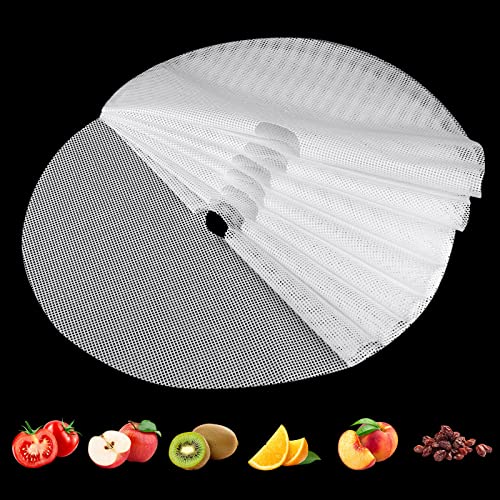
The difference between them is what else they publish. GUCUJI is the only pick that puts a number on durability, stating over 5,000 uses, and it names Magic Mill as the machine it is sized for while publishing no size sentence at all. DOSTK publishes a 13 inch round sheet, eight to a pack, the NESCO FD series by model number, and the instruction to fold the sheet in half and pour.
Two Listings Name a Freeze Dryer and Publish No Figure
The Fitment Claim Without the Rating
Afcabakila names freeze dryer models in its first bullet, saying the set is engineered to fit the majority of freeze dryer and food dehydrator models on the market. It is the clearest statement of intent on this page. It is also the only pick of the five that publishes no temperature figure at either end, so the one listing most explicitly about freeze drying is the one that will not say what temperature its silicone takes.
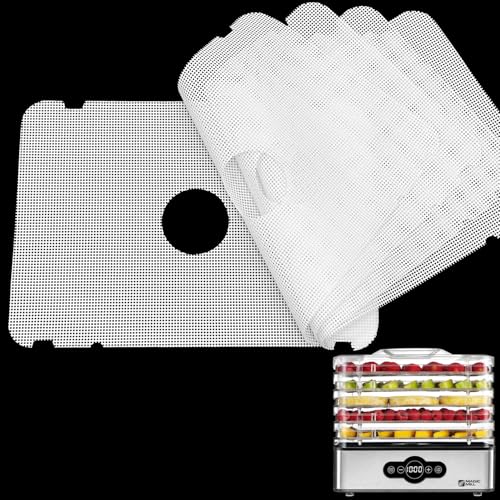
What it does publish is useful for the space: 11 x 11 inches in its own words, twelve pieces split into six silicone trays with stated 0.35 inch raised edges and six fine mesh sheets, and a note that the mats can be rolled for storage. For a small freezer the lipped trays are the relevant half, because a liquid going in has to stay where it is put.
A Title Claim and a Ceiling
Limbeuuu puts Freeze Dryer in its product title and then publishes only an upper limit, up to 230 degrees Celsius at most, in Celsius alone. There is no floor and no Fahrenheit figure anywhere in the listing, which for a product named for a freeze dryer is the wrong half of the range to publish. The sheet is stated at 14 x 21 inches, sixteen to a pack.
It is also the most honest listing here about what the sheet is. The material bullet states that the surface coating is silica gel and the substrate is quality polyester, so it is a coated sheet rather than solid silicone, and a coated fabric is the construction most likely to behave differently at a temperature nobody published. Its thickness is stated at 0.8 mm, written also as 0.03 inch.
What a Small Freezer Actually Needs From These
Nobody Publishes a Dimension Field
This is the single most striking thing on the page. Across these five listings there is not one populated width, depth or height field, so every measurement here comes from a sentence or a size slot. Four of the five do write a size sentence and GUCUJI does not, leaving an 11 INCH entry in a size field and a claim to be perfectly sized for one named machine.
For a small freezer that gap is the one that bites. A reader wants to know whether a loaded sheet clears a shelf, and the only figures available are flat footprints: 21.6 by 13.7 inches, 13 inches round, 11 by 11 inches, 14 by 21 inches, and for GUCUJI an 11 inch entry with no second figure beside it. None of these makers publishes a loaded height or a stack.
Edges, Mesh and What Holds a Liquid
Freezing a puree needs a lip and freezing sliced fruit needs a mesh, and the listings split on which they publish. Afcabakila measures its edge at 0.35 inches on six of its twelve pieces, the only edge figure on this page. Jalowin, GUCUJI and Limbeuuu all publish a mesh figure of 1 by 1 mm, which is fine enough to hold berries and open enough to drain.
DOSTK is the one that states the consequence out loud. Its bullet says the mesh is very fine so liquid can seep through, and that it is good for keeping small pieces from going through, which is a maker telling you plainly that this is not a sheet for anything wet. For a freezer that is the most useful sentence in the listing and it contains no figure at all.
Which One Fits Your Kitchen
You want the maker to say the word. Jalowin. The only pick publishing a floor and naming freezing as a use, at -40 C to 230 C, written also as -40 F to 446 F, on a sheet stated at 21.6 x 13.7 inches that the maker says can be trimmed.
You freeze dry and the tray is round. DOSTK, a 13 inch round mesh sheet, eight to a pack, with -40 F to 428 F published in both scales and an instruction to fold it in half and pour.
Your machine is a Magic Mill. GUCUJI, named for that machine, with -40 F to 428 F published and over 5,000 uses claimed. Accept that it publishes no size sentence, only an 11 INCH size entry.
You need both a lipped tray and a mesh. Afcabakila, twelve pieces at a stated 11 x 11 inches with 0.35 inch raised edges on six of them, named for freeze dryer models. It publishes no temperature figure at all.
Your freezer trays are large. Limbeuuu, sixteen sheets stated at 14 x 21 inches with a 0.8 mm thickness. Read the ceiling of 230 degrees Celsius as the only temperature published, and the sheet as silica gel over polyester.
What We Could Not Verify
These are the specifications we went looking for in all five listings and did not find.
- Any temperature figure from Afcabakila, the one listing most explicitly built for freeze dryer models.
- A temperature floor from Limbeuuu, which publishes a ceiling in Celsius and nothing below zero.
- A size sentence from GUCUJI, which leaves an 11 INCH entry in a size field and no second figure.
- Any width, depth or height field from any of the five. Not one is populated.
- Whether a sheet rated to -40 F behaves the same under ice as under cold air, which no maker here addresses.
- A loaded height or a stack figure, which is what a small freezer shelf actually closes on.